Exploring the Meaning of Empaiktes in Greek
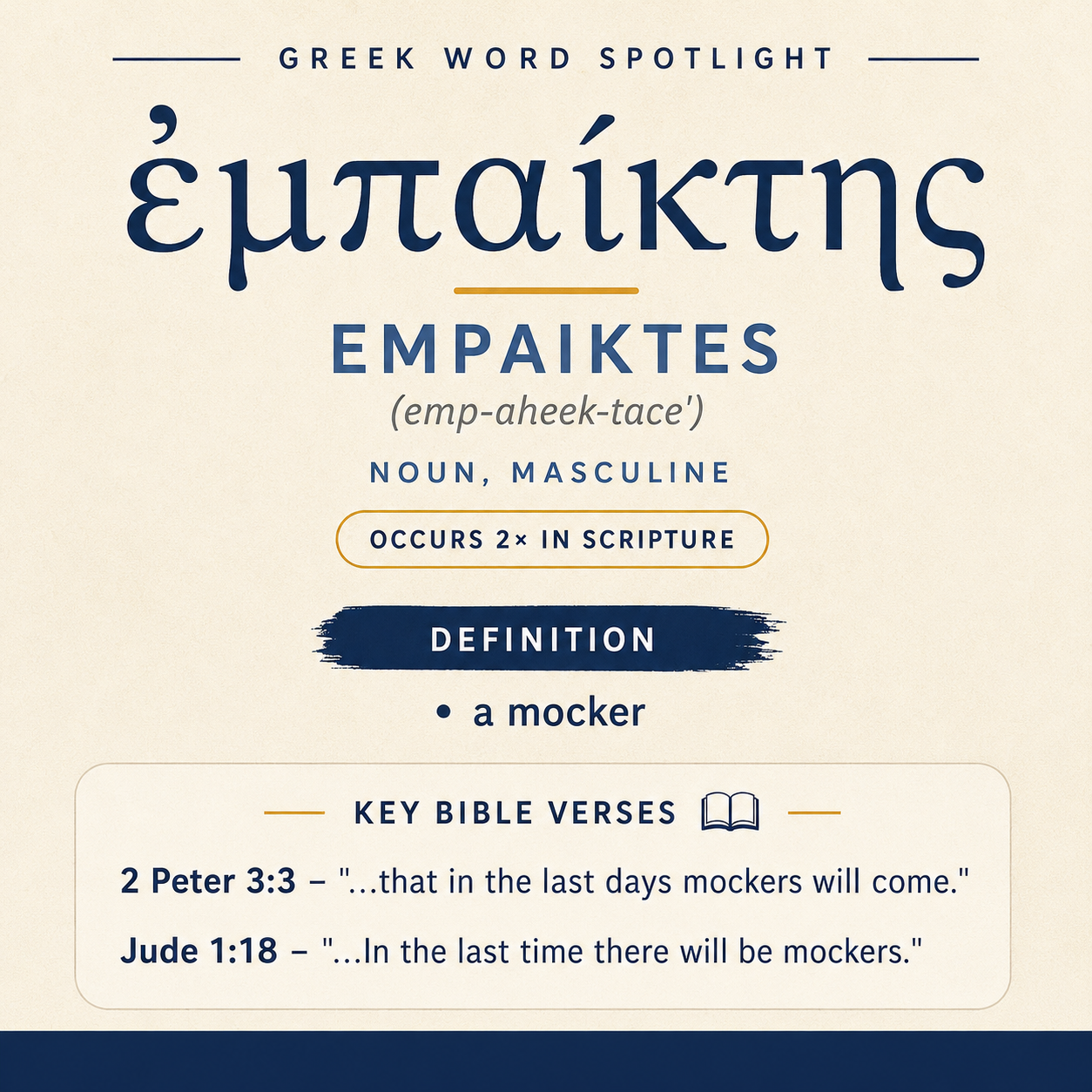
ἐμπαίκτης means “a mocker” and appears twice in Scripture: 2 Peter 3:3 and Jude 1:18.
Biblical Occurrences
This word occurs 2 times in Scripture. It appears in 2 Peter 3:3 and Jude 1:18.
Learn More →Context In Verses
In both 2 Peter 3:3 and Jude 1:18, mockers come “in the last time/days,” walking after their own lusts.
Learn More →ἐμπαίκτης refers to “a mocker,” and it appears in two closely parallel warnings about behavior “in the last days/last time.” In both settings, the term labels a recognizable kind of person whose conduct and desires match their scornful stance.
Root and Related Words
ἐμπαίκτης is related to the verb empaizō (ἐμπαίζω), “to mock” (Strong’s G1702). The noun names the person characterized by that action.
Occurrences
“knowing this first, that in the last days mockers will come, walking after their own lusts” (2 Peter 3:3)
Here ἐμπαίκτης belongs to a statement introduced as something the readers must “know… first,” giving it the force of a foundational expectation. The word marks the arrival of a certain kind of people (“will come”) whose defining feature is not merely what they say but the manner of life that accompanies them: they are “walking after their own lusts.” In this line, “mockers” functions as a moral and social label. It frames their presence as an identifiable group in the community’s experience of “the last days,” and it ties their mockery to a pattern of conduct driven by desire. The clause “walking after their own lusts” supplies the portrait: the mocker is not presented as an isolated heckler but as someone whose scorn coheres with a self-directed way of life. The term therefore contributes a diagnostic category—an interpretive name for opponents whose attitudes and behavior align.
“They said to you, “In the last time there will be mockers, walking after their own ungodly lusts.”” (Jude 1:18)
In Jude the same label occurs inside remembered instruction: “They said to you,” followed by a direct quotation. The term “mockers” is part of what earlier voices had warned the audience to expect, and the framing makes it a matter of received teaching rather than a new observation. Again the mockers are portrayed as a future (or impending) presence: “there will be mockers,” with the time marker “In the last time.” The description of their way of life is slightly expanded: they walk after “their own ungodly lusts.” This pairing places the term in an explicitly ethical light. “Mockers” is not simply a description of temperament; it is set beside “ungodly lusts,” so their mockery is read in the context of irreverent desire. Jude’s wording also makes the mockers’ self-direction emphatic (“their own”), and then characterizes those desires as “ungodly.” In this scene, ἐμπαίκτης contributes to the community’s discernment by naming a kind of person whose scornful posture belongs to a broader pattern of ungodliness.
Sense and Usage
Across both occurrences, ἐμπαίκτης is used in the plural (“mockers”) and is placed in the future (“will come,” “there will be”), so the word functions as a category the audience is meant to anticipate and recognize. The term’s force comes from how it is paired with a life-description: in each passage, mockers are defined by what they “walk” after. The imagery of “walking” presents their mockery as embedded in habitual conduct, not limited to occasional speech. In 2 Peter the mockers’ walk is “after their own lusts,” and in Jude it is “after their own ungodly lusts”; the shared structure links the noun tightly to desire-driven behavior.
The result is that ἐμπαίκτης carries a practical identifying function within these warnings. It points to people whose scorn is consistent with a self-ruled moral direction (“their own lusts”) and, in Jude’s wording, with an expressly irreverent moral quality (“ungodly”). In both texts, the label does not stand alone; it is part of an eschatological expectation (“in the last days,” “in the last time”) and serves the rhetorical purpose of preparing the audience to interpret certain kinds of opposition. The mocker is not introduced as an anonymous abstract type but as someone who “will come” into view and whose way of life provides evidence for the label.
The close verbal parallel between the two passages also shows that ἐμπαίκτης can operate as a recognized warning term within early Christian exhortation: the noun is suited to brief, pointed characterization, especially when joined to a concise description of conduct. Its placement in both sentences makes it the headline designation (“mockers”), with the following participial phrase (“walking after… lusts”) supplying the behavioral profile. In that profile, the emphasis falls on desire that is owned (“their own”) and pursued (“walking after”), so the noun is framed in relation to self-chosen aims rather than external pressure.
Imagery
In these passages the word evokes the picture of people approaching (“will come”) in a climactic season (“the last days/last time”), not as neutral bystanders but as a predictable presence marked by a consistent “walk.” The repeated pairing of mockery with a lust-directed path makes the mocker appear as someone moving forward under the pull of desire, with scorn as the social expression of that inward direction.
Sources: Lexical data from Strong’s Exhaustive Concordance and the Translators Brief Lexicon of Extended Strongs for Greek (STEPBible, CC BY). Occurrence data from the Translators Amalgamated Greek New Testament (STEPBible, CC BY). Scripture quotations from the World English Bible (public domain).