Exploring the Meaning of Empaigmos in Greek
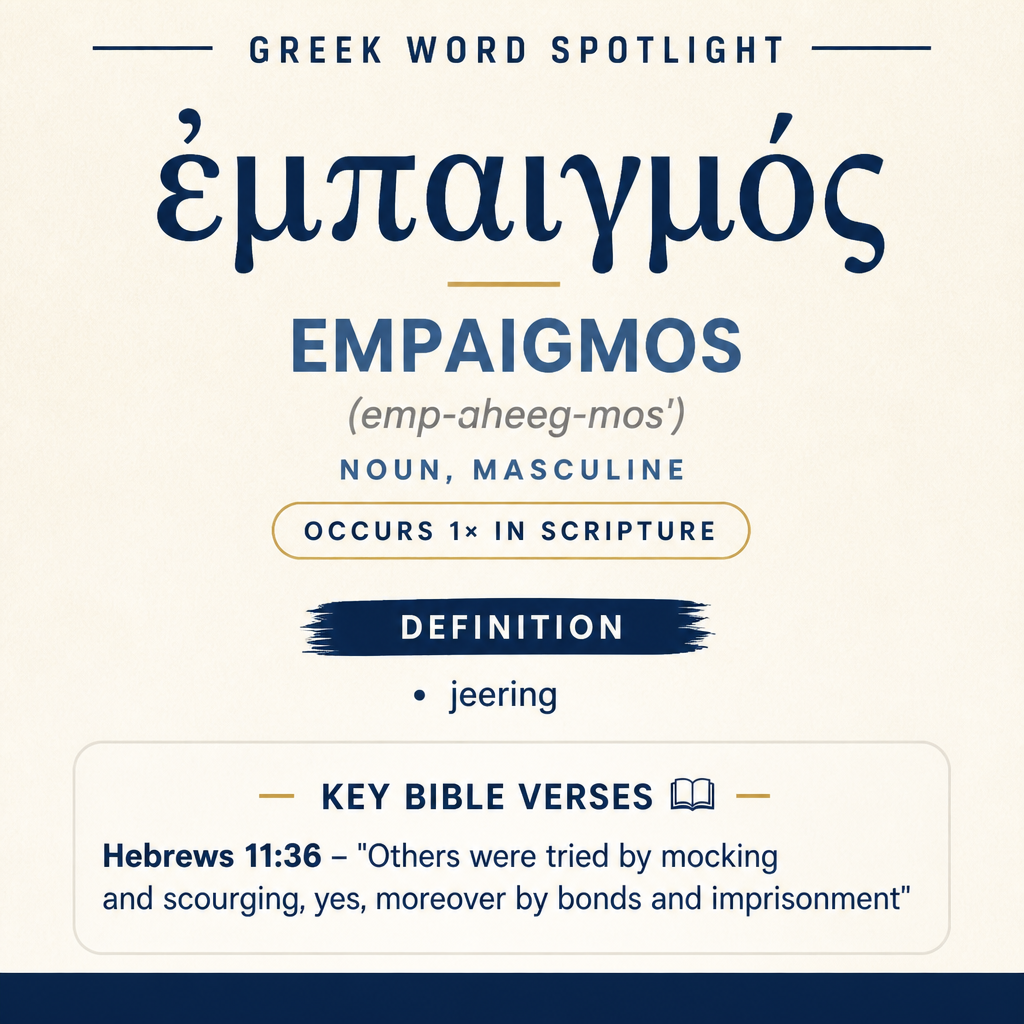
ἐμπαιγμός means “jeering” and appears once in Scripture, in Hebrews 11:36.
Scripture Occurrence
It occurs 1 time in Scripture. The occurrence is in Hebrews 11:36.
Learn More →Verse Context
Hebrews 11:36 uses ἐμπαιγμός in the phrase “mocking and scourging.” The verse also mentions bonds and imprisonment.
Learn More →ἐμπαιγμός speaks of jeering, the kind of contemptuous treatment that ridicules a person rather than merely opposing them. It appears in a single New Testament context that recalls the sufferings endured by God’s people, placing jeering alongside physical punishment and confinement.
Root and Related Words
ἐμπαιγμός is derived from the verb empaizō (ἐμπαίζω), “to mock” (Strong’s G1702). The noun names the result or instance of that action: the experience of being treated as an object of mockery.

Occurrences
“Others were tried by mocking and scourging, yes, moreover by bonds and imprisonment.” (Hebrews 11:36)
In Hebrews 11:36, ἐμπαιγμός stands within a catalog of ordeals that fall upon “Others,” a group described in broad strokes rather than identified individually. The verse pairs “mocking” with “scourging,” then adds “bonds and imprisonment,” arranging injuries of reputation and injuries of body side by side. In that sequence, jeering functions as a distinct kind of trial: it is not simply adversity in general, but adversity directed through derision—treatment that aims to shame, belittle, or make its target appear contemptible in the eyes of observers.
The placement of “mocking” at the front of the list gives it rhetorical weight. Before the reader hears of whips or chains, the verse foregrounds the social and verbal dimension of persecution. Jeering is the kind of hostility that works by turning a person into a spectacle; it wounds through public scorn and the stripping away of honor. Even though the verse does not describe the words spoken, the noun itself signals that the suffering included ridicule as a deliberate tactic, a form of pressure applied to the faithful that is different in kind from “scourging” and different again from “imprisonment.”
The verse also frames these experiences as a “trial”: “Others were tried by mocking and scourging.” Within that phrasing, jeering is not a passing insult but an ordeal capable of testing endurance. The line “yes, moreover” intensifies the picture by adding further hardships, suggesting that mockery can be part of a layered pattern of oppression. In this scene, ἐμπαιγμός contributes the idea of scorn that accompanies or precedes harsher measures, showing how contempt can be one instrument among others in a broader campaign of affliction.
Sense and Usage
The sense of ἐμπαιγμός (“jeering”) carries a social edge: it is mockery directed at a person with the intent to deride. In Hebrews 11:36 it is coordinated with concrete acts of violence (“scourging”) and restraint (“bonds and imprisonment”), which highlights the way jeering belongs to the same world of suffering as physical assault. The verse does not treat ridicule as harmless speech; it stands as one of the ways people are “tried.” In other words, jeering is presented as a real pressure upon the sufferer—an experience that can intimidate, isolate, or destabilize, because it attacks how one is regarded and how one is allowed to appear in public.
Because the verse links mocking and scourging with a simple “and,” the noun also suggests that humiliation and pain may be intertwined. Jeering can prepare the ground for harsher treatment by first discrediting its target, making cruelty seem justified or entertaining to onlookers. Conversely, mockery can accompany physical harm, adding shame to injury. The passage does not narrate those dynamics in detail, but its compressed list places the experiences close enough to one another that the reader is encouraged to hold them together as a single spectrum of hostility: words that belittle, blows that injure, restraints that confine.
Within the verse’s broader cadence, ἐμπαιγμός contributes a particular texture to the idea of suffering: it evokes the noise and atmosphere of derision rather than the silence of a cell or the sting of lashes. “Bonds and imprisonment” picture the deprivation of movement and the loss of freedom; “scourging” pictures bodily torment. “Mocking,” by contrast, signals an assault on dignity—an attempt to make faithfulness look foolish. The author’s decision to include that kind of affliction in a list of trials affirms its severity and its capacity to test perseverance.
The term’s noun form is well suited to this kind of summary catalog. Hebrews 11:36 does not recount a single taunt or a particular episode; it gathers experiences under general labels, and ἐμπαιγμός fits that style by naming the phenomenon of jeering as a recognizable category of mistreatment. It therefore serves the verse’s purpose of evoking a shared memory of suffering without pausing for narrative detail: the reader is meant to recognize the kind of thing described, and to place it alongside scourging, chains, and prison as part of the same harsh reality endured by the faithful.
Imagery
Hebrews 11:36 sets jeering in a stark tableau of abuse and confinement. The imagery is not elaborate, but it is vivid in its simplicity: mockery voiced against a person, lashes inflicted upon a body, and then the heavy finality of “bonds and imprisonment.” In that compressed scene, ἐμπaiγμός evokes the sound of contempt within a setting where suffering is both public (ridicule) and coercive (chains and prison), showing how scorn can be one of the first weapons used against those who endure.
Sources: Lexical data from Strong’s Exhaustive Concordance and the Translators Brief Lexicon of Extended Strongs for Greek (STEPBible, CC BY). Occurrence data from the Translators Amalgamated Greek New Testament (STEPBible, CC BY). Scripture quotations from the World English Bible (public domain).