Exploring the Meaning of Emballo in Greek
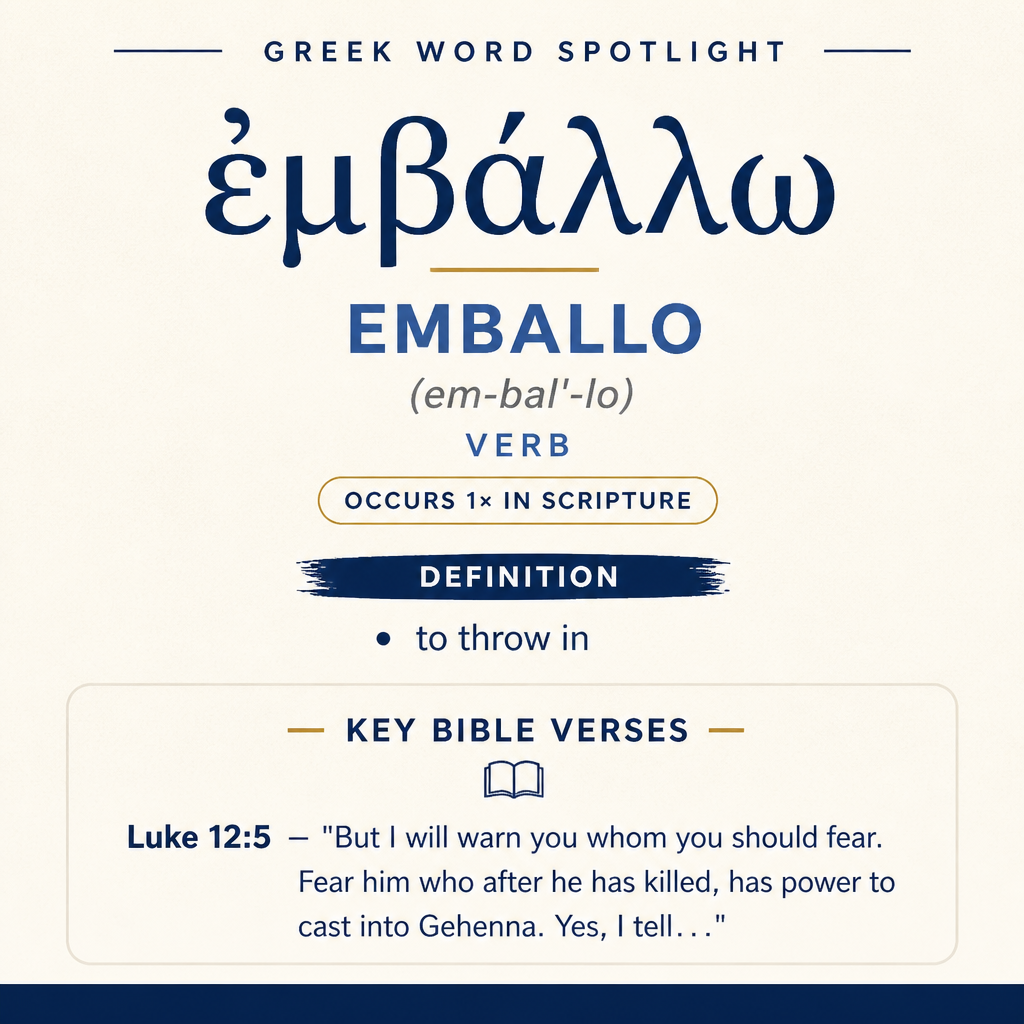
ἐμβάλλω means “to throw in” and appears once in Scripture, in Luke 12:5.
ἐμβάλλω means “to throw in.” It appears in Luke 12:5, where it portrays a decisive act of casting into Gehenna after death.
Root and Related Words
ἐμβάλλω relates to en (ἐν), “in/on/among” (Strong’s G1722), and ballo (βάλλω), “to throw” (Strong’s G906). The combined shape of the word fits an action expressed as a throwing that results in something being placed within a location.

Occurrences
“But I will warn you whom you should fear. Fear him who after he has killed, has power to cast into Gehenna. Yes, I tell you, fear him.” (Luke 12:5)
Here ἐμβάλλω supplies the concrete motion-image inside a warning about proper fear: there is one who “has power to cast into Gehenna.” The verse sets up a sequence: killing happens first (“after he has killed”), and then an additional, subsequent action is possible—casting “into Gehenna.” The verb therefore contributes more than the idea of punishment in general; it depicts a forceful placement into a destination, with the destination named explicitly. The prepositional idea “into” in the English corresponds closely to what ἐμβάλλω expresses by its own form: the action is not merely throwing, but throwing that results in entry into a defined place.
The rhetorical structure of the verse heightens the impact of the verb. Jesus does not frame the fear as vague dread, but as an evaluation of authority: “Fear him … has power to cast into Gehenna.” The casting is described as something within that authority’s capability (“has power”), making the act of throwing-in function as a marker of jurisdiction. The warning culminates in repetition—“Yes, I tell you, fear him”—and ἐμβάλλω is the vivid action that anchors the reason for that fear. In this single line, the verb is joined to the starkly physical imagery of being seized and hurled into a place, strengthening the seriousness of the warning.
Sense and Usage
The sense “to throw in” is spatial and directional: something (or someone) is moved from one sphere into another. In Luke 12:5 that destination is not left implicit; it is specified as “Gehenna,” and the action is presented as a power exercised “after he has killed.” The verb thus works within a two-stage picture: death does not exhaust what the one feared can do, because there remains the capacity to carry out a further act that places a person into a location characterized as the object of dread.
Because “throwing in” is an action that naturally implies force, control, and a boundary crossed, ἐμβάλλω in this warning expresses the kind of authority that can impose an outcome rather than merely announce it. The one feared does not only declare a sentence; he is able to bring about a transfer into Gehenna. The verb’s imagery makes the judgment feel like an enacted relocation: the person is not pictured as walking in or drifting in, but as being cast in. In the verse’s logic, that portrayal supports the contrast Jesus is drawing between fears that stop at human violence and the fear directed toward the one whose power extends beyond it.
The definition also fits the verse’s careful attention to “into.” The act is complete only when the thrown object is inside the destination. That completion matters in Luke 12:5 because the warning is built around outcomes: killing ends a life, but casting into Gehenna describes what can follow. ἐμβάλλω therefore serves as the verb that connects agency (“has power”) to final placement (“into Gehenna”), supplying a compact, forceful description of what that power can accomplish.
Imagery
Luke 12:5 presents ἐμβάλλω with stark physicality: an authoritative act of hurling into a named place. The image is not abstract fear, but fear anchored in a scene of compelled movement—someone being cast across a boundary into Gehenna—so that the warning is felt not only as instruction but as a picture of irreversible placement.
Sources: Lexical data from Strong’s Exhaustive Concordance and the Translators Brief Lexicon of Extended Strongs for Greek (STEPBible, CC BY). Occurrence data from the Translators Amalgamated Greek New Testament (STEPBible, CC BY). Scripture quotations from the World English Bible (public domain).