
Exploring the Meaning of Hellenis in Greek
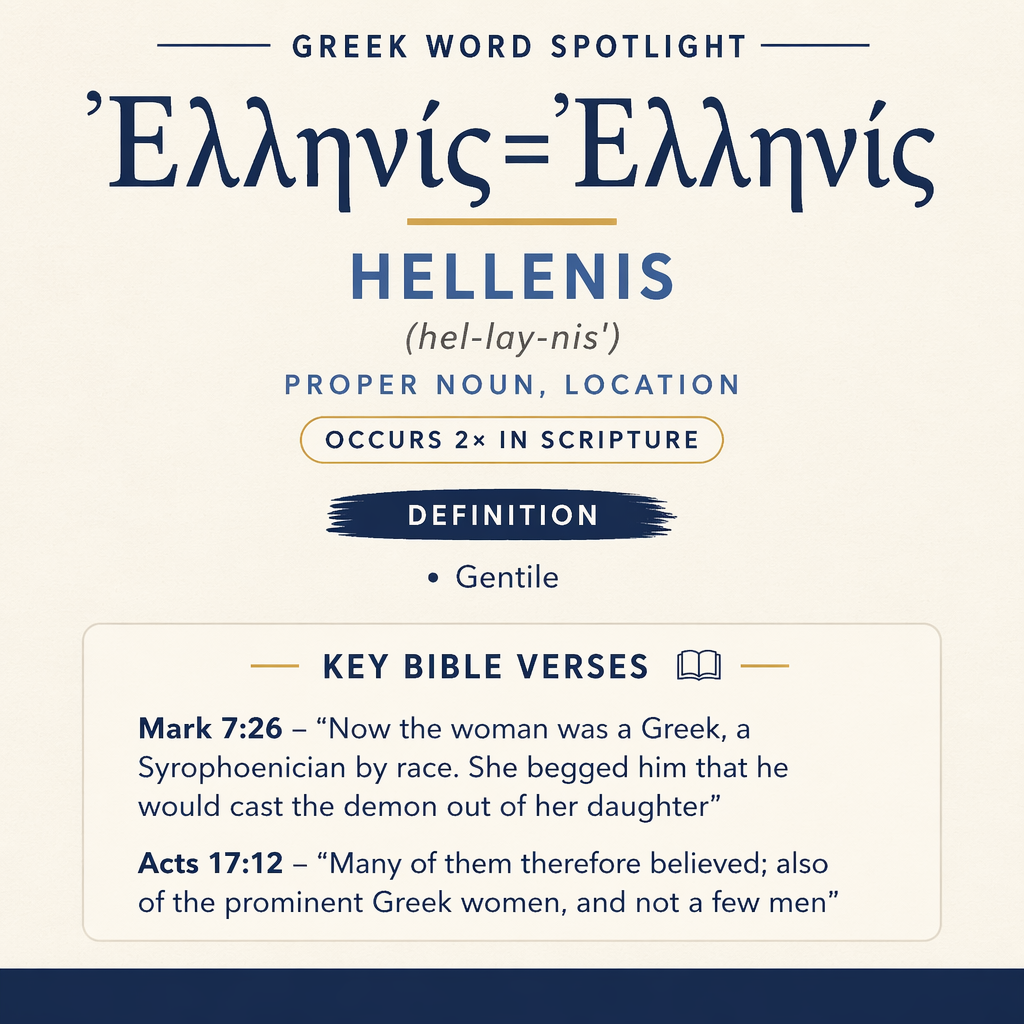
Ἑλληνίς (Hellenis) means “Gentile” and appears twice in Scripture, in Mark 7:26 and Acts 17:12.
Context in Verses
Mark 7:26 describes a Greek, Syrophoenician woman who begged Jesus to cast out a demon. Acts 17:12 mentions prominent Greek women among those who believed.
Learn More →Hellenis denotes a “Gentile,” and it appears in two New Testament narratives: one describing a mother who pleads with Jesus for her daughter, and another noting a group of women among the many who believed. In both places the term functions as an identifying label within a specific social setting.
Root and Related Words
Hellenis is related to the noun Hellēn (Ἕλλην, Strong’s G1672), glossed “Greek, Gentile.” The relationship is reflected in the way the verses use Hellenis to mark people as belonging to the “Greek/Gentile” category in contrast to other groupings that the context also names.

Occurrences
“Now the woman was a Greek, a Syrophoenician by race. She begged him that he would cast the demon out of her daughter.” (Mark 7:26)
Here Hellenis is part of a compact description of the petitioner. The sentence sets her identity in two coordinate phrases: “a Greek” and “a Syrophoenician by race.” Within the scene, that labeling is not ornamental; it frames the reader’s understanding of who is approaching Jesus and from what social location. The action that follows—“She begged him that he would cast the demon out of her daughter”—is presented as a direct appeal flowing from that mother’s need, but the narrative first anchors her as a Gentile woman. In this setting, the term functions as an ethnic descriptor attached to a specific individual, and it stands alongside another descriptor (“Syrophoenician by race”) that further specifies her background. The result is a portrait of a Gentile mother whose request is urgent and personal, expressed through repeated pleading.
“Many of them therefore believed; also of the prominent Greek women, and not a few men.” (Acts 17:12)
In Acts the term appears in a report of response to preaching: “Many of them therefore believed.” The statement then adds further detail about those who believed—“also of the prominent Greek women, and not a few men.” In this verse Hellenis contributes to a brief demographic sketch. It does not name an individual but identifies a subset within the larger group of new believers: “prominent Greek women.” The adjective “prominent” places these women among the socially visible or influential, and Hellenis marks them as Gentile within that description. The phrase works as a concise way to say that the believing community included women of status who were Gentile, as well as “not a few men.” The word thus serves a narrative purpose similar to Mark 7:26—pinpointing social identity—yet here it is embedded in a summary that emphasizes breadth of response.
Sense and Usage
Across its two occurrences, Hellenis consistently operates as a social-ethnic label: it places a person (or group) under the category “Gentile.” The definition is not expressed as an abstract concept but as a concrete marker attached to named participants in real scenes.
In Mark 7:26 the label is attached to a single woman in the posture of petition: she is introduced by what she is (“a Greek”) before the narrative highlights what she does (“She begged him…”). The structure makes the descriptor part of how the reader meets her. The paired description—“a Greek, a Syrophoenician by race”—shows how Hellenis can sit alongside another ethnic designation without collapsing them into a single term; it functions as one element in a fuller identification. Within the verse, being a Gentile is not the content of her request, but it is part of the portrait of the requester.
In Acts 17:12 the label appears in a collective report that counts and distinguishes. The verse is not concerned with a single biography but with the composition of those who “believed.” Here Hellenis helps characterize the make-up of the responding group by noting that among the believers were “prominent Greek women.” The term therefore carries a classificatory force: it distinguishes a recognizable category of people within a larger set (“Many of them… also… and…”). Because the verse pairs “prominent Greek women” with “not a few men,” the effect is to present a multi-part picture of response, and Hellenis supplies one of the key descriptors in that picture.
Read together, these uses show that Hellenis can function both individually and corporately: in one place it identifies a single Gentile woman in a moment of urgent appeal; in the other it identifies Gentile women as a notable segment within a believing multitude. In both, the word’s contribution is to locate people socially—who they are in relation to the community being described—rather than to describe an action or a virtue. The narrative interest lies in the interaction (a plea for deliverance) and in the response (many believing), and Hellenis supplies the Gentile identity of the persons involved in those developments.
Imagery and Emphasis
The two passages attach Hellenis to two different kinds of scenes: an intimate household crisis and a public report of belief. Mark 7:26 places the label next to the image of a mother “begg[ing]” on behalf of “her daughter,” focusing attention on desperate intercession and hoped-for deliverance. Acts 17:12 places the label in a list-like summary—“Many… also… and…”—where the emphasis is on the visible spread of belief across different kinds of people, including “prominent Greek women.” In both cases, Hellenis colors the reader’s imagination by anchoring the people in view as Gentile participants in the unfolding events.
Sources: Lexical data from Strong’s Exhaustive Concordance and the Translators Brief Lexicon of Extended Strongs for Greek (STEPBible, CC BY). Occurrence data from the Translators Amalgamated Greek New Testament (STEPBible, CC BY). Scripture quotations from the World English Bible (public domain).




