Exploring the Meaning of Eleemosune in Greek
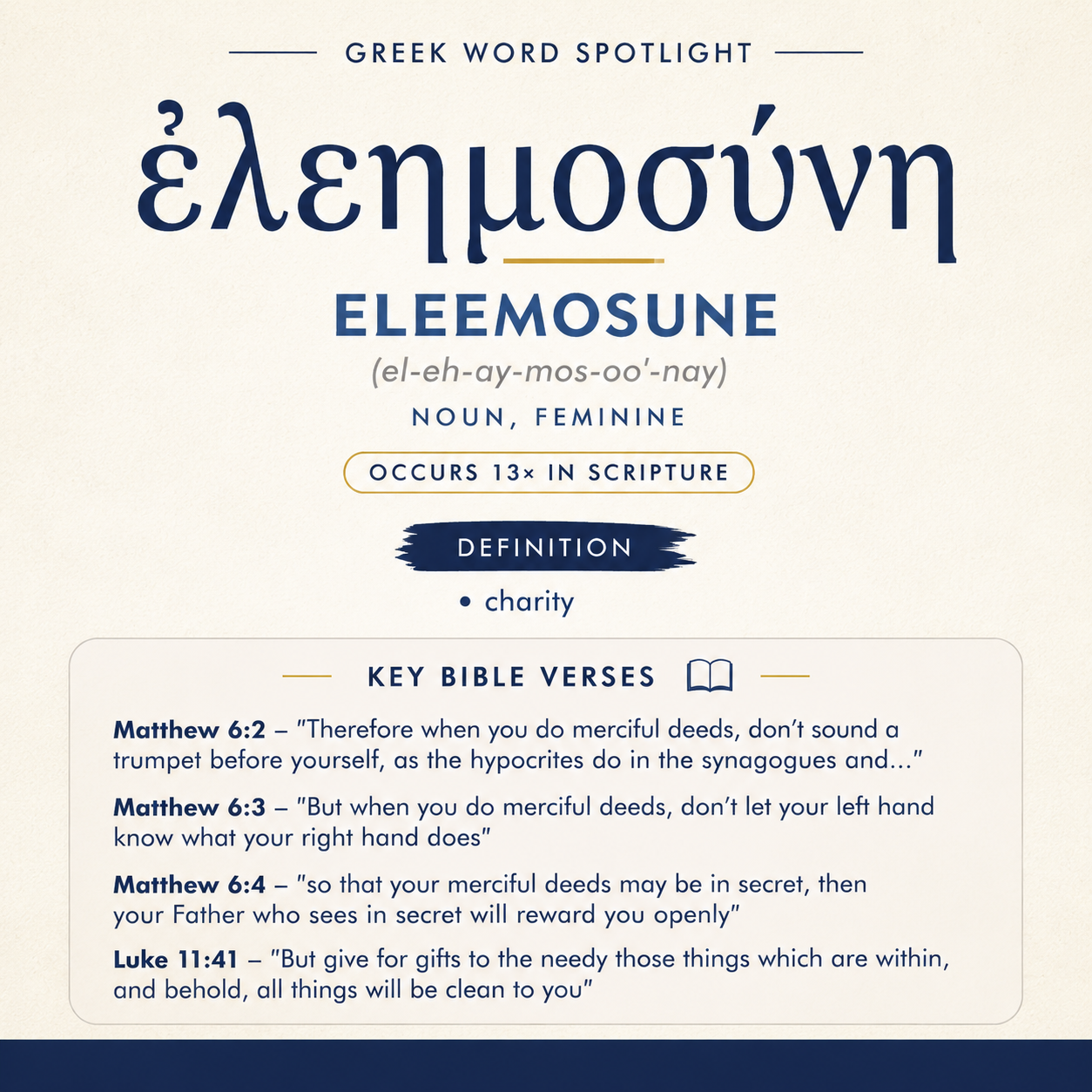
ἐλεημοσύνη means “charity” and occurs 13 times in Scripture, including Matthew 6:2–4, Luke 11:41; 12:33, and Acts 3:2–3, 10.
Core Meaning
ἐλεημοσύνη is defined as “charity.” In the listed passages it is connected with giving gifts to the needy.
Learn More →Jesus’ Teaching
In Matthew 6:2–4, merciful deeds are to be done without public display and in secret. Luke 11:41 and 12:33 speak of giving to the needy.
Learn More →Acts Narrative
In Acts 3:2–3, 10, a lame man at the temple gate asks to receive gifts for the needy. The same man is recognized as one who used to sit begging there.
Learn More →ἐλεημοσύνη means “charity,” appearing in Jesus’ teaching about merciful giving and in Acts in scenes of need, worship, and remembered devotion. Across its uses, the word is tied to concrete actions toward the needy, often set in public spaces (streets, synagogues, the temple gate) and also framed as something God sees and remembers.
Occurrences
Matthew 6:2
“Therefore when you do merciful deeds, don’t sound a trumpet before yourself, as the hypocrites do in the synagogues and in the streets, that they may get glory from men. Most certainly I tell you, they have received their reward.” (Matthew 6:2)
Here ἐλεημοσύνη is presented as an intentional act (“when you do”) that can be performed in settings where others notice—“in the synagogues and in the streets.” The verse contrasts the deed itself with the motive of seeking “glory from men,” treating charity as something that may be turned into a public performance. The word belongs to behavior that has an outcome (“reward”), and the warning assumes charity can be done in a way that shifts attention from the needy to the giver.
Matthew 6:3
“But when you do merciful deeds, don’t let your left hand know what your right hand does,” (Matthew 6:3)
In this saying, ἐλεημοσύνη is again an action done by the giver, but the emphasis is on restraint and concealment. The vivid image of “left hand” and “right hand” describes charity as something that can be so unadvertised it is not even tallied by the doer. Charity is depicted as concrete enough to be “done,” yet meant to be carried out without self-display.
Matthew 6:4
“so that your merciful deeds may be in secret, then your Father who sees in secret will reward you openly.” (Matthew 6:4)
This verse continues the same instruction and adds the setting “in secret” and the divine perspective: “your Father who sees in secret.” ἐλεημοσύνη is framed as capable of being hidden from human observers while still fully seen by God. The act remains real and accountable even when concealed, and it is placed within a moral economy where God, not the crowd, provides the “reward.”
Luke 11:41
“But give for gifts to the needy those things which are within, and behold, all things will be clean to you.” (Luke 11:41)
Here ἐλεημοσύνη is expressed as “gifts to the needy,” and the command targets the source of giving: “those things which are within.” Charity is not merely an outward transaction; it is linked to what a person has internally and then gives outwardly to the needy. The result described—“all things will be clean to you”—connects charitable giving with a broader condition of cleanness, suggesting charity functions as a practical expression of inner reality, not only a social gesture.
Luke 12:33
“Sell that which you have, and give gifts to the needy. Make for yourselves purses which don’t grow old, a treasure in the heavens that doesn’t fail, where no thief approaches, neither moth destroys.” (Luke 12:33)
In this instruction, ἐλεημοσύνη is again “gifts to the needy,” but now placed alongside a deliberate economic action: “Sell that which you have.” Charity is portrayed as purposeful redistribution—turning possessions into help for the needy. The verse then pairs the act with imagery of lasting security: “purses which don’t grow old” and “a treasure in the heavens that doesn’t fail.” Charity, as used here, is not cast as loss but as transfer into a kind of safeguarded treasure beyond theft and decay.
Acts 3:2
“A certain man who was lame from his mother’s womb was being carried, whom they laid daily at the door of the temple which is called Beautiful, to ask gifts for the needy of those who entered into the temple.” (Acts 3:2)
This occurrence places ἐλεημοσύνη in a scene of daily need at a public religious site. The man is “laid daily” at the temple door to “ask gifts for the needy” from worshipers passing through. Charity is depicted as expected and routine: temple entrance traffic creates an opportunity for giving, and the needy person’s request depends on the generosity of those “who entered into the temple.” The word is grounded in the reality of poverty and disability, and in the social practice of almsgiving at a place associated with worship.
Acts 3:3
“Seeing Peter and John about to go into the temple, he asked to receive gifts for the needy.” (Acts 3:3)
Here ἐλεημοσύνη is the specific thing requested from Peter and John as they approach the temple. Charity is framed as something that can be “received,” highlighting its tangible, distributable character. The verse also emphasizes the directness of the encounter—seeing them, he asks—showing charity operating at the level of immediate appeal and response in a public setting.
Acts 3:10
“They recognized him, that it was he who used to sit begging for gifts for the needy at the Beautiful Gate of the temple. They were filled with wonder and amazement at what had happened to him.” (Acts 3:10)
This verse looks back on the man’s former identity: the one who “used to sit begging for gifts for the needy.” ἐλεημοσύνη becomes part of how the community recognizes him—his place (“Beautiful Gate of the temple”) and his activity (begging for charity) mark him as familiar. The public memory of charity highlights how such giving is woven into communal life; people know who regularly depends on it. Their “wonder and amazement” is tied to a change “that had happened to him,” set against the established pattern of his begging for charitable gifts.
Acts 9:36
“Now there was at Joppa a certain disciple named Tabitha, which when translated, means Dorcas. This woman was full of good works and acts of mercy which she did.” (Acts 9:36)
In this portrait of Tabitha, ἐλεημοσύνη is rendered “acts of mercy,” set alongside “good works.” Charity is not a single instance but a characteristic practice—she “was full” of such deeds. The wording stresses repeated, personal initiative: “which she did.” Charity here functions as a pattern of life that marks a disciple’s reputation within a community.
Acts 10:2
“a devout man, and one who feared God with all his house, who gave gifts for the needy generously to the people, and always prayed to God.” (Acts 10:2)
Here ἐλεημοσύνη is “gifts for the needy” given “generously,” presented as a defining element of Cornelius’s piety alongside continual prayer. Charity is directed “to the people,” suggesting a broad and regular distribution rather than a private favor. The verse ties his household character (“with all his house”) to his practices, implying charity can be a visible expression of devotion that shapes a family’s public identity.
Acts 10:4
“He, fastening his eyes on him, and being frightened, said, “What is it, Lord?” He said to him, “Your prayers and your gifts to the needy have gone up for a memorial before God.” (Acts 10:4)
This verse links ἐλεημοσύνη with prayer in a striking way: both “have gone up for a memorial before God.” Charity is portrayed as something God actively registers and remembers, not merely an earthly transaction between giver and recipient. The language “gone up” places charitable giving within the realm of Godward significance, and “memorial” presents it as enduring in divine attention, paired with prayers as part of a single remembered devotion.
Acts 10:31
“and said, ‘Cornelius, your prayer is heard, and your gifts to the needy are remembered in the sight of God.” (Acts 10:31)
Again ἐλεημοσύνη is joined to prayer, but here with two complementary statements: prayer “is heard,” and charitable gifts “are remembered in the sight of God.” Charity is thus placed under God’s ongoing awareness (“in the sight of God”), reinforcing that these deeds are not lost even if they were done quietly or long ago. The pairing shows charity functioning as a persistent marker of a person’s life before God, not simply a momentary act of generosity.

Sense and Usage
Across these passages, ἐλεημοσύνη (“charity”) consistently refers to practical giving directed toward need—“gifts to the needy,” “merciful deeds,” “acts of mercy.” The word operates in two recurring arenas. First, it belongs to everyday social reality: the needy ask, the able give, and the transaction takes place in ordinary spaces such as “the synagogues,” “the streets,” and especially the “Beautiful Gate of the temple.” Charity is public in the sense that need is visible and appeals are made face-to-face; at the same time, Jesus’ instruction presses charity toward secrecy, insisting that the act can be genuinely performed without becoming self-advertisement.
Second, ἐλεημοσύνη is repeatedly framed in relation to God. In Matthew, the Father “sees in secret” and repays, so charity is placed under divine scrutiny even when humans do not know. In Luke, charity is attached to inward integrity (“those things which are within”) and to a kind of treasure that outlasts decay and theft. In Acts 10, charitable giving is remembered before God and in God’s sight, explicitly paired with prayer. Taken together, these uses portray charity as concrete help for the needy that also carries spiritual weight: it is a deed with an audience beyond those who witness it and a permanence beyond the moment of giving.
Imagery
The word’s most vivid imagery is spatial. Charity is imagined at thresholds and crossroads: the synagogue and street where applause can be sought, and the temple gate where a needy man is “laid daily” to ask passersby. Alongside these public settings stands the contrasting scene of secrecy—charity hidden from human view yet fully seen by God. Luke adds the imagery of exchange and storage: possessions sold, purses that do not wear out, and treasure beyond the reach of thief and moth. Acts 10 adds a vertical picture: prayers and charitable gifts “have gone up for a memorial before God,” and are “remembered in the sight of God,” presenting charity as something that rises beyond the immediate scene of giver and recipient.
Sources: Lexical data from Strong’s Exhaustive Concordance and the Translators Brief Lexicon of Extended Strongs for Greek (STEPBible, CC BY). Occurrence data from the Translators Amalgamated Greek New Testament (STEPBible, CC BY). Scripture quotations from the World English Bible (public domain).