Exploring the Meaning of Ektithemi in Greek
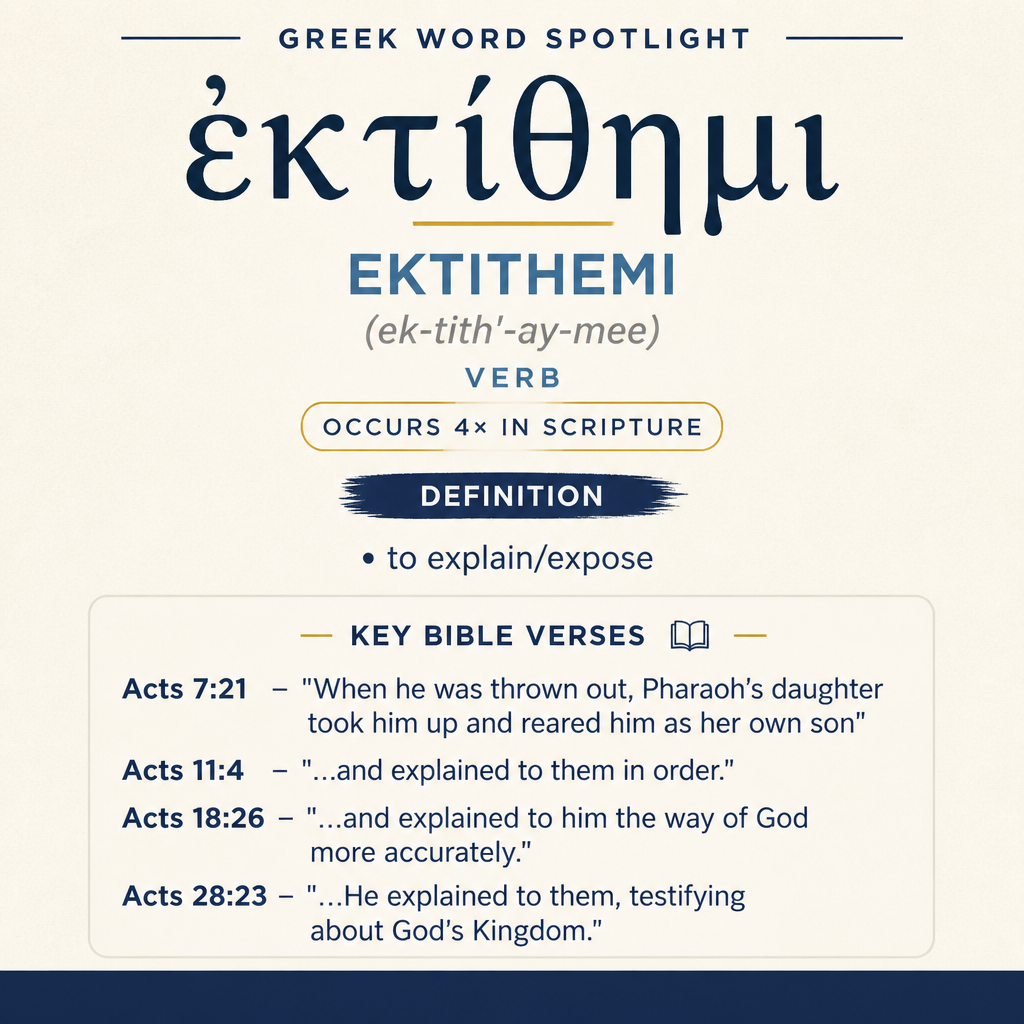
ἐκτίθημι means “to explain/expose” and appears four times in Scripture, all in Acts (7:21; 11:4; 18:26; 28:23).
Core Meaning
ἐκτίθημι means “to explain/expose.” In Acts it describes giving an ordered explanation or making something known.
Learn More →Acts Occurrences
It occurs four times, all in Acts: 7:21; 11:4; 18:26; 28:23. These contexts include both exposure (Acts 7:21) and explanation (Acts 11:4; 18:26; 28:23).
Learn More →How It’s Used
Acts 11:4 shows Peter “explained to them in order.” Acts 18:26 and 28:23 also use it for explaining in teaching settings.
Learn More →ἐκτίθημι means “to explain/expose,” and it appears in Acts in scenes of both public testimony and careful instruction. In these passages it can describe setting out an account in ordered speech and also bringing something into the open.
Root and Related Words
ἐκτίθημι is related to ek (ἐκ), “out from” (Strong’s G1537), and tithemi (τίθημι), “to place” (Strong’s G5087). In combination, these related words suit contexts where a matter is put out in view through spoken explanation or exposed in the course of events.

Occurrences
“When he was thrown out, Pharaoh’s daughter took him up and reared him as her own son.” (Acts 7:21)
In Stephen’s retelling, the verb stands at the turning point in Moses’ early life: he is “thrown out,” and that exposure makes the next action possible—Pharaoh’s daughter “took him up.” The sense “expose” fits the movement from being cast out into the open to being noticed and received. The narrative logic is concrete: what is put out becomes visible, and visibility leads to being taken up and raised “as her own son.”

“But Peter began, and explained to them in order, saying,” (Acts 11:4)
Here ἐκτίθημι marks the start of Peter’s response to others: he “began” and then “explained…in order.” The scene emphasizes structured speech, not a scattered remark. The verb contributes the idea of laying out an account so that hearers can follow its sequence. The phrase “in order” anchors the nuance: what is explained is arranged, presented step by step, and offered as a coherent narrative rather than a mere conclusion.
“He began to speak boldly in the synagogue. But when Priscilla and Aquila heard him, they took him aside, and explained to him the way of God more accurately.” (Acts 18:26)
In the synagogue setting, bold public speaking is followed by private clarification. Priscilla and Aquila “took him aside,” and ἐκτίθημι names what they then do: they “explained…more accurately.” The word’s contribution is practical and instructional—an explanation meant to increase precision. The immediate contrast between public boldness and being taken aside highlights the interpersonal setting of the explanation: it is directed “to him,” and its goal is accuracy regarding “the way of God.”
“When they had appointed him a day, many people came to him at his lodging. He explained to them, testifying about God’s Kingdom, and persuading them concerning Jesus, both from the law of Moses and from the prophets, from morning until evening.” (Acts 28:23)
This is the most extended description of ἐκτίθημι in action. The explanation is scheduled (“appointed him a day”), well attended (“many people came”), and sustained (“from morning until evening”). The verb introduces a thorough presentation in which explanation stands alongside “testifying” and “persuading.” It is not merely explanatory speech as an abstract activity; it is directed “to them” and is supported by sources “from the law of Moses and from the prophets.” In this setting, “to explain” is portrayed as patient, reasoned exposition that spans the day and aims to make the case intelligible and compelling.
Sense and Usage
Across these four passages, ἐκτίθημι moves between two closely linked expressions of its definition “to explain/expose.” In Acts 7:21 the force is situational exposure: someone is put out, left in a condition of being seen, and the story turns on that exposed state. The verb thus can describe exposure that happens to a person, with immediate narrative consequences.
In Acts 11:4, Acts 18:26, and Acts 28:23, the verb functions in explicitly communicative settings. The shared features are clarity, order, and directedness to an audience. Peter’s explanation is “in order,” signaling a careful arrangement of points. Priscilla and Aquila’s explanation is “more accurately,” focusing on correction and precision. Paul’s explanation is extensive and anchored in recognized sources, carried out over many hours and paired with testimony and persuasion. In these scenes, explanation is not treated as brief definition but as a deliberate setting forth of an account or teaching so that hearers can grasp what is being presented.
Read together, these uses show how “expose” and “explain” cohere: explanation brings a matter out into the open for others to see, and exposure places someone or something in view where response becomes possible. Whether the exposure is physical (a child thrown out and then taken up) or verbal (an account laid out, a way clarified, a case presented), ἐκτίθημι consistently marks a movement from hiddenness or uncertainty toward openness and understanding within the immediate scene.
Imagery
The word’s imagery in Acts ranges from a vulnerable exposure to a sustained unfolding. Acts 7:21 pictures exposure as being cast out into public view, with rescue following. The later occurrences picture speech that opens a subject up: an ordered account, a more accurate explanation, and a day-long presentation that brings its content into the open before listeners.
Sources: Lexical data from Strong’s Exhaustive Concordance and the Translators Brief Lexicon of Extended Strongs for Greek (STEPBible, CC BY). Occurrence data from the Translators Amalgamated Greek New Testament (STEPBible, CC BY). Scripture quotations from the World English Bible (public domain).