
Exploring the Meaning of Ekthetos in Greek
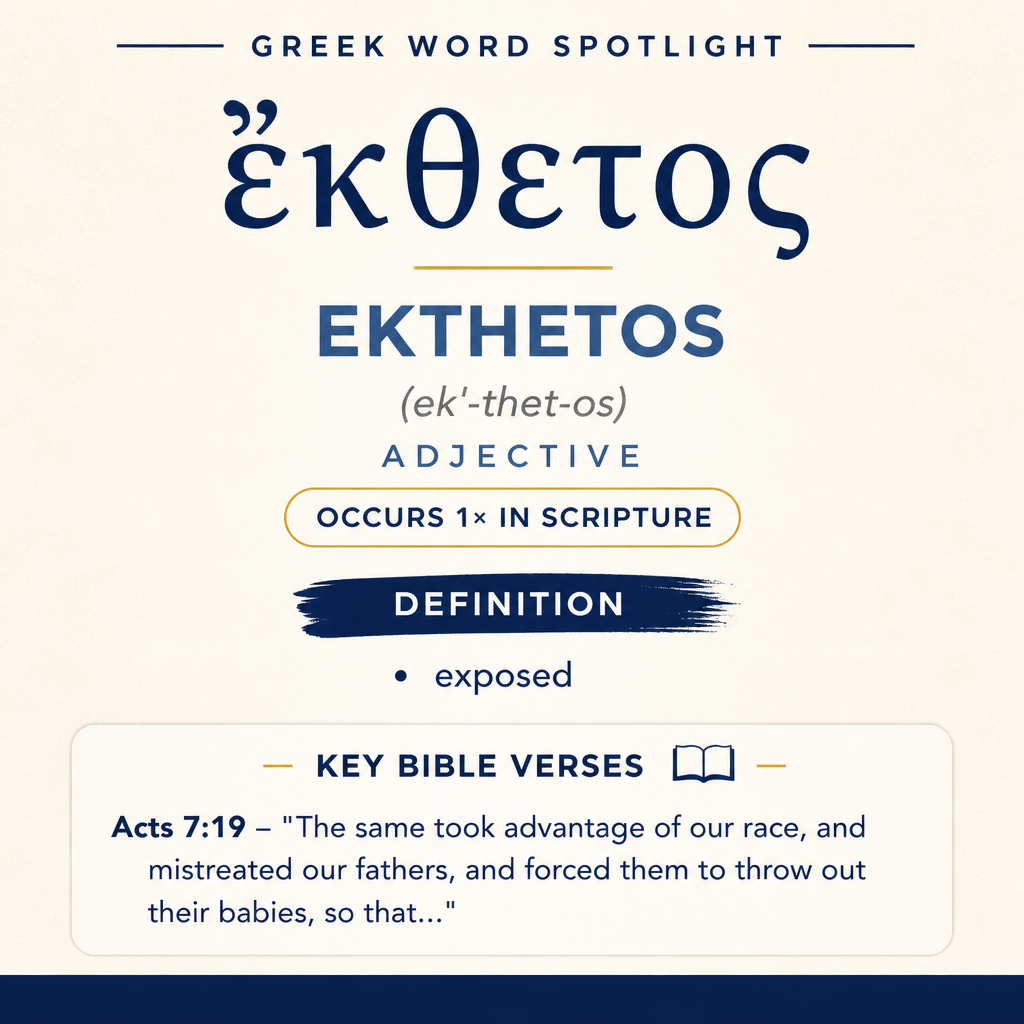
ἔκθετος means “exposed” and appears once in Scripture, in Acts 7:19.
Acts Context
In Acts 7:19 it describes babies being forced to be thrown out, so they would not survive.
Learn More →ἔκθετος means “exposed” and appears once in the New Testament, in Stephen’s retelling of Israel’s early history in Acts 7. In that setting it names the condition forced upon infants when they were thrown out so that they would not survive.
Root and Related Words
ἔκθετος (Ekthetos) is formed from ἐκ (ek), “out from” (Strong’s G1537), and τίθημι (tithemi), “to place” (Strong’s G5087). The compound idea is that of something placed out, set outside, or put out in the open.

Occurrences
“The same took advantage of our race, and mistreated our fathers, and forced them to throw out their babies, so that they wouldn’t stay alive.” (Acts 7:19)
In Acts 7:19, the word belongs to a tightly packed description of oppression: “took advantage,” “mistreated,” and “forced.” Within that chain, “throw out their babies” depicts an act of compulsion aimed at ending life—“so that they wouldn’t stay alive.” ἔκθετος frames the babies’ plight as one of exposure: they are not merely separated from their parents but placed out where protection is removed and vulnerability is heightened. The logic of the sentence ties exposure directly to lethal intent; the condition named by the word is the means by which survival is cut off.

The phrasing also highlights how exposure functions socially. The parents are “forced,” so the exposure is not an accidental abandonment but an imposed policy carried out through coerced actions. In Stephen’s narration, the cruelty is sharpened by the victims’ helplessness: “babies” cannot resist or secure themselves. The term therefore fits the verse’s portrayal of calculated mistreatment—an outward placing that leaves the smallest and weakest without shelter, oversight, or defense, in order to ensure death.
Sense and Usage
The single New Testament use of ἔκθετος shows “exposed” as a concrete, physical condition with immediate consequences. The word does not stand alone as an abstract label; it is embedded in a description of actions (“forced them to throw out their babies”) and outcome (“so that they wouldn’t stay alive”). In this context, exposure is defined by removal from a place of safety and by being left where danger can do its work. The sense is therefore practical and situational: “exposed” describes what happens when someone is put out into circumstances where protection is withdrawn.
The related elements ἐκ (“out from”) and τίθημι (“to place”) help explain why “exposed” fits the scene’s force. The emphasis falls on an outward placement—an action that relocates the vulnerable into the open. Acts 7:19 uses this idea to convey more than location: it communicates a shift from guarded life to unguarded peril. The exposure is not depicted as momentary but as a state intended to persist long enough to accomplish the goal of preventing life from continuing.
Because the verse presents exposure as compelled and systematic (“forced them”), the word’s sense also carries a public dimension. Exposure is a way of treating people as disposable, putting them out where they can be overlooked, neglected, or destroyed without immediate interference. In Stephen’s speech, that is part of what makes the oppression a “taking advantage” and a “mistreatment”: it pressures families into an outward placing that turns newborn life into something left outside the bounds of ordinary care.
Imagery
The imagery of ἔκθετος in Acts 7:19 is starkly spatial: infants are “thrown out,” moved from the inside of family protection to an outside where life is not sustained. The verse itself supplies the emotional weight by pairing the outward action with its intended end—“so that they wouldn’t stay alive”—so that “exposed” is felt not as a mild description but as the cold openness of a place where survival is deliberately denied.
Sources: Lexical data from Strong’s Exhaustive Concordance and the Translators Brief Lexicon of Extended Strongs for Greek (STEPBible, CC BY). Occurrence data from the Translators Amalgamated Greek New Testament (STEPBible, CC BY). Scripture quotations from the World English Bible (public domain).





