Exploring the Meaning of Ekeise in Greek
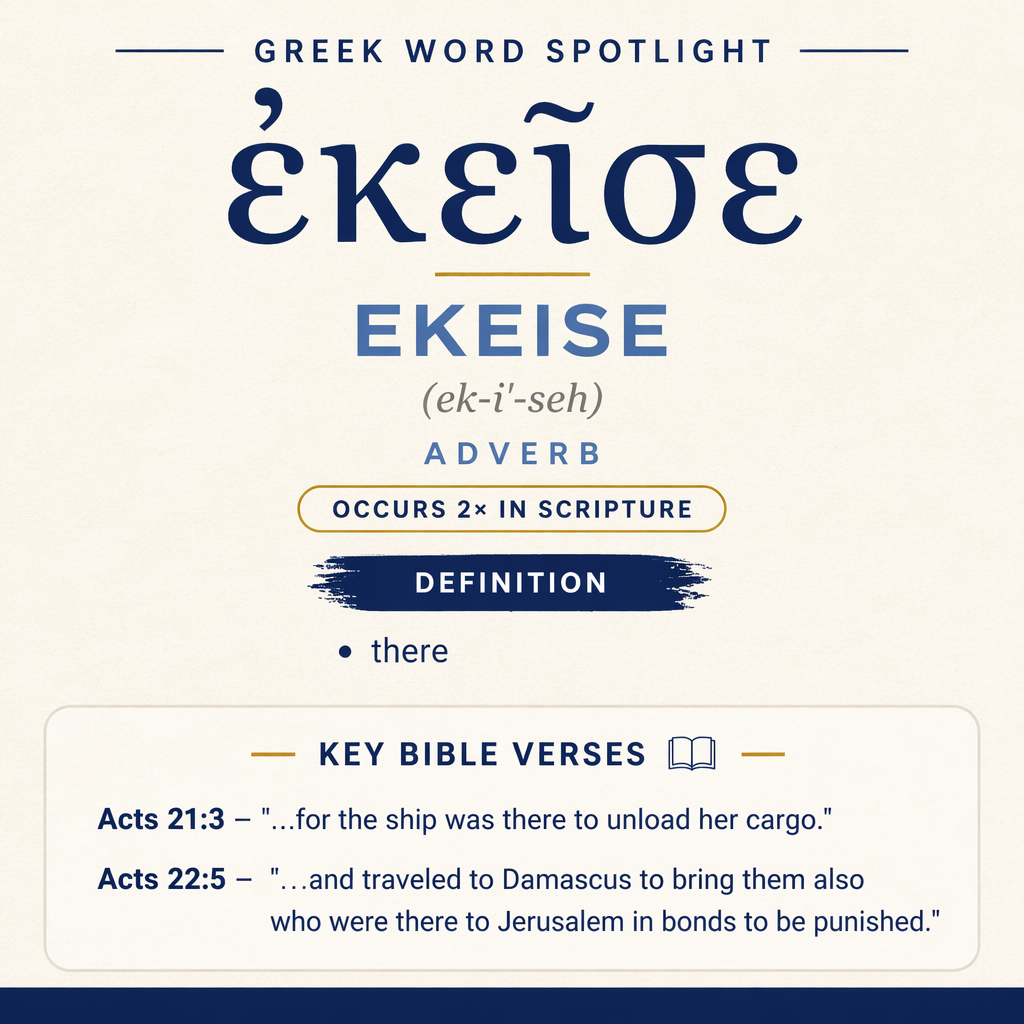
ἐκεῖσε means “there” and appears twice in Scripture: Acts 21:3 and Acts 22:5.
Scripture Occurrences
It occurs 2 times in Scripture. The references are Acts 21:3 and Acts 22:5.
Learn More →Context Glimpses
In Acts 21:3, it appears in a travel account mentioning Cyprus, Syria, and Tyre. In Acts 22:5, it appears in Paul’s statement about receiving letters from the high priest and elders.
Learn More →ἐκεῖσε means “there” and appears in two narrative settings in Acts. In both, it helps locate people or actions at a particular destination within a travel-and-transfer storyline.
Root and Related Words
ἐκεῖσε is related to ekei (ἐκεῖ), “there” (Strong’s G1563). In these passages, the relationship shows up as a shared concern with placing something or someone at a specific location within the account being told.

Occurrences
“When we had come in sight of Cyprus, leaving it on the left hand, we sailed to Syria and landed at Tyre, for the ship was there to unload her cargo.” (Acts 21:3)
In this travel report, the narrative moves step by step: coming in sight of Cyprus, passing it, sailing to Syria, and landing at Tyre. ἐκεῖσε contributes the final locator that anchors the reason for stopping: “for the ship was there to unload her cargo.” The adverb points to Tyre as the relevant place where the unloading is to happen. It does not add a new action; it fixes the unloading to the landing site already named, tightening the connection between the itinerary (“landed at Tyre”) and the practical purpose of the stop (cargo operations). The effect is to make Tyre not merely a dot on the route but the place that explains the ship’s behavior at that moment in the journey.
“As also the high priest and all the council of the elders testify, from whom also I received letters to the brothers, and traveled to Damascus to bring them also who were there to Jerusalem in bonds to be punished.” (Acts 22:5)
Here the speaker recounts authorization and movement: testimony from leaders, receiving letters, traveling to Damascus, and transporting captives to Jerusalem. ἐκεῖσε attaches to “who were there,” identifying the group in view as people located in the place just mentioned, Damascus. Its function is to specify which people were targeted for removal—those present “there”—so that the later movement (“to Jerusalem”) has a clear starting point in the story. This locating force matters because the sentence contains multiple places (Damascus, Jerusalem) and multiple parties (leaders, “brothers,” “them”); ἐκεῖσε helps the reader track that the intended captives are those in Damascus, from which they are to be brought to Jerusalem “in bonds.” The adverb thus serves the narrative’s logistics: it marks where the persons to be seized are found before the transfer and punishment described.
Sense and Usage
Across both occurrences, “there” is used to pin an event or a set of people to a particular named place in an unfolding account. In Acts 21:3 the word works like a narrative hinge: the itinerary leads to Tyre, and “there” makes Tyre the operational site for unloading cargo. The word’s contribution is not descriptive detail about Tyre itself but spatial grounding for why the ship stops where it does; the location functions as an explanation.
In Acts 22:5, “there” does something slightly different: it locates persons rather than an action, identifying the group to be transported as those found at the place already specified (Damascus). This produces clarity within a sentence that moves between authorities (“the high priest and all the council of the elders”), documents (“letters”), destination (“Damascus”), and endpoint (“Jerusalem”). By placing “them” “there,” the statement tightens the chain from authorization to travel to capture to transfer, keeping the narrative’s spatial references coherent.
In both contexts, “there” functions as a deictic locator—pointing back to a place already introduced in the immediate discourse and marking it as the relevant setting for what follows. The passages show how such a small word can carry significant load in narrative prose: it keeps a travel account from becoming a mere list of locations by specifying what is situated at the destination (cargo operations in one case, a targeted group in the other). By doing so, it helps the reader follow movement and purpose without adding any new place-name, simply by fastening attention onto the already-mentioned “there.”
Imagery in Context
Both scenes are shaped by movement between places and by the practical realities that happen at destinations. In Acts 21:3, “there” evokes the concrete rhythm of seafaring travel—sailing, landing, and unloading at a port. In Acts 22:5, “there” evokes the fixed presence of people in a city who are then removed elsewhere “in bonds,” so that a named location becomes the starting point of a forced transfer. In each case, ἐκεῖσε quietly anchors the reader in the place where the next decisive step occurs.
Sources: Lexical data from Strong’s Exhaustive Concordance and the Translators Brief Lexicon of Extended Strongs for Greek (STEPBible, CC BY). Occurrence data from the Translators Amalgamated Greek New Testament (STEPBible, CC BY). Scripture quotations from the World English Bible (public domain).