
Exploring the Meaning of Ekdidomi in Greek
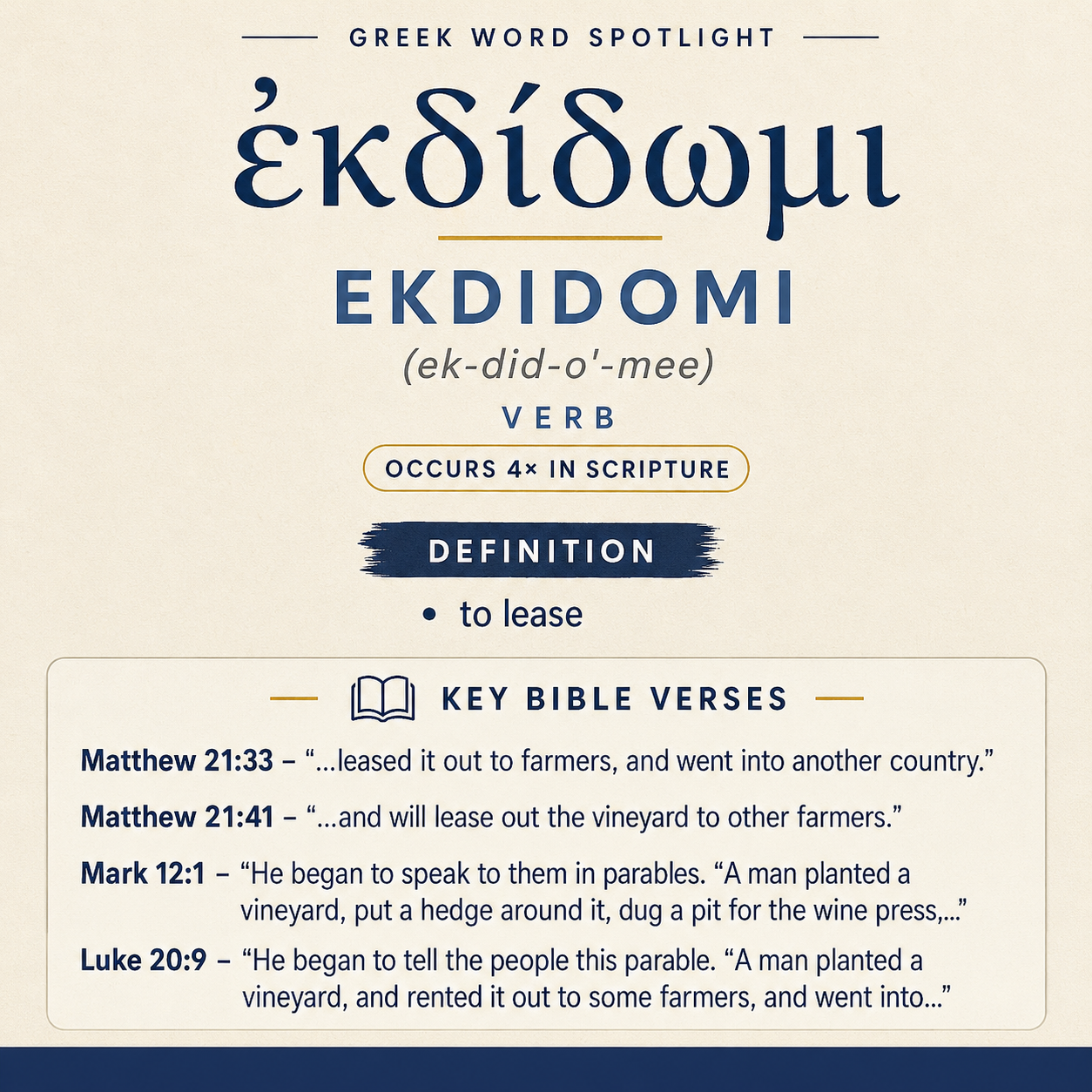
ἐκδίδωμι (Ekdidomi) means “to lease” and occurs four times in Scripture: Matthew 21:33, Matthew 21:41, Mark 12:1, and Luke 20:9.
Core Meaning
ἐκδίδωμι means “to lease.” It is used in contexts of leasing or renting out a vineyard.
Learn More →Scripture Occurrences
This verb appears 4 times in Scripture. Its occurrences are in Matthew 21:33, Matthew 21:41, Mark 12:1, and Luke 20:9.
Learn More →Parable Context
In each listed occurrence, Jesus speaks of a vineyard that is leased or rented out to farmers. These texts appear within parable narratives.
Learn More →ἐκδίδωμι means “to lease” and appears in Jesus’ vineyard parables in Matthew 21, Mark 12, and Luke 20. In each setting it describes a landowner arranging for others to work a prepared vineyard while he is away.
Root and Related Words
ἐκδίδωμι is connected with δίδωμι (didomi), “to give” (Strong’s G1325), and ἐκ (ek), “out from” (Strong’s G1537). In these parables, the leasing action is framed as an owner’s deliberate transfer of use of a vineyard to others for a period, while ownership and expectations remain with the one who arranged the lease.

Occurrences
“Hear another parable. There was a man who was a master of a household, who planted a vineyard, set a hedge about it, dug a wine press in it, built a tower, leased it out to farmers, and went into another country.” (Matthew 21:33)
Here ἐκδίδωμι marks a key turn in the story’s setup. The man is portrayed as a “master of a household” who actively establishes the vineyard’s productivity and protection: he “planted,” “set a hedge,” “dug a wine press,” and “built a tower.” The leasing is the culminating administrative act that follows these preparations. It places the vineyard’s day-to-day operation into the hands of “farmers” while the owner “went into another country,” creating a structured absence in which the farmers’ stewardship will later be measured against the vineyard’s intended purpose.
They told him, “He will miserably destroy those miserable men, and will lease out the vineyard to other farmers, who will give him the fruit in its season.” (Matthew 21:41)
In this response within the same parable, ἐκδίδωμι is used for a second leasing, now as a replacement arrangement after judgment: the vineyard “will [be] lease[d] out … to other farmers.” The word carries the sense of reassignment of tenancy rather than the creation of a new vineyard; the object remains “the vineyard,” but the tenants change. The line “who will give him the fruit in its season” connects leasing with expected yield. Leasing here functions as a means to secure the owner’s rightful reception of “fruit,” and the contrast between the former and “other farmers” is drawn in terms of the outcome the lease is meant to support.
He began to speak to them in parables. “A man planted a vineyard, put a hedge around it, dug a pit for the wine press, built a tower, rented it out to a farmer, and went into another country.” (Mark 12:1)
Mark’s presentation parallels the same narrative structure, and ἐκδίδωμι again identifies the legal-economic step that separates ownership from cultivation. The sequence is vivid and practical: planting, boundary protection (“a hedge”), infrastructure for production (“a pit for the wine press”), and oversight or security (“a tower”). Only after the vineyard is fully equipped does the owner “rente[d] it out to a farmer.” The leasing establishes a relationship in which the farmer works what another has built, and the owner’s departure “into another country” underscores that the lease operates during the owner’s physical absence, depending on the integrity of the tenant’s management.
He began to tell the people this parable. “A man planted a vineyard, and rented it out to some farmers, and went into another country for a long time.” (Luke 20:9)
Luke’s version is more compressed in description of the vineyard’s features, but the leasing still sits at the center of the arrangement: the man “planted a vineyard, and rented it out to some farmers.” The addition “for a long time” intensifies what leasing implies in the story: the tenants’ role is not momentary, but extended. ἐκδίδωμι therefore bears the weight of a durable assignment of the vineyard’s operation to “some farmers” while the owner is away, allowing time for patterns of behavior to form within the lease relationship.
Sense and Usage
Across these four occurrences, ἐκδίδωμι consistently describes leasing as the owner’s intentional act of placing a productive asset into the hands of tenants. The vineyard is not a raw field but a prepared enterprise: it is planted, bounded, and equipped for harvest and processing. Leasing therefore presupposes the owner’s prior investment and frames the tenants’ work as carried out within a setting they did not originate. In each parable the owner’s departure is paired with the lease, so that leasing becomes the mechanism by which the vineyard continues to operate in the owner’s absence.
The scenes also show that leasing is compatible with accountability. Matthew 21:41 makes the expectation explicit by linking the new lease to the giving of “fruit in its season.” Even where that expectation is not spelled out in the immediate sentence (Matthew 21:33; Mark 12:1; Luke 20:9), the vineyard’s built elements—wine press, tower, hedge—present it as oriented toward regular yield and safeguarded stewardship. Leasing, in this narrative world, is not simple abandonment; it is a structured entrusting of use, with an implied purpose grounded in the vineyard’s designed productivity.
Finally, Matthew 21:41 shows that ἐκδίδωμι can describe leasing as a renewed administrative decision: the vineyard can be “lease[d] out … to other farmers.” The word thus serves the story both at the initial entrusting (a first lease) and at a later re-entrusting (a replacement lease). In both cases the action belongs to the owner and concerns who is authorized to work the vineyard during the owner’s absence.
Imagery
In these parables the imagery surrounding ἐκδίδωμι is concrete: a vineyard with boundary hedge, wine press, and tower, and a landowner who leaves the country after arranging tenancy. The leasing gathers the vineyard’s physical features into an economic and relational setting—someone has built and planted, someone else works, and time passes while the owner is away—so that the vineyard becomes a stage for tested stewardship and the expected return of fruit.
Sources: Lexical data from Strong’s Exhaustive Concordance and the Translators Brief Lexicon of Extended Strongs for Greek (STEPBible, CC BY). Occurrence data from the Translators Amalgamated Greek New Testament (STEPBible, CC BY). Scripture quotations from the World English Bible (public domain).





