Exploring the Meaning of Dike in Greek
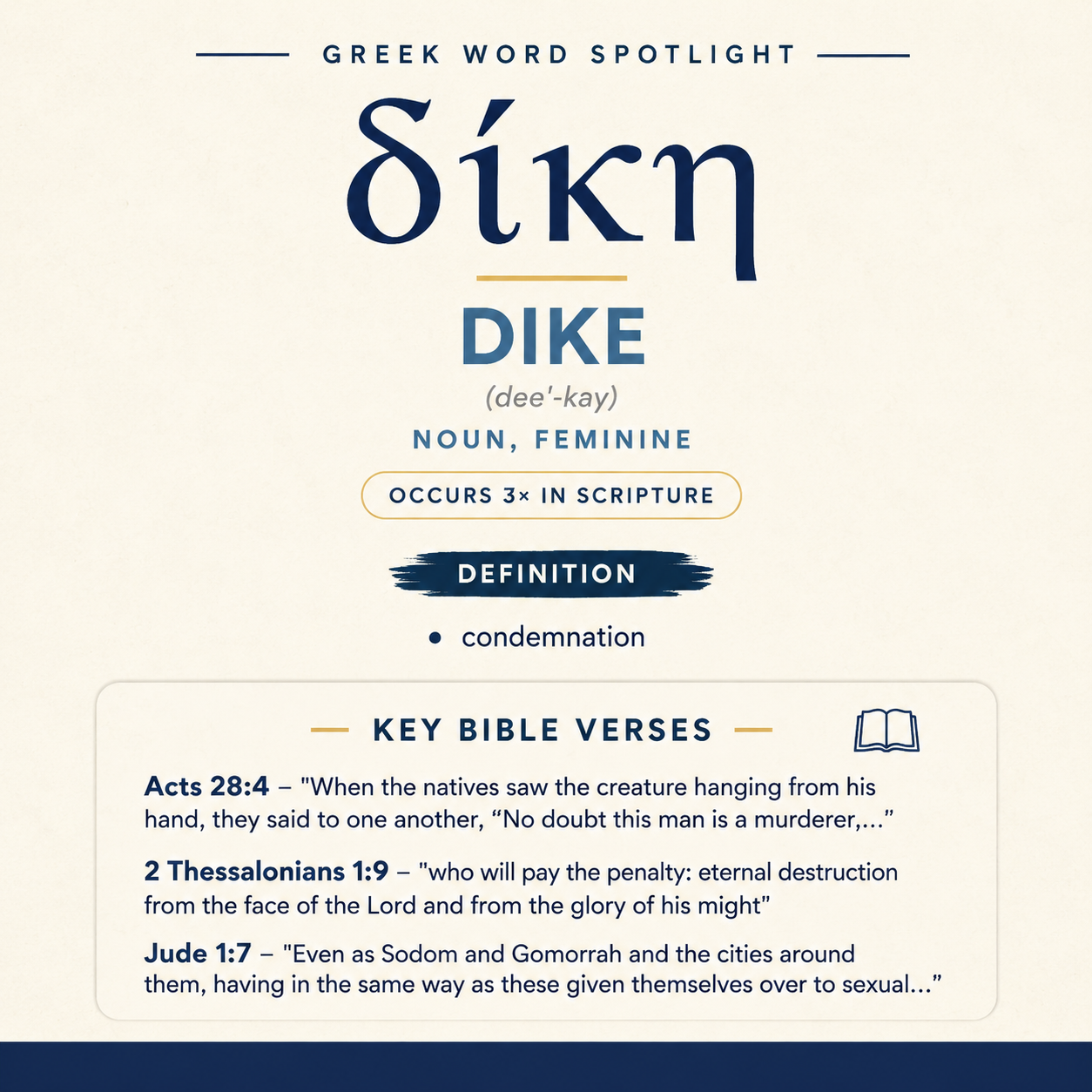
δίκη (Dike) means “condemnation” and occurs three times in Scripture: Acts 28:4, 2 Thessalonians 1:9, and Jude 1:7.
Where It Appears
This word occurs 3 times in Scripture. Its references are Acts 28:4, 2 Thessalonians 1:9, and Jude 1:7.
Learn More →In Context
In Acts 28:4, it appears in the natives’ judgment about the man’s guilt. In 2 Thessalonians 1:9 and Jude 1:7, it appears in penalty and judgment contexts.
Learn More →δίκη is used for “condemnation,” appearing in three New Testament passages where wrongdoing is pictured as meeting its deserved outcome. In narrative, it can be spoken of as an active force that does not let a guilty person go free; in teaching and warning, it names the penalty borne in final judgment.
Root and Related Words
Strong’s links δίκη with the verb deiknyō (δεικνύω, “to show,” Strong’s G1166). Within that relationship, δίκη stands as a noun set alongside a verb of “showing,” a pairing that fits contexts where guilt and its outcome are made evident.

Occurrences
“When the natives saw the creature hanging from his hand, they said to one another, “No doubt this man is a murderer, whom, though he has escaped from the sea, yet Justice has not allowed to live.”” (Acts 28:4)
Here δίκη is framed as “Justice” in the islanders’ interpretation of events. Their reasoning moves from what they see (“the creature hanging from his hand”) to a moral conclusion (“No doubt this man is a murderer”), and then to an expectation of a matching outcome: even if he “has escaped from the sea,” δίκη will still reach him and “has not allowed to live.” In this scene, δίκη functions as condemnation understood in popular, almost personified terms: not merely a verdict in a courtroom, but an enforcing reality that tracks a wrongdoer beyond one danger to another. The word helps the speakers connect crime and consequence into one tight chain—murder should lead to death—and it presents condemnation as something that can “allow” or “not allow,” that is, as something that determines whether a person continues living.
“who will pay the penalty: eternal destruction from the face of the Lord and from the glory of his might,” (2 Thessalonians 1:9)
In this statement, δίκη is rendered as “the penalty,” and its shape is explicitly retributive: it is something that can be “paid.” The verse places the word inside a solemn sentence of judgment, and the content of the penalty is specified as “eternal destruction,” described in relational terms as separation “from the face of the Lord” and “from the glory of his might.” The contribution of δίκη here is to name condemnation as owed payment with enduring consequences. The vocabulary of “penalty” sets the action in the realm of judicial outcome rather than mere misfortune: what happens is not accidental but due. The verse’s prepositional phrases sharpen the felt weight of the condemnation, not by adding a different sense to δίκη, but by spelling out what the penalty entails in this context—an unending ruin characterized by exclusion from the Lord’s presence and glory.
“Even as Sodom and Gomorrah and the cities around them, having in the same way as these given themselves over to sexual immorality and gone after strange flesh, are shown as an example, suffering the punishment of eternal fire.” (Jude 1:7)
Here δίκη appears as “the punishment,” attached to a well-known warning example. The verse gathers the cities into a moral portrait—“given themselves over to sexual immorality and gone after strange flesh”—and then states their didactic function: they “are shown as an example.” Within that framing, δίκη is the condemnation they endure: “suffering the punishment of eternal fire.” The word thus contributes to the warning by naming the consequence as punitive suffering, not simply a tragic end. The phrase “are shown as an example” gives the punishment public, illustrative force: condemnation is not only borne by the offenders but also stands as a displayed lesson. In the logic of the verse, behavior and outcome correspond, and δίκη is the term that gathers that outcome into a single judicial concept—punishment that demonstrates the seriousness of the wrongdoing described.
Sense and Usage
Across these three passages, δίκη consistently carries the force of condemnation as an outcome that follows wrongdoing, yet each setting highlights a different angle of how condemnation is experienced and spoken about.
In Acts 28:4, condemnation is expressed in ordinary speech as the islanders interpret a sudden danger. The event is immediate and visible: a creature is “hanging from his hand.” On the basis of that sight, they pronounce a hidden identity (“a murderer”) and then appeal to δίκη as a principle that ensures the guilty do not ultimately escape. Condemnation is thus imagined as tracking the person through changing circumstances—escape “from the sea” does not remove the reach of δίκη. The word supports a moral reading of providential-looking events: what happens to a person is taken as evidence of what that person deserves.
In 2 Thessalonians 1:9, condemnation is presented not as an inference from an accident but as a declared certainty: it is something that “will” be paid. δίκη fits naturally with the language of recompense (“pay the penalty”), emphasizing that condemnation is not merely a pronouncement but an imposed result. The description “eternal destruction” intensifies the weight of the penalty by duration (“eternal”) and by the kind of loss described (“destruction”). The additional phrases “from the face of the Lord” and “from the glory of his might” locate the experience of condemnation as separation from the divine presence and radiance. Within this usage, δίκη marks condemnation as ultimate and irreversible in effect, defined in the verse by what it excludes and what it removes.
In Jude 1:7, condemnation is connected to exemplar and display. The cities are “shown as an example,” and their state is “suffering.” This makes the condemnation both experiential (it is borne as suffering) and communicative (it teaches by being shown). The phrase “punishment of eternal fire” places the condemnation in a vivid register, portraying it as an enduring punitive reality. In this context, δίκη operates within a warning that ties moral departure (“sexual immorality,” “gone after strange flesh”) to a publicly instructive outcome. Condemnation here is not only what happens to the guilty; it is what is held up to shape the understanding of others.
Taken together, these occurrences show δίκη functioning as a judicially charged term: it can be spoken of as an enforcing “Justice” that refuses to let a supposed murderer live; it can be a “penalty” that is “paid”; and it can be “punishment” that is “suffered.” The common thread is the settledness of the outcome: δίκη is the kind of condemnation that comes with inevitability in the logic of the sentences. Whether voiced by outsiders drawing a quick conclusion, or by apostolic instruction describing final outcomes, the word carries the sense of consequence that fits wrongdoing, conceived not as mere cause-and-effect but as moral recompense.
Imagery in Context
The passages attach δίκη to striking pictures of condemnation. In Acts, the imagery is close and immediate: a dangerous creature clinging to a hand becomes a sign that “Justice has not allowed to live” (Acts 28:4). In 2 Thessalonians, the picture is vast and solemn: a penalty described as “eternal destruction from the face of the Lord and from the glory of his might” (2 Thessalonians 1:9). In Jude, the image is public and cautionary: whole cities “are shown as an example,” visibly “suffering the punishment of eternal fire” (Jude 1:7). Together these scenes portray condemnation as something that can be inferred from an event, imposed as a due payment, and displayed as a lasting warning.
Sources: Lexical data from Strong’s Exhaustive Concordance and the Translators Brief Lexicon of Extended Strongs for Greek (STEPBible, CC BY). Occurrence data from the Translators Amalgamated Greek New Testament (STEPBible, CC BY). Scripture quotations from the World English Bible (public domain).