
Exploring the Meaning of Diatarasso in Greek
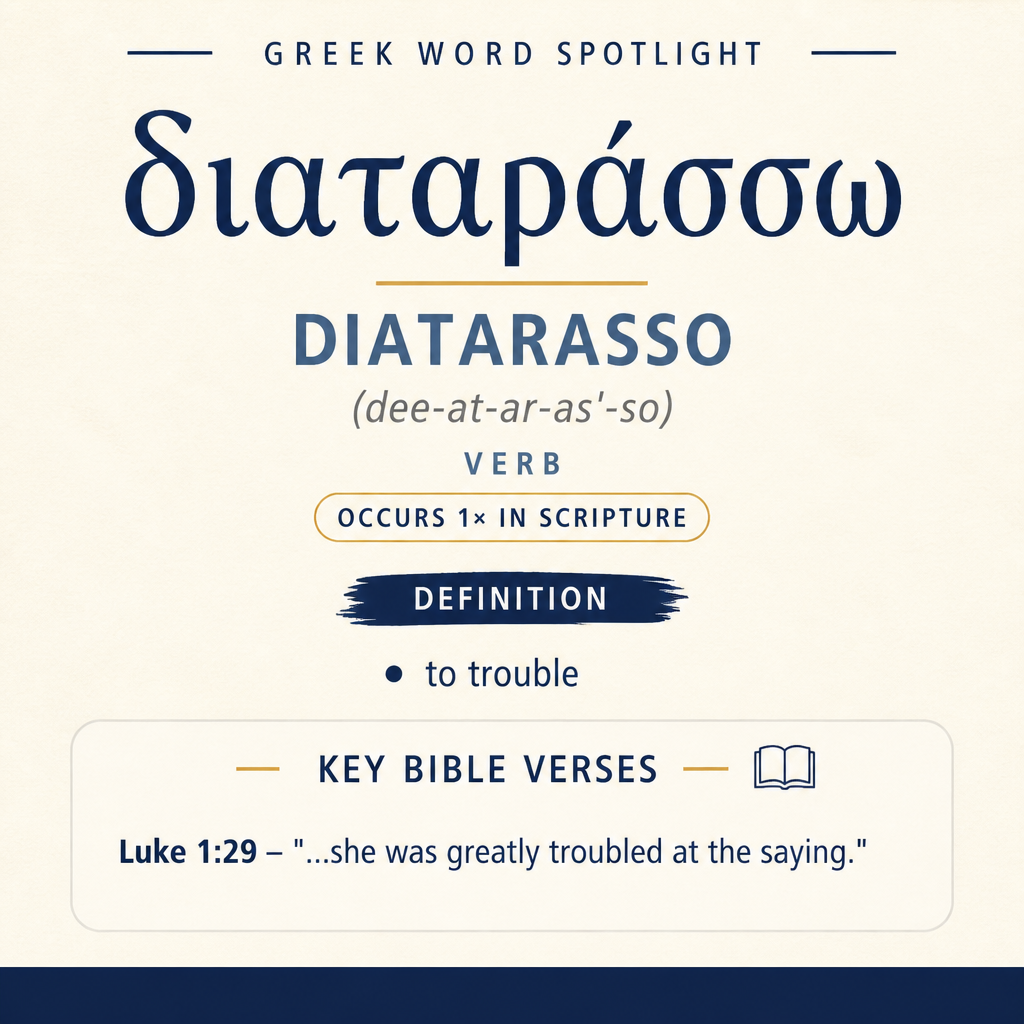
διαταράσσω means “to trouble” and appears once in Scripture, in Luke 1:29.
Scripture Occurrence
This verb occurs 1 time in Scripture. Its single occurrence is in Luke 1:29.
Learn More →Luke 1:29 Context
In Luke 1:29, Mary “was greatly troubled at the saying.” She considered what kind of salutation it might be.
Learn More →διαταράσσω means “to trouble,” and it appears in the account of Mary’s encounter with an angelic messenger in Luke 1:29. In that scene it describes her immediate reaction to what she has just heard.
Root and Related Words
διαταράσσω (Diatarasso) is related to διά (dia), “through/because of” (Strong’s G1223), and ταράσσω (tarasso), “to trouble” (Strong’s G5015). The compound form foregrounds the idea of trouble as something arising in connection with a cause and pressing through the person’s inner life, rather than remaining a detached observation.

Occurrences
“But when she saw him, she was greatly troubled at the saying, and considered what kind of salutation this might be.” (Luke 1:29)
In Luke 1:29, the verb is tied to two closely linked features of Mary’s response: she is “greatly troubled,” and she “considered” the meaning of what she had heard. The troubling is explicitly connected “at the saying,” so the disturbance is not described as a vague unease or a general fear of the visitor; it is a reaction directed toward the content and force of the greeting itself. The narration places her internal disturbance right alongside reflective thought: she does not merely recoil, but turns the greeting over in her mind, “consider[ing] what kind of salutation this might be.”

The wording also frames the troubling as a marked intensification—“greatly troubled”—which portrays the reaction as strong enough to be noticed and narrated as the decisive first effect of the encounter. At the same time, Luke presents this troubling as compatible with deliberate discernment. The scene is built in a sequence: she sees him, she is troubled at the saying, and she considers its character. The verb therefore helps paint the greeting as something that interrupts normal composure and prompts serious evaluation of the message’s nature.
Sense and Usage
The sense “to trouble” in this passage functions as the language of inward disturbance triggered by an encountered word. Luke 1:29 anchors the troubling in a specific stimulus (“the saying”) and then immediately shows the mind at work (“considered what kind of salutation this might be”). The verb thus marks a response that is both affective and cognitive: the greeting unsettles, and the unsettlement leads to interpretation.
Because the action is described in connection with a “salutation,” the trouble is not portrayed as arising from physical harm or an external threat described in the text, but from the weight and oddity of the address itself. In ordinary circumstances a greeting is socially clarifying, telling a person where they stand; here, however, the salutation is precisely what destabilizes. The verb contributes that reversal: the spoken greeting becomes the occasion of inner upheaval, and the narrative slows to show Mary trying to grasp “what kind” of greeting it is—what sort of address, what its intent might be, what it implies about the speaker and the one spoken to.
The placement of the verb within the sentence further colors the action. The troubling comes immediately after “when she saw him,” yet the narrator specifies it is “at the saying.” The encounter is therefore mediated through speech: the troubling is bound to the message as heard. This makes the verb especially suited to scenes where words land with unexpected force—where what is said does not simply inform but disturbs equilibrium. In Luke 1:29, that disturbance does not cancel thought; it accompanies and even occasions it, as Mary’s consideration follows directly in the same breath of narration.
The adverbial intensifier “greatly” frames the troubling as substantial. It is not a passing startle but a pronounced internal agitation that calls for attention. Yet the same sentence shows restraint: Mary’s response is not described as outward panic; it is narrated as inward trouble coupled with reasoning. The verb therefore helps express a kind of troubled composure—an unsettled heart and mind that nevertheless engages the situation by weighing the salutation’s character.
Imagery
Luke 1:29 attaches the imagery of troubling to speech that enters a person’s awareness and unsettles it. The scene is quiet and concentrated: a greeting is spoken, and its effect is portrayed as an inward disturbance that ripples into careful pondering. The verb gives language to that moment when words do more than communicate; they disturb the listener’s settled frame of reference and compel the question, “what kind” of word has just been spoken.
Sources: Lexical data from Strong’s Exhaustive Concordance and the Translators Brief Lexicon of Extended Strongs for Greek (STEPBible, CC BY). Occurrence data from the Translators Amalgamated Greek New Testament (STEPBible, CC BY). Scripture quotations from the World English Bible (public domain).




