
Exploring the Meaning of Diakrino in Greek
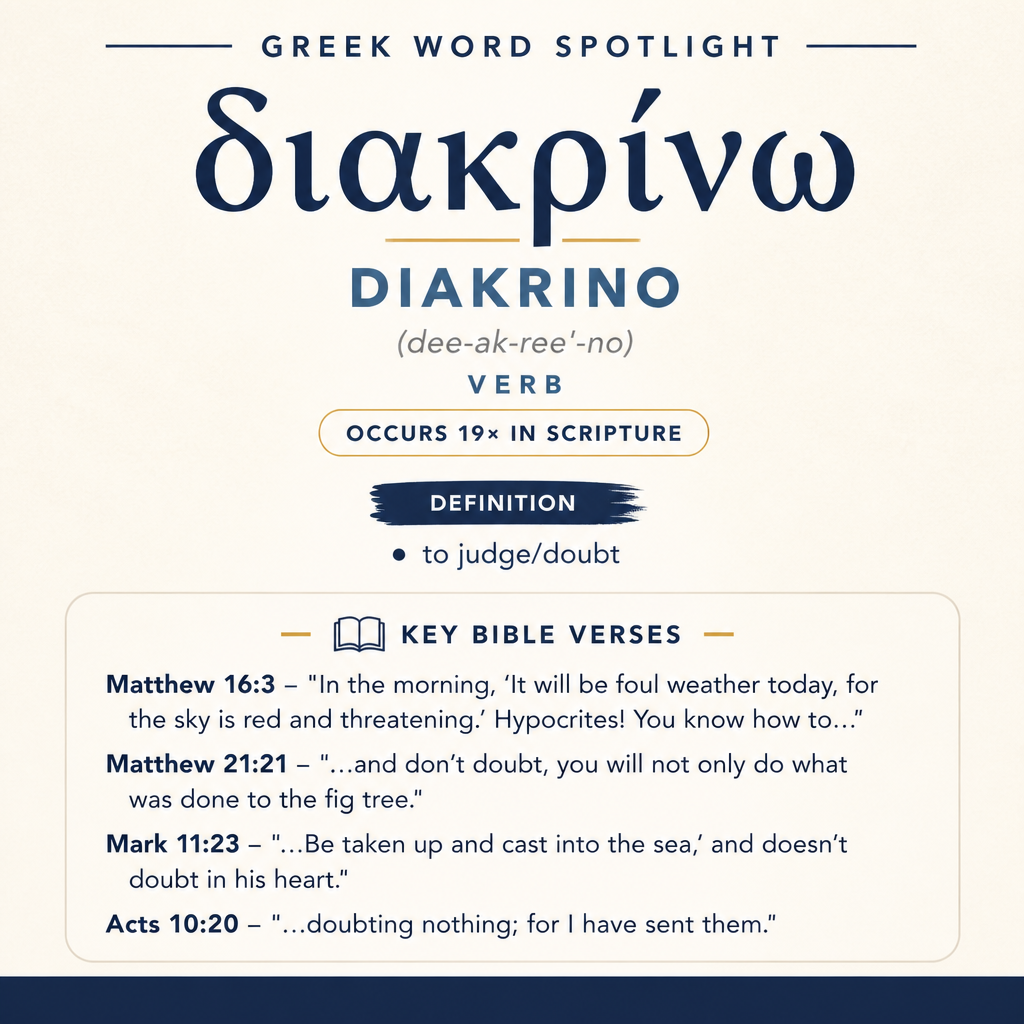
διακρίνω means to judge/doubt and appears 19 times in Scripture, including Matthew 16:3, Matthew 21:21, Mark 11:23, Acts 10–15, and Romans 4:20.
Core Meaning
διακρίνω is defined as “to judge/doubt.” In Scripture it can express discerning, doubting, or making distinctions.
Learn More →Gospel Usage
In Matthew 16:3 it is used of discerning the weather. In Matthew 21:21 and Mark 11:23 it is contrasted with faith: “don’t doubt.”
Learn More →Acts and Romans
In Acts 10:20 Peter is told to go “doubting nothing,” and Acts 11:12 uses it for going “without discriminating.” Romans 4:20 says Abraham “didn’t waver through unbelief.”
Learn More →διακρίνω expresses “to judge/doubt,” appearing in scenes where people assess signs, make decisions, draw distinctions, or struggle with wavering. Across the passages below, it sits at the intersection of discernment and inner hesitation, showing how judgment can be either clear-sighted or unsettled.
Occurrences
Matthew 16:3: “In the morning, ‘It will be foul weather today, for the sky is red and threatening.’ Hypocrites! You know how to discern the appearance of the sky, but you can’t discern the signs of the times!”
Here διακρίνω functions in the realm of perception and evaluation. The hearers are portrayed as competent at judging what the sky’s appearance implies (“foul weather”), yet incompetent at judging “the signs of the times.” The contrast makes discernment a moral and spiritual failing, not merely a lack of information: they can assess visible cues but misjudge what matters most in the moment.
Matthew 21:21: “Jesus answered them, “Most certainly I tell you, if you have faith, and don’t doubt, you will not only do what was done to the fig tree, but even if you told this mountain, ‘Be taken up and cast into the sea,’ it would be done.”
In this saying, διακρίνω is cast as doubt that undermines effective faith. The condition “have faith, and don’t doubt” frames doubt as an inner counter-force that can cancel the confidence needed for the extraordinary commands described. The statement ties the absence of doubt to decisive, outcome-bearing speech (“you told this mountain … it would be done”).
Mark 11:23: “For most certainly I tell you, whoever may tell this mountain, ‘Be taken up and cast into the sea,’ and doesn’t doubt in his heart, but believes that what he says is happening; he shall have whatever he says.”
This occurrence tightens the focus: doubt is located “in his heart,” while belief accompanies speech that is treated as already in motion (“believes that what he says is happening”). διακρίνω here marks the internal hesitation that would fracture belief and thus destabilize the described certainty of outcome.
Acts 10:20: “But arise, get down, and go with them, doubting nothing; for I have sent them.”
διακρίνω is paired with immediate action. The command “go with them” is strengthened by “doubting nothing,” so the verb expresses the kind of hesitation that could delay obedience or cause second-guessing. The reason given—“for I have sent them”—positions the absence of doubt as the fitting response to a clear divine directive.
Acts 11:2: “When Peter had come up to Jerusalem, those who were of the circumcision contended with him,”
Although the verb itself is not visible in this English sentence, the scene supplies the social pressure in which διακρίνω-related issues play out: contention over boundaries and decisions. The conflict described (“contended with him”) sets up a context where judgments about association and procedure will be contested, and where discriminatory judgment can become a community flashpoint.
Acts 11:12: “The Spirit told me to go with them, without discriminating. These six brothers also accompanied me, and we entered into the man’s house.”
Here διακρίνω leans into judging by making distinctions between people. “Without discriminating” depicts a deliberate refusal to separate or rank potential companions, and it is anchored in “The Spirit told me to go with them.” The narrative result is communal and concrete: “we entered into the man’s house,” an action that would naturally invite scrutiny if distinctions were being enforced.
Acts 15:9: “He made no distinction between us and them, cleansing their hearts by faith.”
In this doctrinal summary, διακρίνω is about boundary-making—“distinction between us and them.” The statement denies such a division, grounding the unity in a shared cleansing “by faith.” The verb thus aligns judging/deciding with community inclusion: the decisive judgment reported here is that no separating line is to be drawn.
Romans 4:20: “Yet, looking to the promise of God, he didn’t waver through unbelief, but grew strong through faith, giving glory to God,”
διακρίνω is portrayed as wavering that would spring from “unbelief.” The contrast is not between thinking and not thinking, but between unsettledness and steadiness: instead of wavering, the subject “grew strong through faith.” The verb’s contribution is to depict unbelief as a destabilizing inner movement that faith overcomes.
Romans 14:23: “But he who doubts is condemned if he eats, because it isn’t of faith; and whatever is not of faith is sin.”
Here διακρίνω is a state of doubt that renders an ordinary act (“eats”) morally culpable for that person. The logic is explicitly internal: the issue is not the food itself but that the action “isn’t of faith.” The verb captures the divided or uncertain judgment that prevents the eater from acting with settled confidence, and that very uncertainty becomes condemnation.
1 Corinthians 4:7: “For who makes you different? And what do you have that you didn’t receive? But if you did receive it, why do you boast as if you had not received it?”
Even without the verb’s English visibility, the questions revolve around difference-making (“who makes you different?”). The rhetoric challenges the basis on which distinctions are claimed, especially distinctions that become grounds for boasting. In this setting, διακρίνω belongs to the sphere of judging oneself as set apart in a way that ignores reception and dependence.
1 Corinthians 6:5: “I say this to move you to shame. Isn’t there even one wise man among you who would be able to decide between his brothers?”
Here διακρίνω is explicitly judicial in community life: the ability “to decide between his brothers.” The verse assumes that disputes require a discerning judgment, and it shames the community for lacking someone capable of such deciding. The verb’s force is practical and communal: sound judgment prevents relational breakdown by rendering decisions within the brotherhood.
1 Corinthians 11:29: “For he who eats and drinks in an unworthy way eats and drinks judgment to himself if he doesn’t discern the Lord’s body.”
διακρίνω appears as the discernment necessary for proper participation. Failure “to discern the Lord’s body” results in “judgment to himself,” linking discernment with accountability. The verse portrays discernment not as a luxury but as a requirement whose absence has serious consequences.

Sense and Usage
Across these contexts, διακρίνω moves along a coherent line between judging clearly and being pulled into doubt. In Matthew 16:3, the verb operates as competent discernment of visible evidence; the critique is that such judgment can be selectively applied—sharp with weather signs, dull with “the signs of the times.” This exposes an evaluative faculty that is not merely intellectual but also responsive (or unresponsive) to what one is willing to face.
In Matthew 21:21 and Mark 11:23, the verb shifts from outward discernment to inward instability. Doubt is not depicted as cautious humility; it is a heart-level wavering that disrupts the alignment of faith, speech, and expected outcome. The repeated mountain imagery sets doubt against bold, directive confidence: the difference between a command that “would be done” and one that fails lies in whether the heart becomes divided.
Acts places διακρίνω into the social fabric of the early community. “Doubting nothing” (Acts 10:20) shows hesitation as a barrier to obedience when a directive is clear. Immediately after, the conflict of Acts 11:2 frames the pressure around contested decisions. When Peter recounts acting “without discriminating” (Acts 11:12), διακρίνω expresses the impulse to sort people into acceptable and unacceptable categories; the narrative commends the refusal to do so in that moment. Acts 15:9 then broadens the same idea into a settled communal judgment: “no distinction between us and them,” grounded in cleansing “by faith.” In these passages, the verb touches both private hesitation and public boundary-making—two different ways judgment can fracture fellowship.
Romans brings the verb into the arena of conscience and promise. In Romans 4:20, wavering through unbelief is set against strengthening through faith; the inner posture toward “the promise of God” determines whether judgment becomes unstable. Romans 14:23 applies the same dynamic to daily practice: doubting turns a routine act into condemnation because the act is detached from faith. Here διακρίνω highlights that moral failure can arise not only from what is done, but from doing it while internally unconvinced.
In 1 Corinthians, διακρίνω addresses both status and decision-making. The probing questions of 1 Corinthians 4:7 challenge difference-making that supports boasting, pushing the community to judge distinctions more honestly in light of receiving. In 1 Corinthians 6:5, the verb is needed for adjudicating disputes—discernment as practical wisdom. Finally, 1 Corinthians 11:29 places discernment at the heart of worship practice: failure to discern results in self-incurred judgment. Taken together, these uses portray διακρίνω as the faculty by which a community evaluates, distinguishes, and decides—either in a way that steadies faith and unity, or in a way that yields doubt, division, and judgment.
Imagery in Context
The passages attach διακρίνω to vivid scenes: reading the sky’s redness, speaking to a mountain, stepping into a house with companions, and eating and drinking with discernment. These concrete settings keep “judge/doubt” from becoming abstract: discernment is portrayed as something exercised in weather-watching, obedience, community boundaries, courtroom-like decisions, and table fellowship—moments where an inner judgment becomes visible in what one does.
Sources: Lexical data from Strong’s Exhaustive Concordance and the Translators Brief Lexicon of Extended Strongs for Greek (STEPBible, CC BY). Occurrence data from the Translators Amalgamated Greek New Testament (STEPBible, CC BY). Scripture quotations from the World English Bible (public domain).




