
Exploring the Meaning of Diairesis in Greek
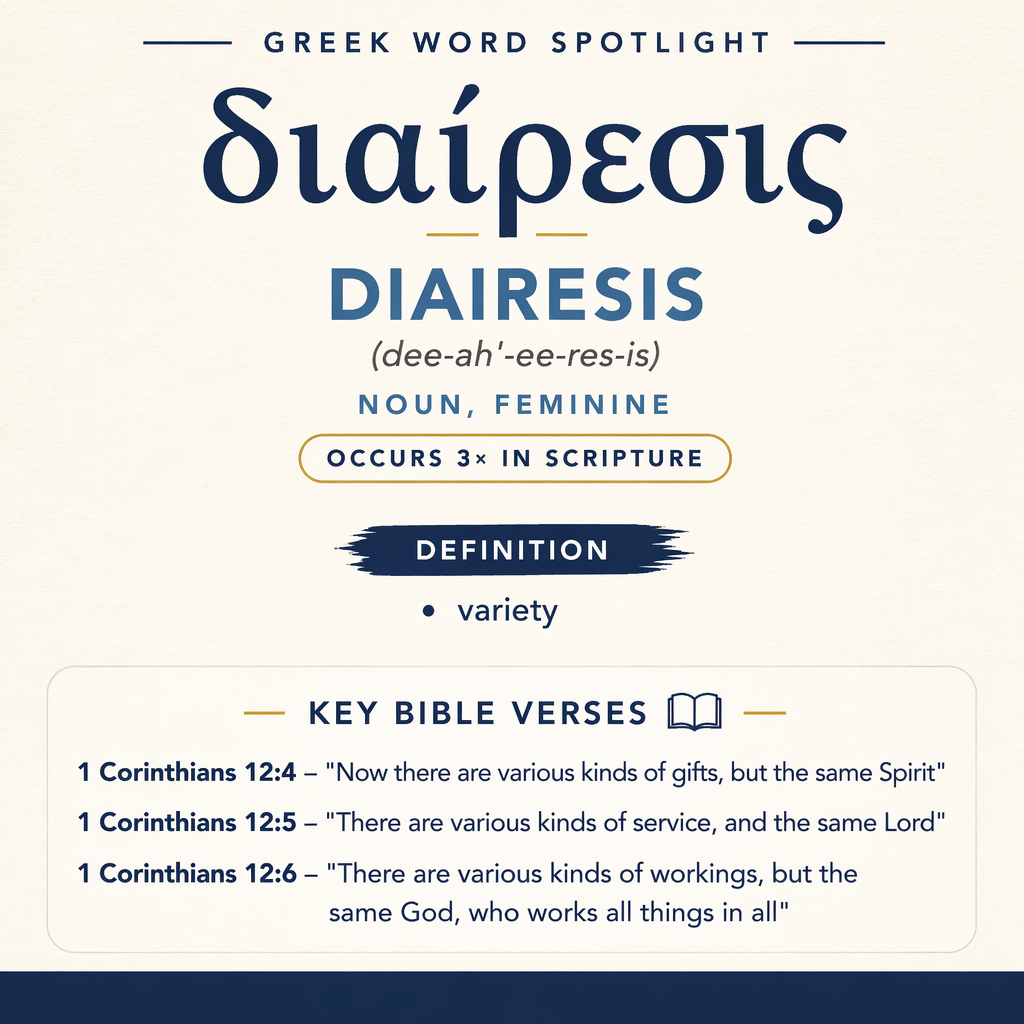
διαίρεσις means “variety” and appears three times in Scripture, in 1 Corinthians 12:4–6.
Context in 1 Corinthians
In these verses it describes various kinds of gifts, service, and workings, alongside the same Spirit, Lord, and God.
Learn More →διαίρεσις describes “variety” in Paul’s concentrated opening to his teaching on spiritual gifts. In 1 Corinthians 12:4–6 it frames a triad—gifts, service, and workings—so that difference is affirmed while unity is anchored in the Spirit, the Lord, and God.
Root and Related Words
διαίρεσις is related to the verb diaireō (διαιρέω), “to distribute” (Strong’s G1244). This connection places διαίρεσις in a word-family that naturally suits contexts where multiple items or expressions are present and considered in relation to one source or organizing agent.

Occurrences
“Now there are various kinds of gifts, but the same Spirit.” (1 Corinthians 12:4)
Here διαίρεσις marks the reality of difference within “gifts.” The sentence is built to hold two truths together: on the one hand, gifts are not uniform; on the other, the Spirit is “the same.” διαίρεσις therefore contributes a controlled acknowledgment of multiplicity, not as a problem to be solved, but as a feature of the community’s life that can be named without threatening spiritual unity. In this first line the contrast is crisp: “various kinds” stands opposite “the same Spirit,” so the word helps Paul open with a principle—diversity in expression can coexist with oneness in source.
“There are various kinds of service, and the same Lord.” (1 Corinthians 12:5)
In the second occurrence, διαίρεσις is applied to “service.” The move from “gifts” to “service” shifts attention from what is received or possessed to what is done. By using the same wording pattern, Paul sets variety within the sphere of ministry activity: service may take distinct forms, yet it is tethered to “the same Lord.” διαίρεσις thus contributes a way of speaking about difference in roles and tasks without fragmenting allegiance. The verse’s parallel structure makes the word function almost like a hinge: it keeps “service” open to multiple expressions while fastening the entire range of service to a single Lordship.
“There are various kinds of workings, but the same God, who works all things in all.” (1 Corinthians 12:6)
In the third instance, διαίρεσις qualifies “workings.” The term “workings” places emphasis on effects and operations—what is brought about—rather than on the gifts themselves or the acts of service. Within the sentence, variety is again paired with divine sameness, now intensified by the clause, “who works all things in all.” διαίρεσις contributes to a portrait in which different operations occur, yet none are outside the scope of the one God’s active working. The statement presses the reader to see variety not merely as a collection of separate items, but as a field of activity encompassed by a single divine worker whose action reaches “all things” and “in all.” The word therefore helps the verse hold together plurality of workings and comprehensiveness of God’s working.
Sense and Usage
Across these three tightly-linked lines, διαίρεσις functions as a repeated marker of “variety” in three domains: gifts, service, and workings. The repetition is not redundant; it builds a layered account of how difference appears in the life of the community. First, variety is present in what is given (“gifts”); second, in what is carried out (“service”); third, in what is effected (“workings”). The word’s placement at the head of each sentence makes “variety” the starting point of each assertion, but each sentence immediately counters any inference that variety implies competing sources. Instead, the same Spirit, the same Lord, and the same God are set as the unifying referent for the full range of expressions.
Because διαίρεσις is attached to a plural category each time (“gifts,” “service,” “workings”), it does not point to a single exceptional instance but to a pattern: there are multiple kinds within a shared class. The verses also show that variety is not isolated to one layer of experience. It is not only that people possess different gifts; the actual forms of service differ, and the workings themselves differ. διαίρεσις thus supports a comprehensive view of differentiated activity in the church’s life, with each sphere named explicitly and treated as legitimate.
At the same time, διαίρεσις is consistently balanced by sameness language: “the same Spirit,” “the same Lord,” “the same God.” This balance gives the word a stabilizing role in Paul’s rhetoric. The word acknowledges real distinctions, yet its immediate pairing with divine unity prevents those distinctions from becoming grounds for rivalry or division. In these verses, “variety” is not contrasted with “unity” as opposites; rather, variety is set within unity, and unity is described in personal terms—Spirit, Lord, God—rather than as a mere principle. The result is that διαίρεσις becomes a way to speak about difference while keeping the focus on the one divine agency behind the whole range.
The third line adds a final interpretive frame: “the same God, who works all things in all.” In that statement, the variety of “workings” is not merely tolerated; it is gathered under an overarching divine action. The effect is to portray variety as something that can exist under a single comprehensive working—“all things in all.” Within this triad, διαίρεσις therefore contributes to a view of church life where multiplicity of expressions is compatible with, and even situated within, unified divine activity.
Imagery
The imagery carried by διαίρεσις in these verses is that of a single source giving rise to many expressions. Paul’s phrasing evokes a scene in which different kinds of gifts, different kinds of service, and different kinds of workings can all be traced back to one Spirit, one Lord, and one God. “Variety” is thus pictured not as scattered independence, but as a coordinated range of manifestations held together by the sameness of the divine giver, ruler, and worker.
Sources: Lexical data from Strong’s Exhaustive Concordance and the Translators Brief Lexicon of Extended Strongs for Greek (STEPBible, CC BY). Occurrence data from the Translators Amalgamated Greek New Testament (STEPBible, CC BY). Scripture quotations from the World English Bible (public domain).





