Understanding the Meaning of Diadechomai in Greek
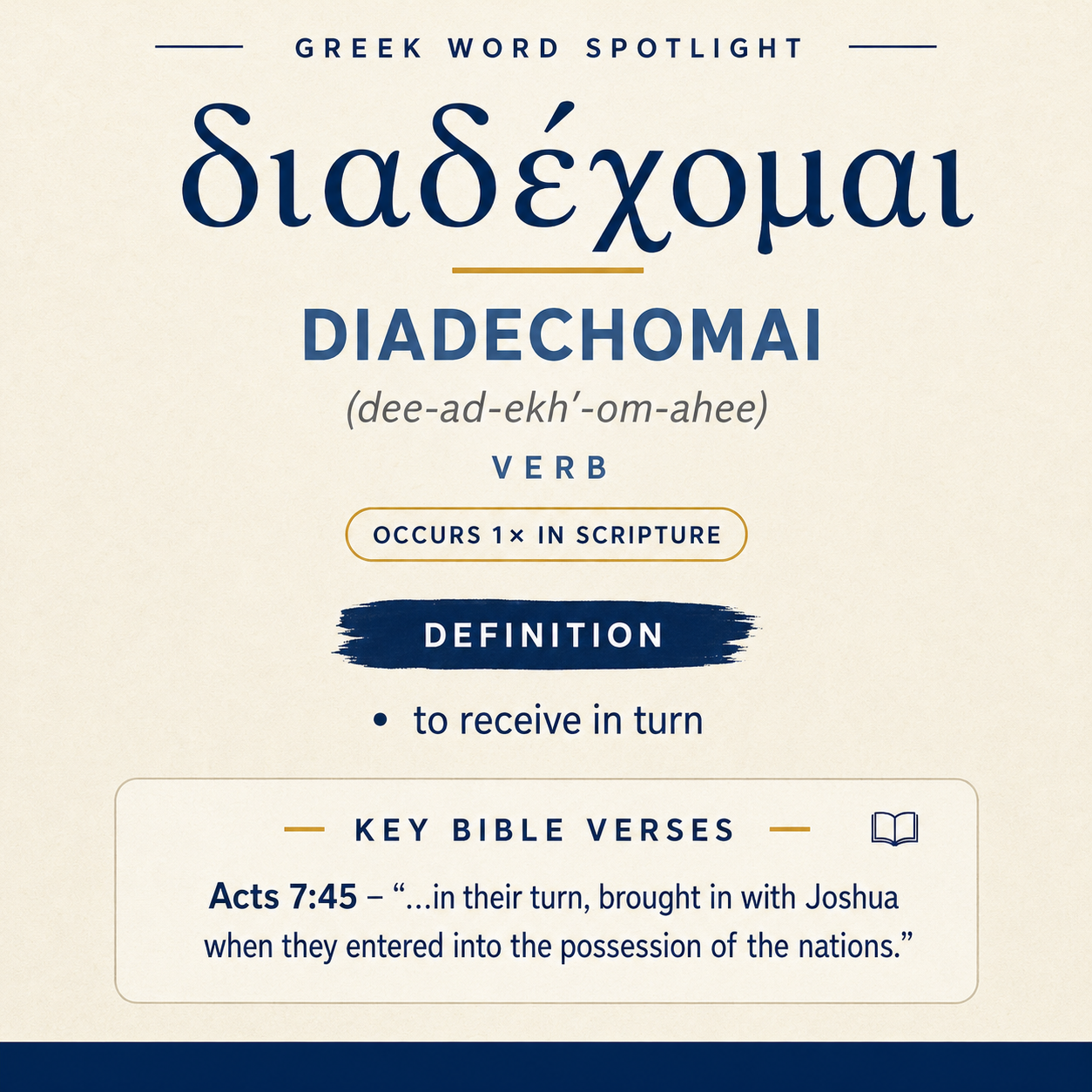
διαδέχομαι means “to receive in turn” and appears once in Scripture, in Acts 7:45.
Scripture Occurrence
It occurs 1 time in Scripture. The single occurrence is in Acts 7:45.
Learn More →Context in Acts
In Acts 7:45, it describes the fathers bringing something in “in their turn” with Joshua into the possession of the nations.
Learn More →διαδέχομαι means “to receive in turn.” It appears once in the New Testament, in Stephen’s speech where he recounts Israel’s history of receiving and carrying forward what earlier generations had possessed.
Root and Related Words
διαδέχομαι is related to δέχομαι (dechomai), “to receive” (Strong’s G1209), and to διά (dia), “through/because of” (Strong’s G1223). Together these relationships frame the verb’s idea of receiving with a sense of movement through a sequence, suited to contexts where something passes from one party to another across time or stages.

Occurrences
“which also our fathers, in their turn, brought in with Joshua when they entered into the possession of the nations, whom God drove out before the face of our fathers, to the days of David,” (Acts 7:45)
In Acts 7:45, the verb functions inside a compressed narrative of succession. Stephen speaks of “our fathers” and marks their action “in their turn,” placing them within a relay of stewardship: what one generation had, the next generation received and carried forward. The clause “brought in with Joshua” ties this reception to a concrete historical movement—entry into “the possession of the nations.” The language is not merely about acquiring something once; it depicts a transfer that happens as the story progresses, where one group receives and then, as the narrative continues, bears the responsibility of bringing it onward.
The surrounding phrases sharpen how “receive in turn” fits the scene. The fathers are pictured acting after others, not independently: they “brought in” what they had received, and they did so “when they entered into the possession of the nations.” The possession is described as belonging to “the nations” until God “drove out” those peoples “before the face of our fathers.” Within that flow, διαδέχομαι contributes the idea of an inherited receipt—something coming into the fathers’ hands as the next stage in an unfolding sequence, enabling their subsequent action of bringing it in alongside Joshua. The verse then stretches the timeline “to the days of David,” extending the horizon beyond the initial entry; this wider span reinforces that Stephen is describing continuity across generations, where receiving “in turn” is a key mechanism by which the story advances.
Sense and Usage
The definition “to receive in turn” emphasizes reception marked by sequence. In Acts 7:45, the sequence is explicit: “our fathers, in their turn.” The verb does not stand alone as a general statement of receipt; it is embedded in generational language (“our fathers”) and historical progression (Joshua, entry, dispossession of the nations, and an endpoint “to the days of David”). This setting shows that the “turn” is not an abstract cycle but an ordered handoff across time, where later participants receive what earlier participants held.
The verse also shows that this kind of receiving is oriented toward further movement. The fathers “brought in” what they had received; reception is paired with transport and introduction into a new setting. The narrative thus presents “receiving in turn” as the gateway to continued custody: what is received becomes what is carried, and what is carried becomes part of a longer historical trajectory. The phrase “with Joshua” places the fathers’ action under a recognized leader in the story, suggesting coordinated transition: the reception “in turn” is not accidental but occurs within the community’s shared passage into possession.
Finally, the verse’s broad sweep—from entry under Joshua to “the days of David”—lets the word’s sense resonate with the theme of continuity. The verb’s contribution is to mark that the fathers stand within a chain: they are neither the first to have the item in view nor the last to be connected to it. The meaning “receive in turn” fits this chain-like portrayal, where each stage of the people’s history involves receiving and then carrying forward what has come to them in sequence.
Imagery
Acts 7:45 attaches the verb to the image of a people on the move, receiving something and then “bringing [it] in” as they enter a land. The word’s “in turn” quality evokes a relay across generations: hands receiving, then bearing, then passing the story forward within the same unfolding journey “to the days of David.”
Sources: Lexical data from Strong’s Exhaustive Concordance and the Translators Brief Lexicon of Extended Strongs for Greek (STEPBible, CC BY). Occurrence data from the Translators Amalgamated Greek New Testament (STEPBible, CC BY). Scripture quotations from the World English Bible (public domain).