Understanding the Significance of Diabaino in Greek
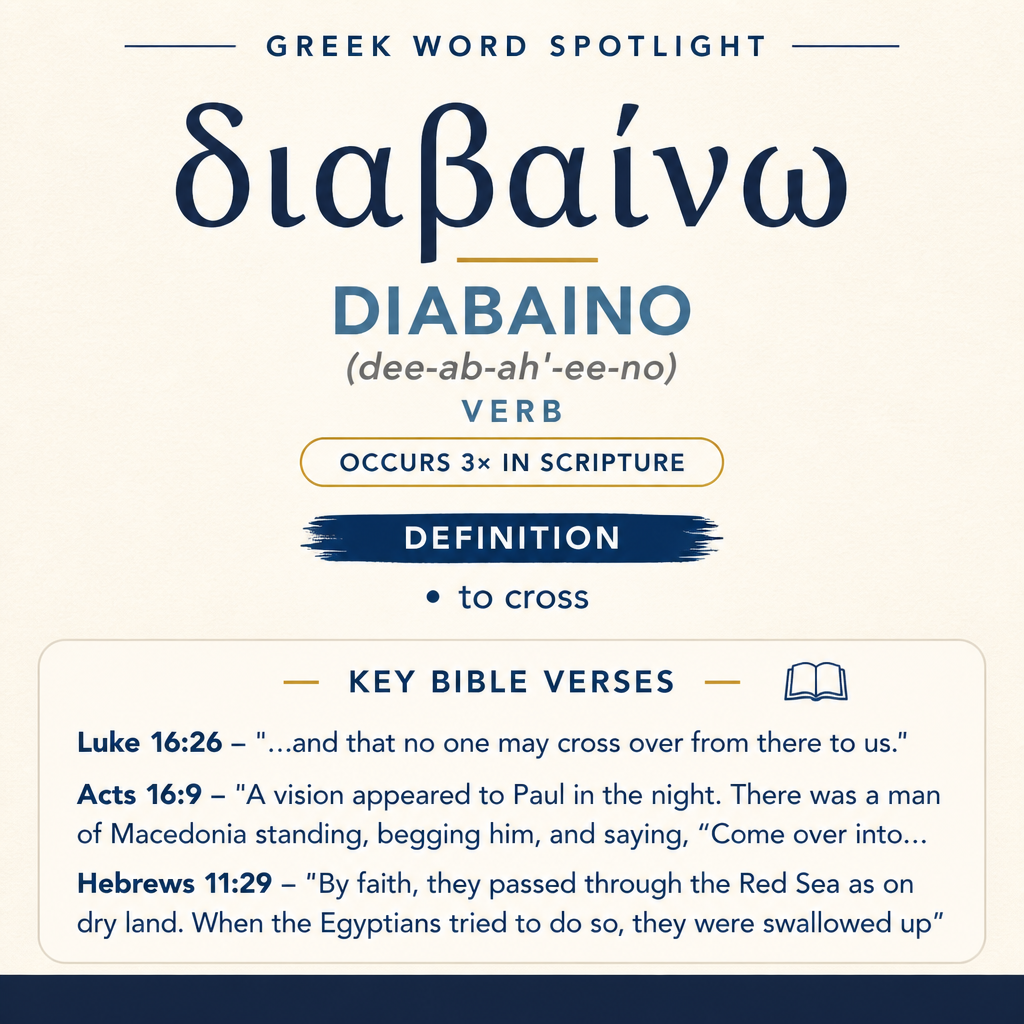
διαβαίνω means “to cross” and occurs three times in Scripture: Luke 16:26, Acts 16:9, and Hebrews 11:29.
Core Meaning
διαβαίνω is defined as “to cross.” It describes movement from one place to another.
Learn More →Where It Appears
This word occurs three times in Scripture. The references are Luke 16:26, Acts 16:9, and Hebrews 11:29.
Learn More →Verse Snapshots
Luke 16:26 uses it for wanting to “pass” across a fixed gulf; Acts 16:9 for “come over” into Macedonia; Hebrews 11:29 for passing through the Red Sea.
Learn More →διαβαίνω describes the act of crossing from one side to another. It appears in scenes that stress either an impossible crossing between separated parties, an urgent appeal to come across to a new region, or a decisive passage through a body of water.
Root and Related Words
διαβαίνω is connected with dia (διά), “through/because of” (Strong’s G1223), and basis (βάσις), “foot” (Strong’s G939). Together these related elements picture movement “through” by means of stepping.
Occurrences
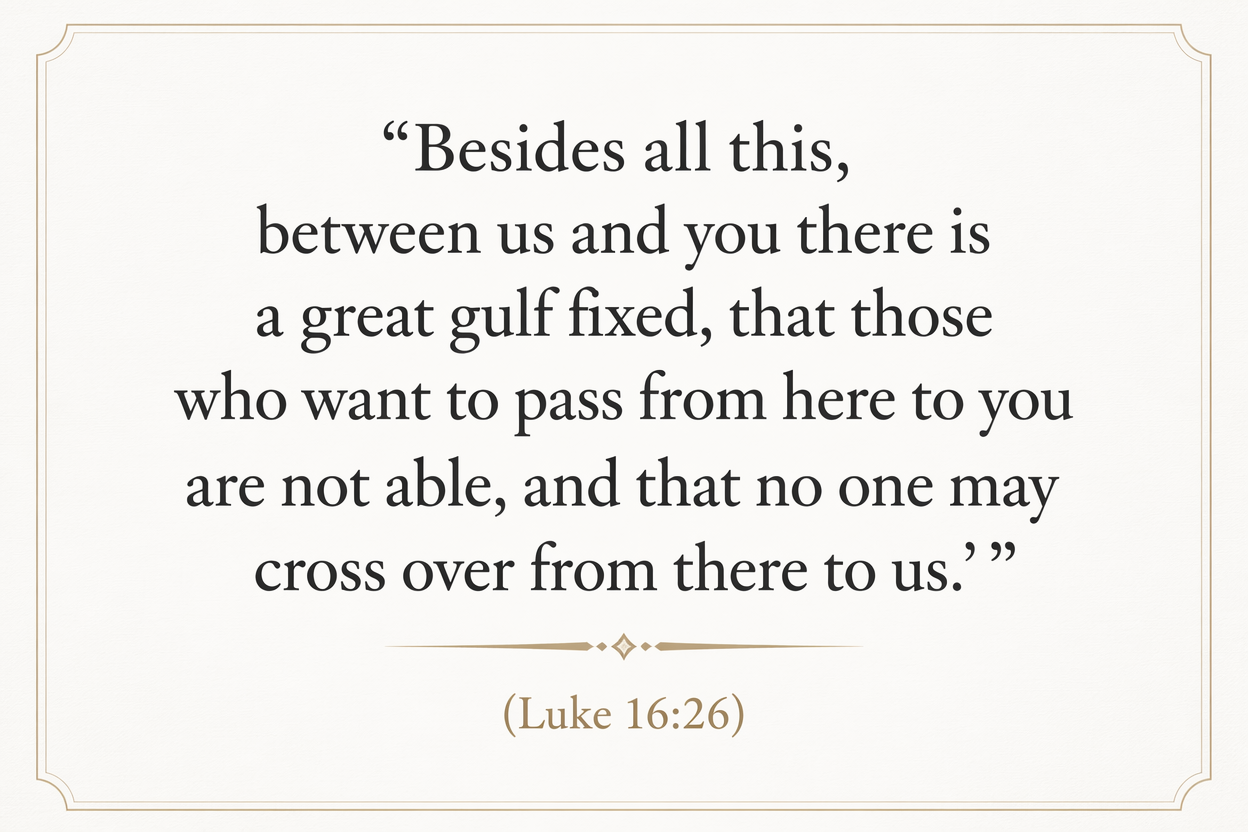
“Besides all this, between us and you there is a great gulf fixed, that those who want to pass from here to you are not able, and that no one may cross over from there to us.’” (Luke 16:26)
Here διαβαίνω is placed in the mouth of a speaker who points to a “great gulf fixed” that stands “between us and you.” The word expresses the desire for movement across that divide (“those who want to pass from here to you”) but immediately frames that movement as blocked (“are not able”). The second clause reinforces the same barrier from the opposite direction: “no one may cross over from there to us.” The verb therefore serves Luke’s depiction of two sides separated by an unbridgeable interval: crossing is conceived clearly enough to be desired, but the scene insists it cannot be carried out in either direction.
“A vision appeared to Paul in the night. There was a man of Macedonia standing, begging him, and saying, “Come over into Macedonia and help us.”” (Acts 16:9)
In Acts, διαβαίνω sits inside a direct appeal: “Come over into Macedonia and help us.” The verb gives the request a concrete, directional force: the help sought is not only moral support at a distance but assistance that involves changing location—crossing into a named place. The setting adds urgency (“begging him”), and the word makes that urgency practical: the plea calls for action that moves Paul from where he is to “into Macedonia.” The scene does not describe the route, boundary, or obstacle; the verb itself supplies the basic idea of crossing into a new area as the necessary first step toward providing help.
“By faith, they passed through the Red Sea as on dry land. When the Egyptians tried to do so, they were swallowed up.” (Hebrews 11:29)
Hebrews uses διαβαίνω for a dramatic, large-scale crossing: “they passed through the Red Sea as on dry land.” The clause ties the crossing to a particular manner of movement—“as on dry land”—so that the act of crossing is presented as a successful transit where such transit would ordinarily be threatened by water. The following line sets up a contrast: “When the Egyptians tried to do so, they were swallowed up.” The same kind of movement is attempted (“to do so”), yet the outcome differs sharply. In this verse, the verb highlights both the reality of the crossing itself and the difference between a completed passage and an attempted one, with the sea becoming the decisive boundary that either yields a way across or overwhelms those who enter it.
Sense and Usage
Across these passages, “to cross” is used with several kinds of boundaries, each shaping how the crossing is understood.
In Luke 16:26, the boundary is a “great gulf” that is “fixed,” and the verb is surrounded by language of inability and prohibition (“are not able,” “no one may”). The crossing remains a meaningful concept—people “want” it—yet the scene treats it as permanently prevented. The verb therefore helps draw a line between two sides that can be recognized and addressed, but not traversed.
In Acts 16:9, the boundary is implied rather than described. “Come over into Macedonia” assumes a separation between Paul’s present location and Macedonia, and the verb supplies the basic movement needed to change that situation. Here “to cross” is the doorway into an act of aid: the request does not stop at goodwill, but calls for relocation. The verb’s simplicity works in service of the urgency of “help us,” making the appeal both directional and immediate.
In Hebrews 11:29, the boundary is a body of water named specifically as “the Red Sea.” The crossing is not merely getting from one region to another; it is passing “through” in a way that is described as “on dry land.” The same action, when “the Egyptians tried to do so,” ends in disaster (“they were swallowed up”). In this setting, “to cross” carries the weight of a test: it marks the difference between a passage completed safely and an attempt that ends mid-crossing. The verb functions as the hinge for the verse’s comparison, because it is the shared action that leads to opposite results.
Putting these uses side by side, διαβαίνω can describe crossing as (1) desired but impossible because a separation is fixed, (2) requested as a necessary move toward help, and (3) achieved through a formidable natural boundary with consequences attached to the attempt. The consistent core is movement from one side to another; the texts then develop that movement into either a barred transition, a summoned transition, or a perilous transition where success or failure is made evident.
Imagery
The passages attach vivid spatial imagery to διαβαίνω. Luke speaks of a “great gulf” that forbids any crossing in either direction, fixing the imagination on distance that cannot be traversed. Acts places the verb in a nighttime vision and a human plea—“Come over… and help us”—so the crossing becomes a turning point toward engagement with those in need. Hebrews sets the verb in the middle of a sea-crossing “as on dry land,” and then describes others being “swallowed up,” making the act of crossing stand out as a moment where the boundary itself becomes either a path or a peril.
Sources: Lexical data from Strong’s Exhaustive Concordance and the Translators Brief Lexicon of Extended Strongs for Greek (STEPBible, CC BY). Occurrence data from the Translators Amalgamated Greek New Testament (STEPBible, CC BY). Scripture quotations from the World English Bible (public domain).