
Exploring the Meaning of Demosios in Greek
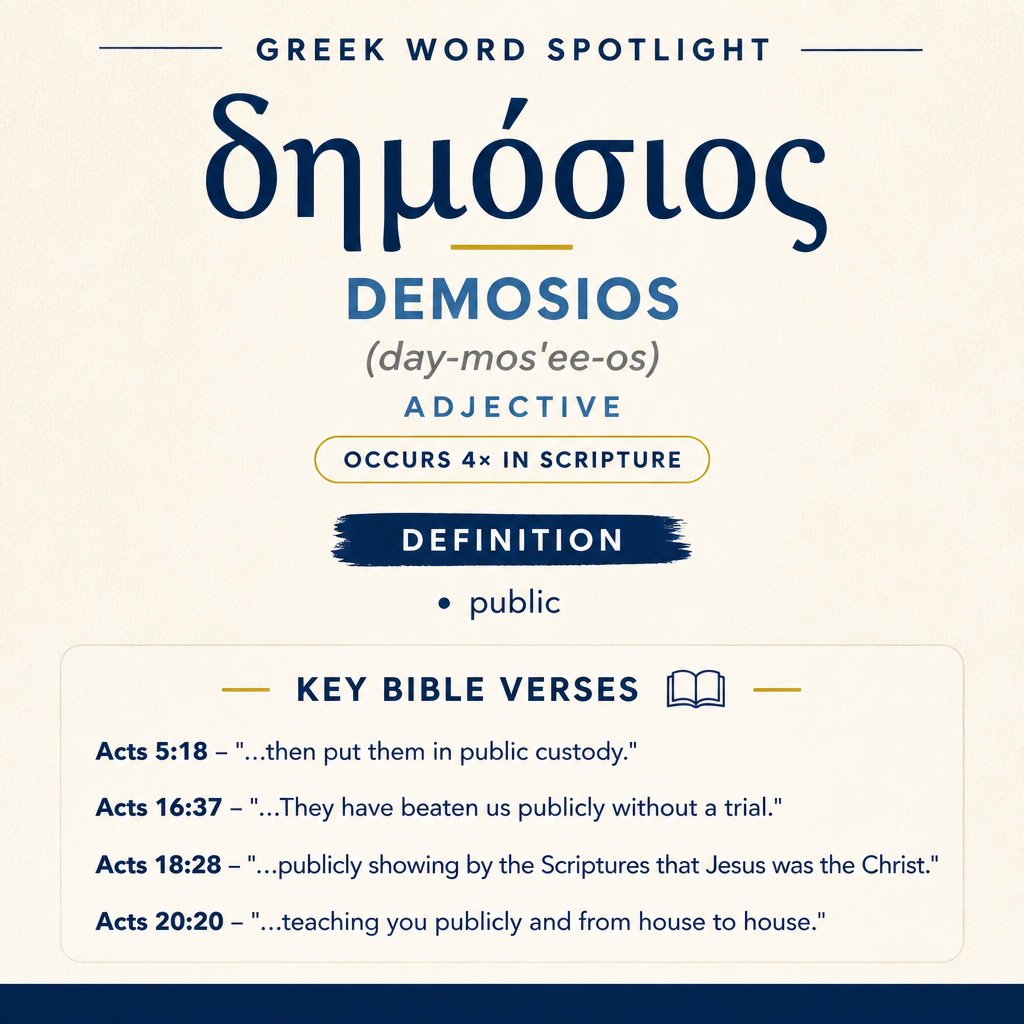
δημόσιος means “public” and appears four times in Scripture, all in Acts (5:18; 16:37; 18:28; 20:20).
Core Meaning
δημόσιος means “public.” In Acts it describes actions done openly or in a public setting.
Learn More →Acts Occurrences
It occurs in Acts 5:18, 16:37, 18:28, and 20:20. Each context highlights public custody, public beating, public refutation, and public teaching.
Learn More →Usage Snapshots
Acts 16:37 uses it for being beaten publicly without a trial. Acts 20:20 uses it for teaching publicly and from house to house.
Learn More →δημόσιος describes what belongs to the open sphere of communal life—what is carried out or handled in view of others. In Acts it appears in settings ranging from legal restraint to public speech and instruction.
Root and Related Words
δημόσιος is related to dēmos (δῆμος), “people” (Strong’s G1218), linking the term’s force to what stands in relation to the people as a whole.

Occurrences
“and laid hands on the apostles, then put them in public custody.” (Acts 5:18)
Here δημόσιος qualifies the custody imposed on the apostles after they are seized. The phrase “public custody” frames their confinement as an official, outwardly administered holding rather than a private detention; the action is not merely that they are imprisoned, but that they are placed under a form of keeping recognizable in the public sphere. Within the sentence, the move from “laid hands on the apostles” to “put them in public custody” traces an escalation from arrest to a custody that has a public character—something done as part of public order, visible and accountable as a civic act.

“But Paul said to them, “They have beaten us publicly without a trial, men who are Romans, and have cast us into prison! Do they now release us secretly? No, most certainly, but let them come themselves and bring us out!”” (Acts 16:37)
In Paul’s protest, δημόσιος marks the beating as something done in the open, not hidden away. The contrast within the quotation sharpens the term’s weight: “beaten us publicly” stands against “release us secretly.” The public nature of the mistreatment is central to Paul’s complaint, paired with “without a trial” and the stated fact of Roman status. Because the beating happened publicly, Paul refuses a quiet resolution; he calls for a correspondingly public act—“let them come themselves and bring us out.” In this scene, δημόσιος helps define the moral and civic stakes of what happened: the wrong is not only physical harm but harm enacted in the open arena where authorities act before witnesses.
“for he powerfully refuted the Jews, publicly showing by the Scriptures that Jesus was the Christ.” (Acts 18:28)
δημόσιος here characterizes the manner of argumentation: the refutation is accompanied by “publicly showing by the Scriptures.” The word signals that this “showing” is not confined to a private exchange; it takes place in a setting open to observation and hearing by others. The verse also coordinates strength and openness: he “powerfully refuted” and did so in a way that was publicly accessible, grounding the demonstration “by the Scriptures.” In this context, δημόσιος highlights the outward, open presentation of evidence, making the claim about Jesus not merely asserted but displayed in a way that belongs to public discourse.
“how I didn’t shrink from declaring to you anything that was profitable, teaching you publicly and from house to house,” (Acts 20:20)
In Paul’s description of his ministry, δημόσιος sets one axis of his teaching activity: “publicly and from house to house.” The pairing presents two settings without collapsing them into one. “Publicly” names instruction in open, communal venues; “from house to house” names instruction in domestic, smaller settings. The term therefore helps depict a teaching pattern that spans public life and private homes, with the content described as “anything that was profitable.” The word’s contribution is to anchor part of Paul’s work in the open sphere, suggesting instruction offered where a broader audience could be present, alongside more personal household teaching.
Sense and Usage
Across these four passages, δημόσιος consistently locates an action or condition within the arena that is open to communal awareness: custody that carries an official, outward character (Acts 5:18), punishment carried out in open view (Acts 16:37), argument made as a public demonstration from Scripture (Acts 18:28), and teaching delivered in settings belonging to shared civic life (Acts 20:20). The word therefore links two major domains in Acts: (1) the public exercise of authority—detention and corporal punishment—and (2) the public communication of the Christian message—reasoned presentation and instruction.
The passages also show that publicness can be a point of tension. In Acts 16:37, the public act of beating creates a demand for an equally public remedy; secrecy is portrayed as an inadequate response to a public wrong. By contrast, in Acts 18:28 and Acts 20:20 publicness is an aspect of proclamation: what is shown and taught is offered in the open rather than confined to private circles. The word thus frames both opposition and witness in terms of their placement before the wider community.
Finally, the occurrences display how “public” can describe different kinds of visibility. “Public custody” concerns the public character of an institution or setting; “beaten us publicly” concerns an event carried out openly; “publicly showing” concerns the mode of persuasion; “teaching you publicly” concerns the venue and accessibility of instruction. In each case, δημόσιος marks a relationship to the public realm—what takes place where others can see, hear, recognize, or hold accountable.
Imagery
The word’s imagery in Acts alternates between public spaces of restraint and public spaces of speech. “Public custody” and a beating done “publicly” evoke the visible reach of authorities, while “publicly showing” and “teaching… publicly” evoke open arenas where claims are presented and tested before others. Together these scenes portray public life as the shared stage on which both coercion and instruction occur.
Sources: Lexical data from Strong’s Exhaustive Concordance and the Translators Brief Lexicon of Extended Strongs for Greek (STEPBible, CC BY). Occurrence data from the Translators Amalgamated Greek New Testament (STEPBible, CC BY). Scripture quotations from the World English Bible (public domain).




