
Understanding the Meaning of Demas in Greek
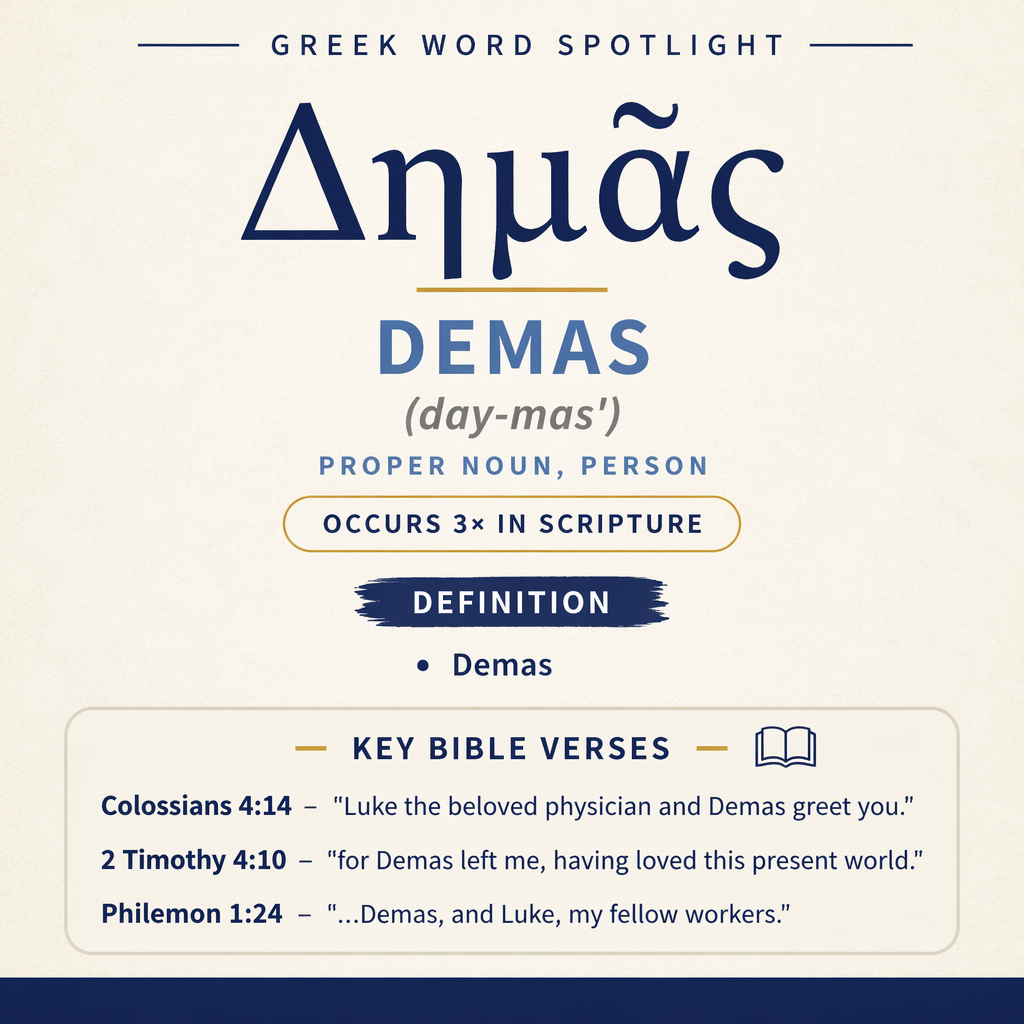
Δημᾶς (Demas) means “Demas” and appears three times in Scripture: Colossians 4:14, 2 Timothy 4:10, and Philemon 1:24.
Named Greetings
In Colossians 4:14, Demas sends greetings alongside Luke. In Philemon 1:24, Demas is listed among Paul’s fellow workers.
Learn More →Departure Noted
In 2 Timothy 4:10, Paul reports that Demas left him, loved this present world, and went to Thessalonica.
Learn More →Δημᾶς refers to the individual named Demas. The name appears in three Pauline settings: two greetings that place him among close associates, and one later report that he “left” and “went to Thessalonica.”
Root and Related Words
Demas is related to the proper name Demetrios (Δημήτριος), “Demetrius” (Strong’s G1216).

Occurrences
Colossians 4:14: “Luke the beloved physician and Demas greet you.”
Here Demas is presented as one of the identifiable senders of greetings to the recipients. The construction joins him with “Luke the beloved physician,” placing Demas alongside a named coworker in a brief, personal close to the letter. The name functions as a concrete point of connection: the community receiving the letter is not only addressed by the writer but also greeted by known companions, and Demas is one of those companions whose greeting is conveyed.
2 Timothy 4:10: “for Demas left me, having loved this present world, and went to Thessalonica; Crescens to Galatia; and Titus to Dalmatia.”
In this line Demas is the subject of a specific action affecting the speaker directly: “Demas left me.” The statement is expanded by two coordinate details. First, a motive clause frames the departure: “having loved this present world.” Second, the movement is given a destination: he “went to Thessalonica.” In the same sentence, the departures of others are also noted (“Crescens to Galatia; and Titus to Dalmatia”), but Demas alone is described as leaving the speaker and is singled out with an explanatory description. Within the scene, the name Demas therefore carries narrative weight: it marks a particular relational break (“left me”) and a particular direction of travel (“went to Thessalonica”), set against the broader dispersal of associates to other places.
Philemon 1:24: “as do Mark, Aristarchus, Demas, and Luke, my fellow workers.”
In Philemon, Demas appears in a compact list of four names, each counted among “my fellow workers.” The name here contributes to a picture of shared labor and cooperation: Demas is not merely present but grouped with others under a collective description that characterizes their relationship to the writer. The listing style—multiple names followed by a single description—presents Demas as one participant in a wider circle, with the focus falling less on individual biography and more on the collaborative identity of the group.
Sense and Usage
Across these passages, Demas functions as a personal name that anchors shifting relational and situational contexts. In Colossians 4:14 and Philemon 1:24, the name serves a social purpose: it identifies an associate whose connection to the letter’s sender is presented positively and publicly. In Colossians, the emphasis lies on greeting and the extension of goodwill; Demas is one of those whose personal regard is carried to the recipients. In Philemon, the emphasis lies on shared work; Demas is explicitly placed among “fellow workers,” so the name signals belonging to the writer’s active team.
2 Timothy 4:10 uses the same name in a markedly different kind of notice. The name still identifies a person within the writer’s circle, but now the circle is defined by loss and movement away. “Left me” describes a direct change in relationship, and the added phrases make the notice more than a bare travel update: Demas’s departure is interpreted (“having loved this present world”) and located (“went to Thessalonica”). The name thus becomes a point where personal relationship (“me”), motivation (“loved this present world”), and geography (“Thessalonica”) converge in one short report.
Read together, the three occurrences show how a proper name can carry more than identification while still meaning only the person named. Demas is first heard as one who greets, then as one who is counted among fellow workers, and then as one who departs. The word’s role remains stable—naming the same individual—while the surrounding verbs and descriptions (“greet,” “fellow workers,” “left,” “went”) supply the changing contours of his relationship to the writer and to the mission implied by the letters’ closings.
Imagery in Context
The passages attach Demas’s name to simple, concrete acts: greeting a distant community, being listed within a working group, and leaving for a named city. The most vivid image comes from the travel language in 2 Timothy 4:10: a departure from the speaker’s side followed by a journey “to Thessalonica,” set within a wider scattering of associates to different regions. Against the stillness of a greeting list, the line “Demas left me” gives the name a sharp, relational edge, making Demas memorable not through a title or description of office, but through the movement of departure and the reason stated alongside it.
Sources: Lexical data from Strong’s Exhaustive Concordance and the Translators Brief Lexicon of Extended Strongs for Greek (STEPBible, CC BY). Occurrence data from the Translators Amalgamated Greek New Testament (STEPBible, CC BY). Scripture quotations from the World English Bible (public domain).




