
Understanding the Significance of the Meaning of Deilia in Greek
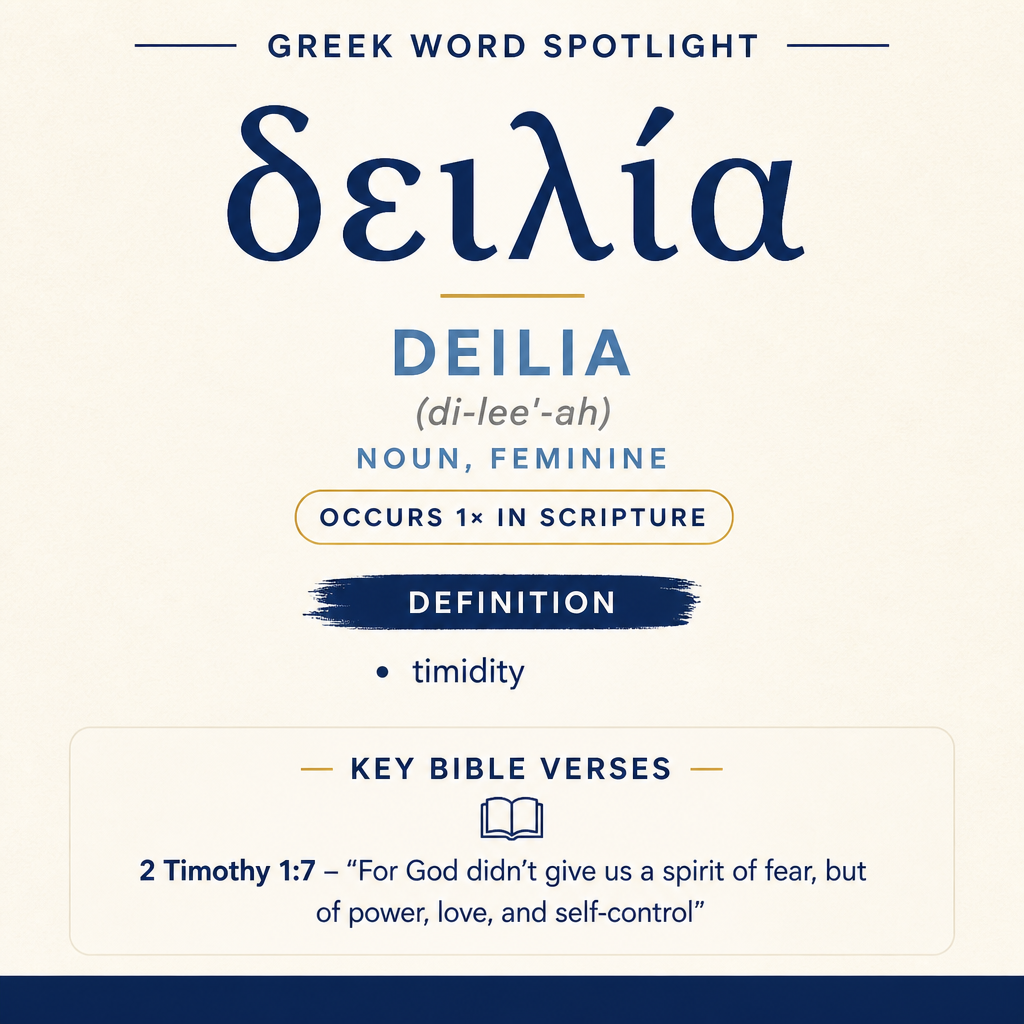
δειλία means “timidity” and appears once in Scripture, in 2 Timothy 1:7.
Scripture Occurrence
It occurs 1 time in Scripture. Its single occurrence is in 2 Timothy 1:7.
Learn More →Verse Context
In 2 Timothy 1:7, it is contrasted with “power, love, and self-control.”
Learn More →δειλία means “timidity,” and it appears once in the New Testament, in Paul’s charge to Timothy. In its lone context it is contrasted with what God gives, and so it functions as a negative point of comparison that sharpens the traits named as God’s gift.
Root and Related Words
δειλία is derived from the adjective deilos (δειλός), “timid” (Strong’s G1169). The relationship between the two forms links the noun to an established word-family describing the quality or condition associated with being timid.

Occurrences
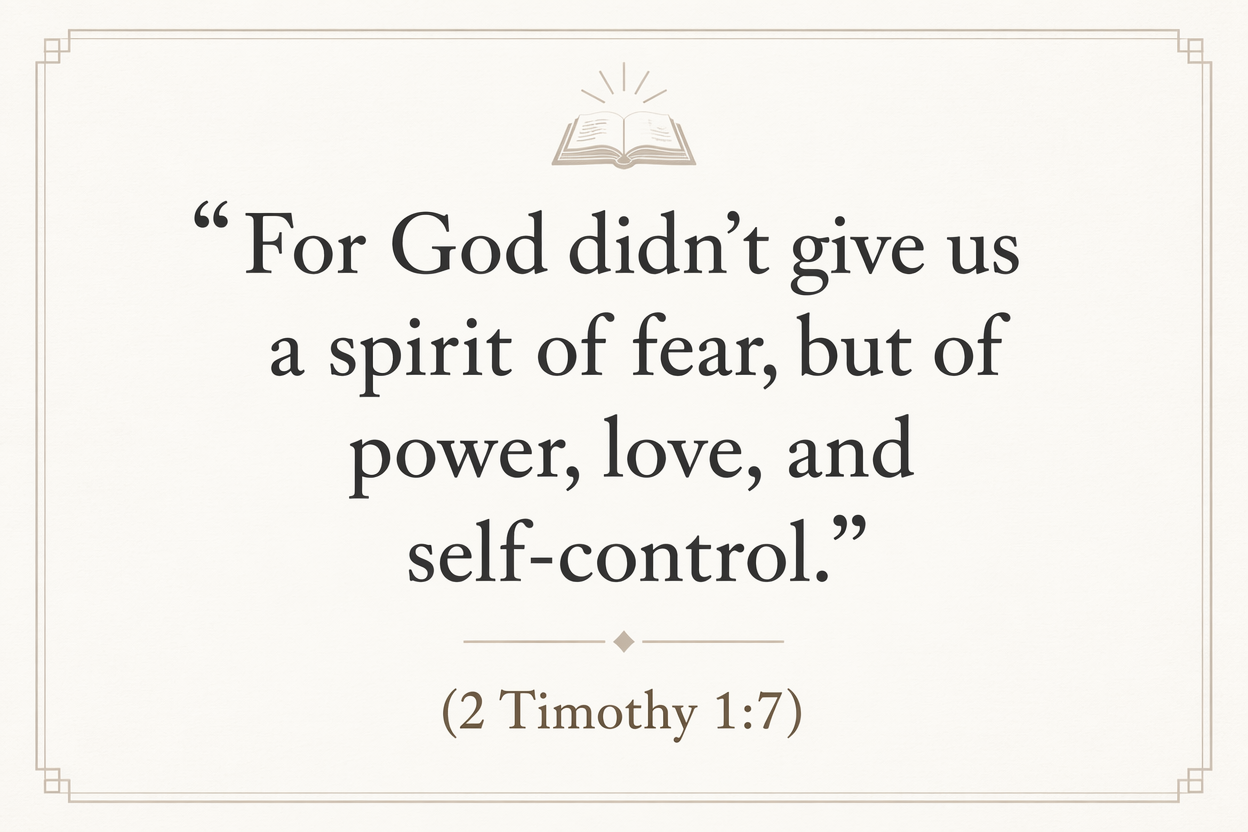
“For God didn’t give us a spirit of fear, but of power, love, and self-control.” (2 Timothy 1:7)
In this sentence Paul frames Christian courage and steadiness as something grounded in God’s giving. δειλία, rendered in the verse as “fear,” is set on one side of a sharp contrast: it is not what God gives (“didn’t give us a spirit of fear”), whereas “power, love, and self-control” are placed on the other side as the positive description of the spirit God gives. The effect is to cast timidity as an alien quality, not an entitlement of God’s gift, and to present it as incompatible with the triad that follows. Because the verse speaks of “a spirit,” the word’s force is not merely about a fleeting reaction; it points to a settled disposition or animating bent that can characterize a person or community.
Within the logic of the line, timidity is not treated as a neutral temperament. It is something that would diminish the lived expression of “power,” flatten “love,” and undercut “self-control.” Paul does not attempt to define the inner mechanics of fear; instead, he places it in a moral and theological frame: God’s gift produces certain recognizable qualities, and timidity does not belong among them. The wording “didn’t give us” makes the contrast practical and relational—what Timothy (and the “us” with him) is to embody is tied to the Giver rather than to personal resources or circumstances.
Sense and Usage
The definition “timidity” fits the way the term functions here: δειλία names a shrinking or hesitating posture that is unfit to stand alongside the three qualities Paul names. The verse positions timidity as the opposite of a God-given spiritual posture characterized by capacity (“power”), outward devotion (“love”), and inward steadiness (“self-control”). In this rhetorical setting, timidity is not explored through synonyms or examples but through contrast; its sense is illuminated by what it is set against.
Because δειλία occurs in a single, tightly argued line, its semantic contour is shaped by that immediate opposition. The term serves as a summary label for the kind of inward reluctance that would keep a person from acting with the strength implied by “power,” from expressing love with the freedom implied by “love,” or from maintaining the composure implied by “self-control.” The sentence does not say that difficulties are unreal or that fear is impossible; it simply locates timidity outside the scope of God’s gift. That placement gives the word a diagnostic function: where timidity dominates as an animating “spirit,” it does not match what Paul describes as granted by God.
The phrasing also suggests that timidity, in this context, is not merely an emotion to be managed but a controlling orientation that can shape behavior and decision-making. By speaking of “a spirit of fear,” the verse treats timidity as something that can color a person’s whole stance. Paul’s alternative list is similarly comprehensive: it spans capability, relational posture, and personal discipline. δειλία therefore functions as a broad descriptor for the opposite of these qualities taken together, pointing to a constricted stance that would limit the exercise of God-given power, the practice of love, and the maintenance of self-control.
Finally, the contrastive structure (“not … but …”) gives δειλία a clear evaluative edge. It is not simply different from power, love, and self-control; it is excluded by the very nature of God’s giving. In the flow of the sentence, timidity is treated as something that can be named and rejected on theological grounds, because the community’s animating spirit is sourced in God’s gift and is recognizable by the qualities it produces.
Imagery
Although the verse is abstract, its language evokes an inner atmosphere that either constricts or strengthens. δειλία contributes the image of a “spirit” marked by fear—an inward climate that tightens rather than enlarges—set against the expansive triad of “power, love, and self-control.”
Sources: Lexical data from Strong’s Exhaustive Concordance and the Translators Brief Lexicon of Extended Strongs for Greek (STEPBible, CC BY). Occurrence data from the Translators Amalgamated Greek New Testament (STEPBible, CC BY). Scripture quotations from the World English Bible (public domain).




