Understanding the Significance of Daktulios in Greek
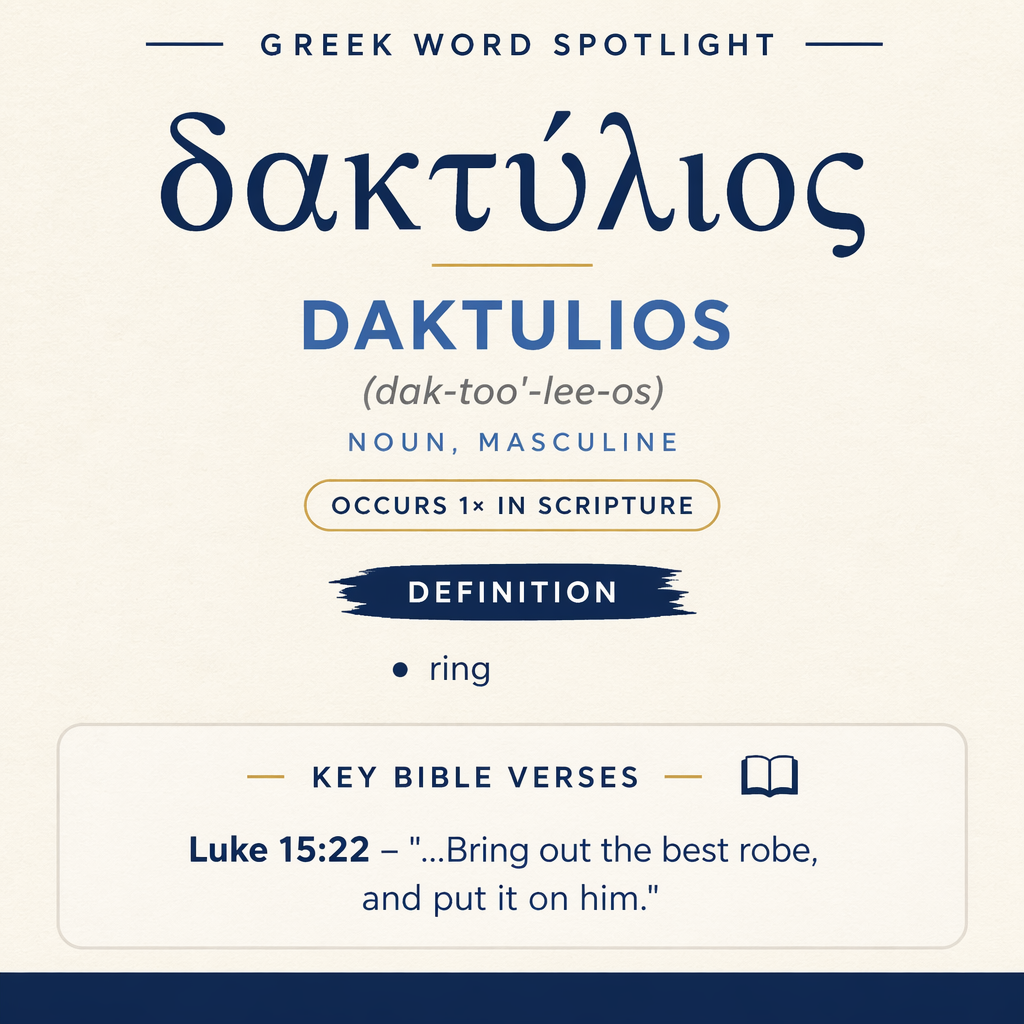
δακτύλιος means “ring” and appears once in Scripture, in Luke 15:22.
Biblical Usage
It occurs one time in Scripture. Its single occurrence is in Luke 15:22.
Learn More →δακτύλιος means “ring” and appears in Jesus’ parable of the returning son, where the father orders a ring placed on his son’s hand. In that single scene, the word functions as a concrete item of dress given alongside other visible signs of welcome.
Root and Related Words
δακτύλιος is related to daktylos (δάκτυλος), “finger” (Strong’s G1147). The relationship is seen in the way a ring belongs to, and is worn on, a finger.

Occurrences
“But the father said to his servants, ‘Bring out the best robe, and put it on him. Put a ring on his hand, and sandals on his feet.” (Luke 15:22)
In Luke 15:22, δακτύλιος names one of three tangible items the father commands his servants to supply: “the best robe,” “a ring,” and “sandals.” The ring is singled out with a precise placement: it is to be put “on his hand.” This instruction makes the ring an immediately visible object, not merely a possession handed over, but something worn and displayed. Within the father’s rapid sequence of imperatives—“Bring out… put it on him… Put… Put…”—the ring functions as part of the son’s re-clothing and re-presentation, restoring an outward appearance that corresponds to the father’s reception of him.

The verse frames the ring as a gift mediated through servants. The father does not describe the ring’s workmanship, material, or value; instead, he focuses on action and placement. The ring is treated as an accessory that belongs with being dressed, like the robe and sandals. It is therefore embedded in the social scene of public recognition: servants are instructed, the son is outfitted, and the result is a son whose body bears the signs of being welcomed. The ring’s location—on the hand—also makes it an item that accompanies ordinary gestures and interactions; it is part of what others would see as the son moves, eats, or is embraced in the household context assumed by the father’s command.
Sense and Usage
The sense “ring” is expressed in Luke 15:22 in the most literal, physical way: an object that can be brought out and put onto a person. The verse presents it as a wearable article, parallel to clothing and footwear, and therefore part of a complete outfitting. Because the father pairs the ring with “the best robe” and “sandals,” the ring is not introduced as a tool or an ornament detached from the scene, but as a component in a coordinated act of dressing. The language makes δακτύλιος concrete and practical: it belongs to the realm of things servants can fetch and place, and it occupies a defined position on the body (“on his hand”).
The verse also shows that a ring, as δακτύλιος, can serve as a marker within a relational action. The father’s commands are not private purchases or abstract declarations; they are visible acts performed on the son. In that setting, the ring contributes to the portrayal of restoration by means of external signs. Without introducing additional meanings beyond “ring,” the narrative still allows the object to carry social weight because it is part of what the father chooses to put on the son immediately. The ring is not described independently; it is meaningful in the way it is given and worn, and in how it completes the son’s appearance in the father’s household.
Attention to placement strengthens this usage. The ring is not said to be placed “in his hand” as though simply held; it is put “on his hand,” language that suits something that fits onto a finger and remains there. This idiom treats the ring as an item that becomes part of the son’s outward person—an enduring adornment rather than a temporary object carried for a moment. The verse’s focus on dressing implies readiness for participation: robe, ring, and sandals are all things that prepare someone to stand and move about in public, rather than remain in a state of deprivation. δακτύλιος thus appears as a small but deliberate detail in the father’s action, one piece in a full restoration of the son’s appearance.
Imagery
Luke 15:22 places δακτύλιος in a scene of quick, practical generosity: servants are commanded to bring and put on tangible items. The ring’s imagery is therefore domestic and visible—an object slipped onto the hand as part of being clothed anew—so that welcome is expressed not only in words but in what can be seen worn on the body.
Sources: Lexical data from Strong’s Exhaustive Concordance and the Translators Brief Lexicon of Extended Strongs for Greek (STEPBible, CC BY). Occurrence data from the Translators Amalgamated Greek New Testament (STEPBible, CC BY). Scripture quotations from the World English Bible (public domain).