Exploring the Meaning of Genealogia in Greek
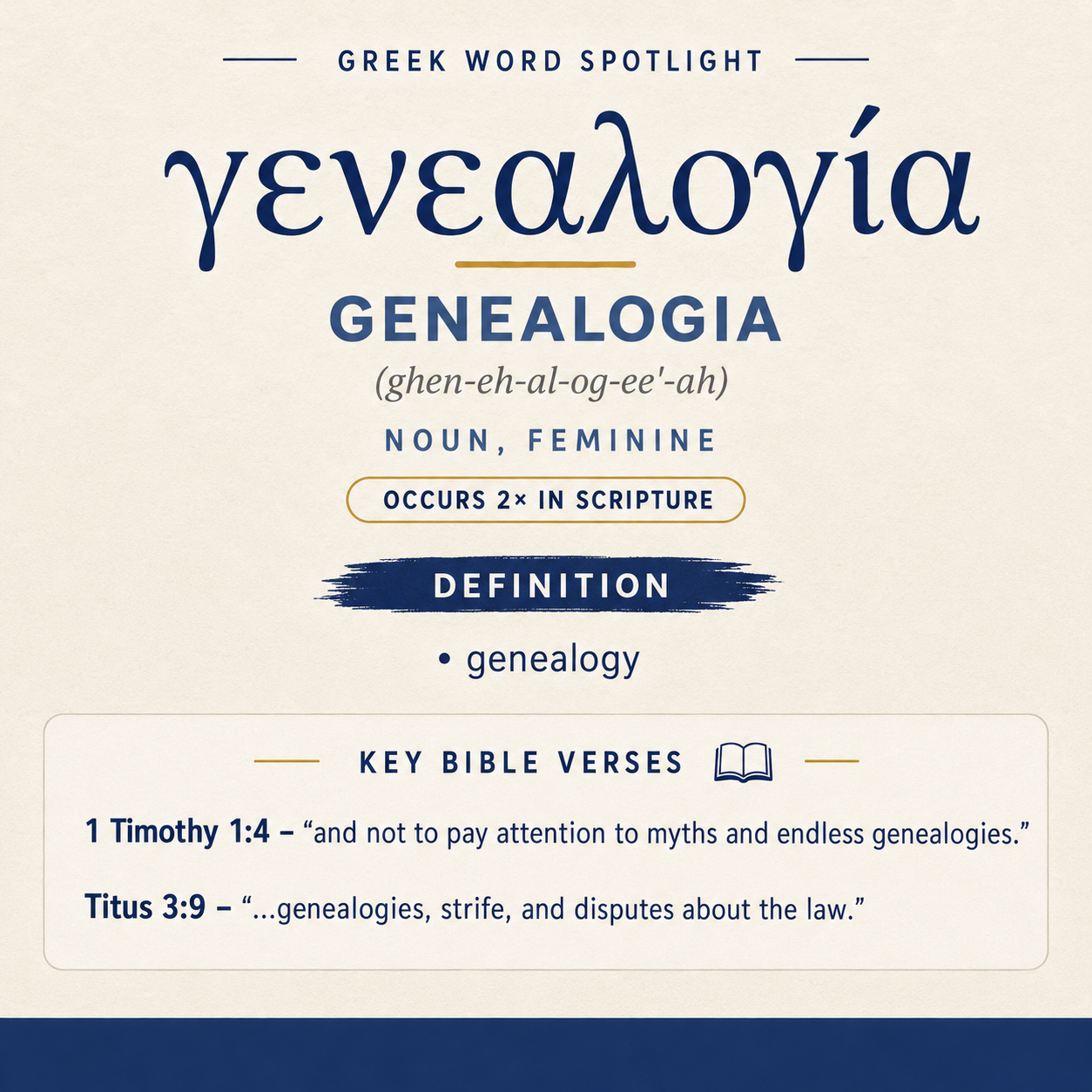
γενεαλογία means “genealogy” and appears twice in Scripture: 1 Timothy 1:4 and Titus 3:9.
Contextual Use
In 1 Timothy 1:4 it is linked with “myths” and described as “endless,” causing disputes. In Titus 3:9 it is listed among matters to shun as “unprofitable and vain.”
Learn More →Genealogia means “genealogy.” It appears in two pastoral exhortations that warn against certain kinds of talk that generate contention and prove spiritually fruitless.
Root and Related Words
Genealogia is related to the verb Genealogeo (γενεαλογέω), “to trace genealogy” (Strong’s G1075). The noun names what the verb does: a genealogy considered as a traced line or register.
Occurrences
“and not to pay attention to myths and endless genealogies, which cause disputes, rather than God’s stewardship, which is in faith—” (1 Timothy 1:4)
Here genealogia is paired with “myths” and described as “endless,” placing it in a category of material that can occupy attention without producing the intended outcome of the instruction. The phrase “pay attention to” frames genealogies as an object of mental focus and sustained interest; the warning is not merely about their existence, but about the posture of giving them weight and time. In this sentence, the practical effect is explicit: such genealogies “cause disputes.” Genealogia therefore functions as a label for lines of discussion that, in this setting, multiply controversy rather than serving “God’s stewardship, which is in faith.” The contrast is sharp: on one side are topics that generate argumentative friction; on the other side is an entrusted administration that is characterized as “in faith.” The word contributes the image of extended lineage-tracing turned into an open-ended preoccupation—something that can keep expanding (“endless”) and keep producing fresh points of contention (“disputes”).
“but shun foolish questionings, genealogies, strife, and disputes about the law; for they are unprofitable and vain.” (Titus 3:9)
In Titus, genealogia appears in a list of things to “shun,” surrounded by terms that describe argumentative dynamics: “foolish questionings,” “strife,” and “disputes about the law.” The placement of genealogies among these items frames it not as a neutral record, but as a recurring trigger for quarrelsome exchanges. The directive “shun” makes genealogia something to avoid as a habitual source of distraction and conflict, and the closing evaluation—“unprofitable and vain”—gives the controlling assessment of the whole cluster. In this scene, the word helps define a class of conversations whose output does not justify the energy they consume. Genealogia is thus portrayed as a topic that can be used in a way that fails to build and instead drains: it belongs to the sphere of exchanges that churn and escalate (“strife,” “disputes”) while yielding no beneficial return (“unprofitable”) and lacking real substance (“vain”).
Sense and Usage
Across both occurrences, genealogia names “genealogy” as a subject matter that can become an engine of controversy when treated as a field for endless inquiry or combative debate. The word itself is straightforward, but the two contexts together give it a particular profile: genealogies are described as (1) capable of becoming “endless,” (2) able to “cause disputes,” and (3) connected to patterns of argument that are “unprofitable and vain.” The concern is not framed as simple curiosity about lineage, but as the way genealogies can be handled—paid attention to as an absorbing pursuit, or deployed within “foolish questionings” and “disputes about the law.”
In 1 Timothy, the contrast with “God’s stewardship, which is in faith” shows how genealogies can compete with the aims of faithful administration. The issue is directional: attention is a limited resource, and genealogies, when treated as inexhaustible material, can steer a community toward controversy rather than toward the faithful execution of what has been entrusted. In Titus, the evaluation “unprofitable and vain” reinforces a pragmatic test: the talk that gathers around genealogies can be measured by its fruit, and in this list it fails that test. The two passages thus present genealogia as a term that, though definable as “genealogy,” carries an implied warning about what happens when lineage-tracing becomes a platform for contentious, speculative, or legal wrangling.
Because genealogia is placed alongside “myths” in one text and alongside “disputes about the law” in the other, the noun also serves as a bridge between different kinds of argumentative material: imaginative narratives on the one hand and combative legal discussions on the other. In both cases the word marks content that can invite prolonged engagement while producing division. The repeated pairing of genealogies with relational disruption (“disputes,” “strife”) indicates that the problem is not merely intellectual error but communal damage: genealogies become a pretext for conflict.
Imagery
The imagery carried by genealogia in these warnings is that of a line that can always be extended: a chain of names or connections that, once made the center of attention, never reaches a satisfying endpoint. In 1 Timothy it is “endless,” suggesting a trail that keeps lengthening and fueling “disputes.” In Titus it is something to “shun” because it belongs to the same argumentative atmosphere as “strife” and “disputes about the law,” and the whole bundle is judged “unprofitable and vain.”
Sources: Lexical data from Strong’s Exhaustive Concordance and the Translators Brief Lexicon of Extended Strongs for Greek (STEPBible, CC BY). Occurrence data from the Translators Amalgamated Greek New Testament (STEPBible, CC BY). Scripture quotations from the World English Bible (public domain).