
Exploring the Meaning of Genealogeo in Greek
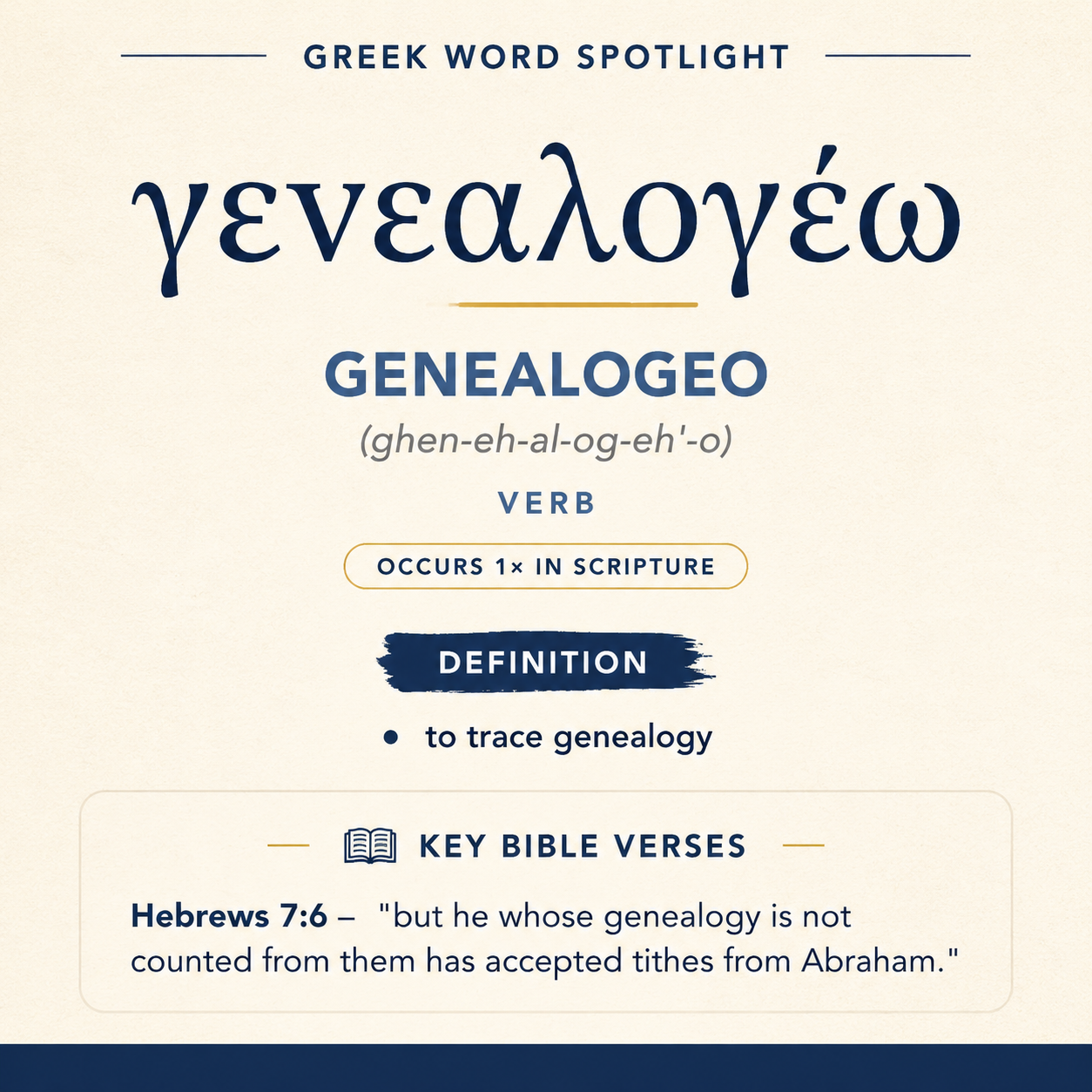
γενεαλογέω means “to trace genealogy” and appears once in Scripture, in Hebrews 7:6.
Hebrews Context
In Hebrews 7:6, it is used in the statement about one whose genealogy is not counted from them.
Learn More →γενεαλογέω means “to trace genealogy.” It appears once in Scripture, in Hebrews 7:6, where it is used to describe a person’s relationship (or lack of it) to a particular genealogical line.
Root and Related Words
γενεαλογέω (Genealogeo) is connected with γενεά (genea), “generation” (Strong’s G1074), and with λόγος (logos), “word” (Strong’s G3056). These related terms frame the verb’s idea of tracing a genealogy as a matter of generational connection expressed in an account or reckoning.
Occurrences
“but he whose genealogy is not counted from them has accepted tithes from Abraham, and has blessed him who has the promises.” (Hebrews 7:6)
In Hebrews 7:6 the verb sits inside a contrast that hinges on lineage and recognition: “he whose genealogy is not counted from them” versus “them,” the group from whom genealogical counting would normally be made. The sentence then describes two actions—“has accepted tithes from Abraham” and “has blessed him who has the promises”—and places those actions in the mouth of someone who stands outside the specified genealogical reckoning. Here “to trace genealogy” functions as a criterion for inclusion: whether a person is reckoned within a line (“counted from them”) is the question, and the text emphasizes that this particular figure is not included in that genealogical accounting.
Because the clause is framed negatively (“is not counted”), the verb’s contribution is not the performance of genealogical tracing but the denial of it. The author is not simply saying that a genealogy is unknown; the point is that the genealogy is not computed as deriving from a certain source (“from them”). Genealogical tracing is portrayed as a way of establishing relational standing—who belongs to which line—so that the actions narrated in the verse (receiving tithes; blessing) are heard against the backdrop of an expected lineage-based structure. The effect of the verb is therefore to mark a discontinuity: the person who receives tithes from Abraham and blesses the promise-holder is presented as outside the normal line of descent being referenced, yet still acting in an authoritative role within the scene described by the verse.
Sense and Usage
The sense “to trace genealogy” in this passage is closely tied to formal reckoning. The phrase “whose genealogy is not counted” treats genealogy as something that can be computed, recorded, or assigned—an act of counting “from” a certain group. Genealogical tracing is thus not only the identifying of ancestors but the establishing of a recognized derivation: a person is “counted from” a line when that person’s origin is reckoned as coming out of that line.
In Hebrews 7:6, genealogical tracing functions as an interpretive lens for relationships and status. The verse places two concrete interactions—tithes and blessing—next to the genealogical statement, so that genealogy becomes a way of framing how those interactions are to be understood. The mention of Abraham and “him who has the promises” makes the genealogical point more pointed: the person described is not genealogically derived “from them,” yet is in direct relation with Abraham and with the one who possesses the promises. Within the verse’s own logic, that combination highlights the weight carried by genealogical accounting: it is a recognized system for determining belonging, and it is invoked precisely so the author can underscore that the key figure does not fit the expected genealogical category while still receiving and blessing.
The usage here also shows that tracing genealogy can be conceived in corporate terms (“from them”). The verb is not framed around private family curiosity but around membership in a defined line. The clause assumes a known reference group (“them”) from which genealogical descent would be traced and “counted.” In that setting, genealogy is not a mere list of names; it is a boundary marker that determines whether someone’s lineage is reckoned as deriving from a particular body.
Finally, the grammar of the sentence places genealogical counting as background information that sets up the main relational actions. The verse does not pause to explain how genealogies are traced; it simply uses the notion as a given point of comparison. That rhetorical placement suggests that “to trace genealogy” is a concept the author expects readers to understand as a meaningful and weighty category. In this one attestation, the verb therefore carries the idea of an established genealogical reckoning that can be affirmed or denied, and that affirmation or denial shapes how a person’s standing is understood within the verse’s argument.
Imagery
Hebrews 7:6 attaches the language of genealogical reckoning to vivid social and religious actions: “has accepted tithes from Abraham” and “has blessed him who has the promises.” The imagery is not abstract: genealogy is portrayed as something that can be “counted,” while the scene itself depicts a meeting in which offerings are received and a blessing is given. Against that concrete backdrop, genealogical tracing becomes a way of picturing recognized descent as a kind of accounted membership—something that can be tallied as belonging “from” a certain line—even as the verse stresses a figure who stands outside that tally.
Sources: Lexical data from Strong’s Exhaustive Concordance and the Translators Brief Lexicon of Extended Strongs for Greek (STEPBible, CC BY). Occurrence data from the Translators Amalgamated Greek New Testament (STEPBible, CC BY). Scripture quotations from the World English Bible (public domain).




