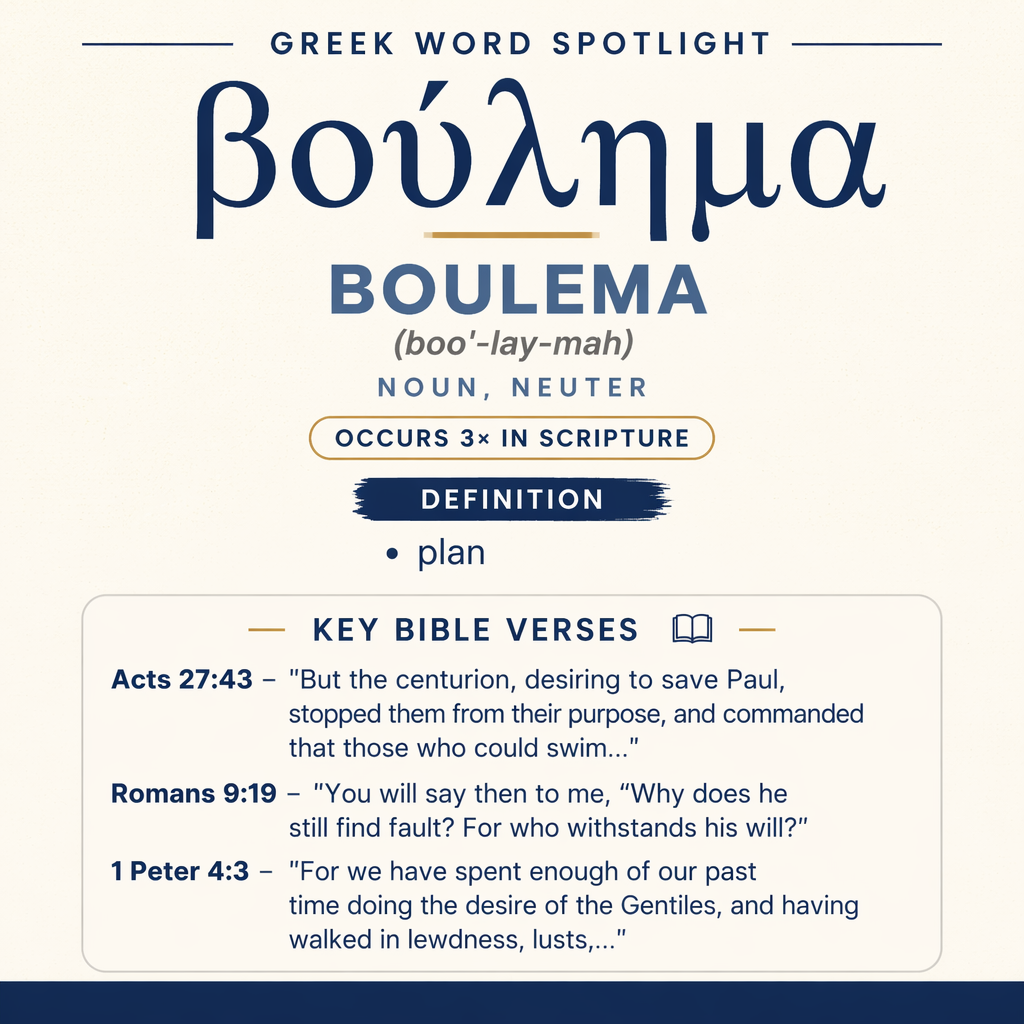
βούλημα expresses a “plan,” a settled intention that shapes what people attempt or what is conceived as decisive in a given situation. It appears in three New Testament passages: in a crisis at sea (Acts 27:43), in a theological objection framed as a question about God’s will (Romans 9:19), and in a moral description of former pagan life (1 Peter 4:3).
Root and Related Words
βούλημα derives from the verb boulomai (βούλομαι), “to plan” (Strong’s G1014). The noun concentrates that verbal idea into the result or product of planning—what is held as the formed intention that guides action or is appealed to in argument.
Occurrences
“But the centurion, desiring to save Paul, stopped them from their purpose, and commanded that those who could swim should throw themselves overboard first to go toward the land;” (Acts 27:43)
Here βούλημα is tied to a moment of command and counter-command. The centurion’s desire “to save Paul” becomes the decisive motivation that interrupts “their purpose.” The verse frames that “plan” as something concrete enough to be halted: it belonged to “them” (the group acting in the emergency), and it was sufficiently advanced that only an authoritative intervention could stop it. Against that prevented plan, the centurion issues an alternative operational plan: swimmers go first, heading toward land. In this setting, βούλημα names a practical course of action—an intended procedure—set within the pressures of imminent danger and the need for immediate coordination.
“You will say then to me, “Why does he still find fault? For who withstands his will?”” (Romans 9:19)
In Romans 9:19 the word appears in a rhetorical exchange, voiced as an anticipated objection. The question turns on accountability (“Why does he still find fault?”) and resistance (“who withstands his will?”). Within that framing, βούλημα functions as the ground of the argument: if the “plan” is decisive, then opposing it seems impossible, and fault-finding seems incoherent to the objector. The verse does not place the word in a scene of physical action but in the logic of a protest, where “will” is treated as an operative plan that, by its nature, cannot be successfully opposed. The noun thus carries argumentative force: it is not merely an intention but something assumed to be effectual enough to define the limits of resistance.
“For we have spent enough of our past time doing the desire of the Gentiles, and having walked in lewdness, lusts, drunken binges, orgies, carousings, and abominable idolatries.” (1 Peter 4:3)
In 1 Peter 4:3 the term is situated within a retrospective moral assessment—“enough of our past time”—and it is linked with habitual patterns (“having walked in…”). The “plan” is characterized as “the desire of the Gentiles,” presented as something that directed conduct over time. The list that follows (“lewdness, lusts, drunken binges, orgies, carousings, and abominable idolatries”) supplies the concrete content of what that plan looked like in daily life: it was not a single impulse but an organizing intention that shaped a way of walking. Within this sentence, βούλημα contributes the idea of a shaping intention that can be “done,” an aim that people enacted through repeated behaviors.
Sense and Usage
Across these three passages, “plan” is consistent, but its scope shifts with context. Acts 27:43 presents a plan as a specific, time-sensitive intention attached to an immediate course of action. It is something a group can form and attempt, and it can be stopped and replaced by a superior order. The word fits naturally beside verbs of command and movement, because the plan there is procedural: it determines what will happen next.
Romans 9:19, by contrast, places the word inside a question about fault and resistance. The “plan” in view is treated as determinative: if it stands, it sets the terms of what can be withstood. In this use, the noun gathers weight not by describing steps to be taken but by implying an intention that governs outcomes. The verse’s rhetorical pressure depends on that: the challenge presumes that a plan of this kind is not easily thwarted, and that this has implications for how one talks about blame.
1 Peter 4:3 applies the notion of “plan” to a communal pattern of living. Here the plan is not an emergency procedure or a debated point in a logical objection, but an animating intention behind a way of life. By speaking of “doing the desire” and then describing a “walk” filled with repeated vices, the passage depicts a plan as something enacted over time—an orientation that organizes conduct and produces recognizable practices. The word thus covers both the momentary (a purpose in a crisis) and the enduring (a settled intention behind a lifestyle), showing how “plan” can name either a short-term design or a long-term directing aim, depending on what the surrounding verbs and descriptions emphasize.
Together these uses also show that a plan can be attributed to different subjects and evaluated differently. In Acts, “their purpose” is blocked by the centurion, whose own desire sets a different plan into motion; the narrative treats plans as competing intentions, with authority and concern for a person’s life deciding which will proceed. In Romans, the plan is invoked as an explanatory factor in an objection about divine fault-finding, making the noun central to how one frames questions of power and resistance. In 1 Peter, the plan belongs to “the Gentiles” as a descriptor of a former pattern, and the speaker counts the time spent in that plan as sufficient—suggesting a decisive break from the old guiding intention.
Imagery in Context
The strongest concrete imagery comes from Acts 27:43, where a “plan” is something that can be interrupted in real time while a ship’s occupants face the urgency of reaching land. Romans 9:19 presents a different kind of image: a plan imagined as something so comprehensive that no one can “withstand” it. 1 Peter 4:3 provides the image of a “walk,” where a plan is not merely held but carried out through repeated acts, making intention visible in conduct.
Sources:
Lexical data from Strong’s Exhaustive Concordance and the Translators Brief Lexicon of Extended Strongs for Greek (STEPBible, CC BY). Occurrence data from the Translators Amalgamated Greek New Testament (STEPBible, CC BY). Scripture quotations from the World English Bible (public domain).