
Exploring the Meaning of Bosko in Greek
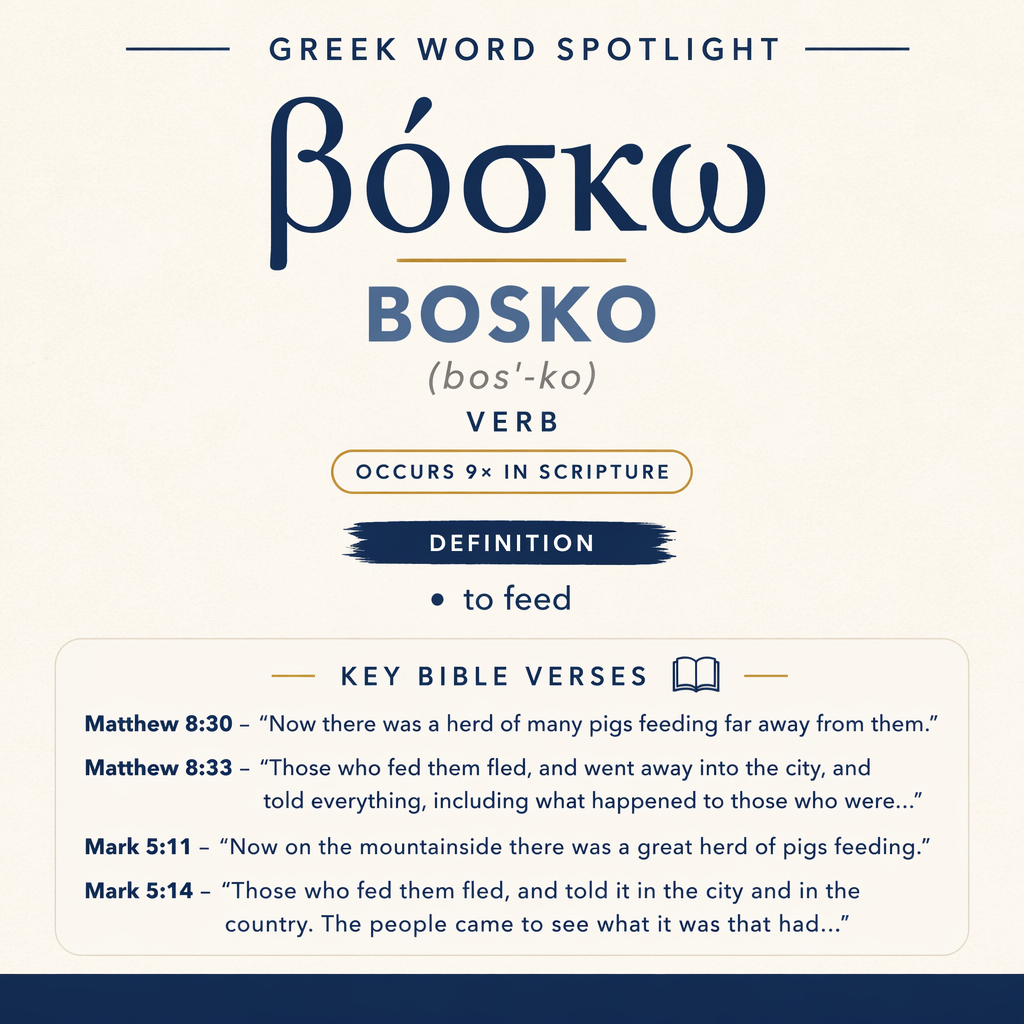
βόσκω means “to feed” and appears 9 times in Scripture, including passages in Matthew, Mark, Luke, and John.
Gospel Occurrences
It appears in Matthew 8:30, 8:33; Mark 5:11, 5:14; Luke 8:32, 8:34, 15:15; and John 21:15.
Learn More →Usage Examples
Several occurrences describe pigs feeding (e.g., Matthew 8:30; Mark 5:11; Luke 8:32). Luke 15:15 uses it for feeding pigs in the fields.
Learn More →βόσκω means “to feed.” In the Gospels it appears in scenes of animal husbandry—especially pigs in the Gerasene episode—and in Jesus’ direct charge to Simon Peter after breakfast by the sea.
Occurrences
Matthew 8:30 — “Now there was a herd of many pigs feeding far away from them.”
Here βόσκω sets the initial, ordinary activity of the animals: a “herd of many pigs” engaged in feeding at a distance. The word supplies a calm pastoral detail—what the pigs are doing and where—before any disruption described in the wider narrative context of the chapter.
Matthew 8:33 — “Those who fed them fled, and went away into the city, and told everything, including what happened to those who were possessed with demons.”
βόσκω identifies the human agents responsible for the herd’s feeding: “Those who fed them.” Their role as feeders explains why they are present to witness events and why they become messengers who “told everything.” The verb, applied to their work, ties their livelihood to the report they carry into the city.
Mark 5:11 — “Now on the mountainside there was a great herd of pigs feeding.”
In Mark the same verb paints the scene with location and scale: “on the mountainside” and “a great herd.” βόσκω again marks the animals’ ongoing action—feeding—so that the herd is not merely present as background but actively occupied when the ensuing events unfold.
Mark 5:14 — “Those who fed them fled, and told it in the city and in the country. The people came to see what it was that had happened.”
βόσκω is used for the herdsmen (“Those who fed them”), emphasizing their practical connection to the animals and making them the first interpreters of what they have seen: they “told it” broadly, “in the city and in the country.” The verb helps define them by their task, which in turn explains their alarm (“fled”) and their urgency as witnesses.
Luke 8:32 — “Now there was there a herd of many pigs feeding on the mountain, and they begged him that he would allow them to enter into those. Then he allowed them.”
Luke places βόσκω within a tightly staged setting: a “herd of many pigs” is “feeding on the mountain” precisely when a request is made to “enter into those.” The feeding detail fixes the herd as a visible, immediate option in the landscape. βόσκω thus anchors the narrative in a concrete activity that makes the herd more than an abstract reference; the pigs are right there, feeding, when permission is granted.
Luke 8:34 — “When those who fed them saw what had happened, they fled and told it in the city and in the country.”
As in Matthew and Mark, βόσκω characterizes the witnesses as “those who fed them.” The verb underscores that their eyewitness testimony comes from people engaged in routine work that is suddenly overturned by what they “saw.” It also sharpens the contrast between the ordinary act of feeding and their immediate response: they “fled” and spread the news widely.
Luke 15:15 — “He went and joined himself to one of the citizens of that country, and he sent him into his fields to feed pigs.”
βόσκω appears here in a personal, downward-moving storyline: the man is sent “into his fields to feed pigs.” The verb describes assigned labor done under another’s authority (“he sent him”), and the specified object (“pigs”) makes the work concrete and socially defining within the parable’s scene. βόσκω is the action that places the character out in the fields, occupied with the most basic task of sustaining animals rather than participating in household abundance.
John 21:15 — “So when they had eaten their breakfast, Jesus said to Simon Peter, “Simon, son of Jonah, do you love me more than these?” He said to him, “Yes, Lord; you know that I have affection for you.” He said to him, “Feed my lambs.”
In this exchange βόσκω becomes an imperative: “Feed my lambs.” The verb is framed as Jesus’ direct commission following a meal (“when they had eaten their breakfast”) and following Peter’s affirmation of affection. The object “my lambs” personalizes the charge: the feeding is not generic but directed toward animals that belong to Jesus (“my”), and it is given to Peter as a concrete responsibility arising from the relationship just voiced in dialogue.
John 21:17 — “He said to him the third time, “Simon, son of Jonah, do you have affection for me?” Peter was grieved because he asked him the third time, “Do you have affection for me?” He said to him, “Lord, you know everything. You know that I have affection for you.” Jesus said to him, “Feed my sheep.”
βόσκω is repeated in the climactic moment of the threefold questioning: “Feed my sheep.” The repetition of the command, now paired with Peter’s grief and appeal to Jesus’ knowledge (“Lord, you know everything”), makes feeding a steady, defining task set against emotional strain. The shift in the object from “lambs” to “sheep” keeps the image within the same pastoral world while broadening the scope of what Peter is told to do: the feeding extends to the flock as a whole as named in Jesus’ words.

Sense and Usage
Across these passages βόσκω consistently expresses the act of feeding in a way that connects three elements: an eater (animals), a feeder (either the animals’ keepers or a commissioned person), and a setting where feeding happens as part of ordinary life. In the pig-herd texts (Matthew 8; Mark 5; Luke 8), the verb functions like a scene-setter and a role-marker. When pigs are “feeding,” the narrative space is stabilized: a mountainside or mountain is not just terrain but grazing ground, and a herd is not just present but engaged in its sustaining activity. When the herdsmen are described as “those who fed them,” βόσκω identifies them by vocation and ties their identity to the herd’s welfare. Their flight and their reporting are therefore not random reactions of passersby; the verb has already established why they are there and why the event matters to them.
Luke 15:15 uses βόσκω differently: not to sketch a public disturbance around a herd but to locate one person in a job assignment that defines his place in a foreign land (“one of the citizens of that country”). Feeding is work done in “his fields,” indicating not only activity but also subordination and distance: the man is sent out to do it. βόσκω thus communicates a lived reality—hours in the fields, attention to animals, and the repetitive duty of providing what keeps them alive—without needing to add extra description.
In John 21 the verb takes on the weight of a personal mandate. Spoken as an imperative—“Feed my lambs” and “Feed my sheep”—βόσκω is no longer merely what animals happen to be doing or what hired workers do, but a task entrusted by Jesus. The feeding is still concrete (lambs, sheep), but it is also relationally framed: the flock belongs to Jesus (“my”), and the command is spoken in direct response to Peter’s declarations of affection. The dialogue places feeding alongside knowledge and love: Peter appeals to what Jesus knows (“you know that I have affection for you”), and Jesus answers with what Peter must do (“Feed…”). In this way βόσκω operates as a bridge between affection expressed in words and responsibility expressed in ongoing care.
Pastoral Imagery
These passages cluster around feeding as a visible, earthy action: pigs feeding on a mountain, herdsmen who feed them, fields where pigs are fed, and a shepherding commission to feed lambs and sheep. The imagery consistently keeps feeding close to the ground—animals, terrain, fields, a shared breakfast—so that the verb evokes provision that is practical and sustained. Whether in a disrupted countryside scene or in quiet conversation after a meal, βόσκω portrays feeding as the kind of work that both reveals who someone is (“those who fed them”) and defines what someone is charged to do (“Feed my lambs… Feed my sheep.”).
Sources: Lexical data from Strong’s Exhaustive Concordance and the Translators Brief Lexicon of Extended Strongs for Greek (STEPBible, CC BY). Occurrence data from the Translators Amalgamated Greek New Testament (STEPBible, CC BY). Scripture quotations from the World English Bible (public domain).





