
Understanding the Meaning of Bolis in Greek
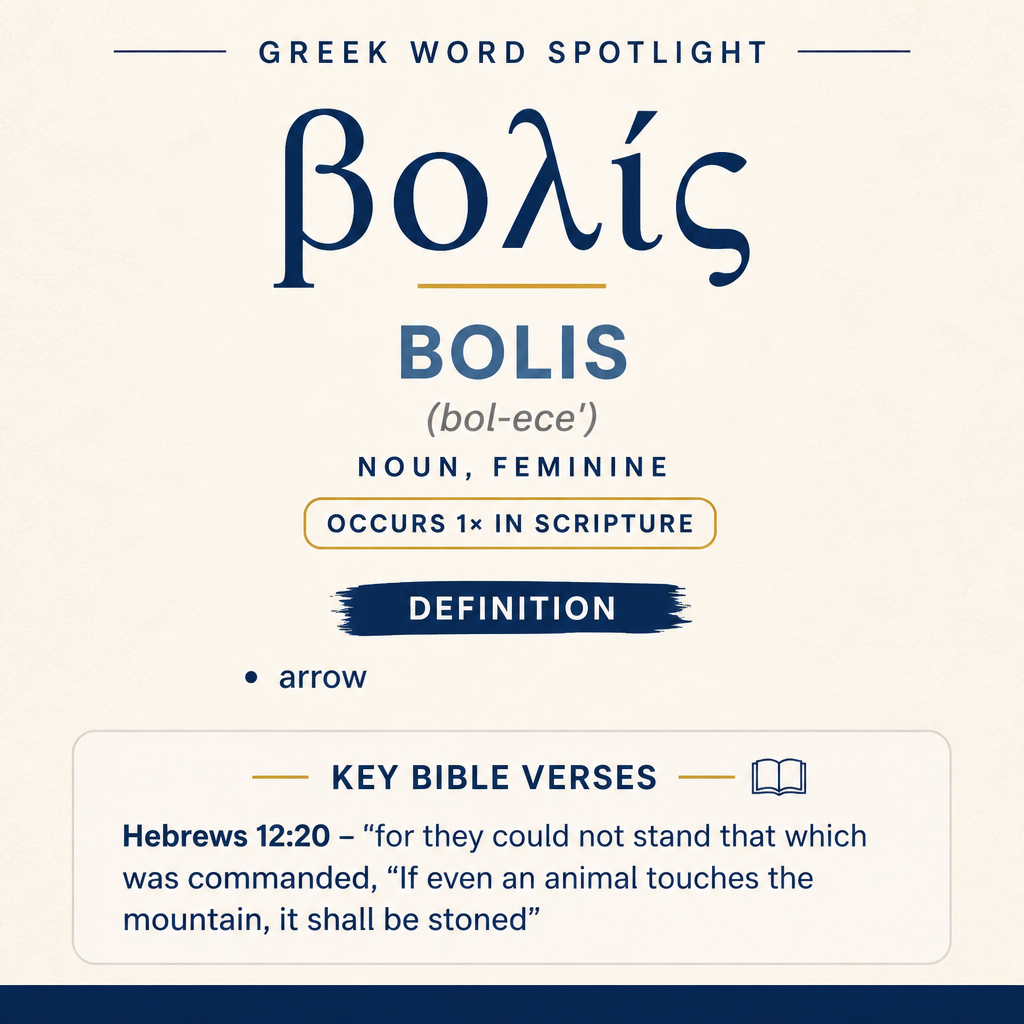
βολίς means “arrow” and appears once in Scripture, in Hebrews 12:20.
Verse Context
Hebrews 12:20 records a command: “If even an animal touches the mountain, it shall be stoned”.
Learn More →βολίς means “arrow” and appears in the New Testament in Hebrews 12:20. In that setting it belongs to the scene of a divine command at a mountain where even an animal’s contact brings lethal judgment.
Root and Related Words
βολίς is associated with the verb ballo (βάλλω), “to throw” (Strong’s G906). The connection sets the noun in the sphere of a thrown or projected object.

Occurrences
“for they could not stand that which was commanded, “If even an animal touches the mountain, it shall be stoned”.” (Hebrews 12:20)
In Hebrews 12:20, βολίς functions within a remembered command that puts strict limits around “the mountain.” The quoted wording emphasizes the severity of the boundary: the offense is as slight as an animal merely “touch[ing] the mountain,” yet the prescribed response is death—“it shall be stoned.” Within that atmosphere, “arrow” belongs to the same field of sanctioned lethal force as the stoning that is explicitly mentioned. The image is not of hunting or warfare for its own sake, but of enforcing a sacred perimeter: contact with the mountain is treated as an intolerable breach, and the measures described are decisive and fatal.
The wording “they could not stand that which was commanded” frames the command as overwhelming. “Arrow,” as a concrete projectile associated with distance, matches the logic of restraint implied by the command: if the mountain is dangerous to touch, the community must keep separation, and the means of executing the command naturally lies in actions that can be carried out without direct contact. The verse itself speaks of stoning, and the mention of “arrow” fits the same practical dynamic—judgment delivered while maintaining distance from what must not be approached. The result is a scene shaped by fear of transgression and by the need to uphold the command without violating the boundary oneself.
Because the verse directs attention to “even an animal,” the force of the command is heightened: the threat is not limited to deliberate human defiance but extends to accidental or non-moral contact. In that context, “arrow” contributes to the portrayal of impersonal, enforceable holiness—an order that does not depend on assessing intention. The mountain stands as a guarded place, and the “arrow” image adds to the sense that the boundary is real, externally maintained, and backed by lethal consequences.
Sense and Usage
The sense “arrow” is sharply concrete: a small, directed weapon whose point and flight embody precision and finality. Even though Hebrews 12:20 quotes the command in terms of stoning, the appearance of βολίς alongside this command places the word in a setting where the main idea is not the arrow’s craftsmanship or military deployment, but its suitability as an instrument of enforcement. An arrow is a means of killing that can be aimed and released from a position of separation. That feature aligns with the setting’s demand that the people not cross into forbidden contact with “the mountain.”
Within this single attestation, βολίς is not used to develop a narrative of archery, but to reinforce an atmosphere: the boundary is protected by sanctioned death, and the community is confronted with the seriousness of the command. The “arrow” thus participates in the rhetorical weight of the passage by contributing a vivid, physical image of judgment that can be inflicted swiftly and at range. In a context where the people “could not stand” what was commanded, the word’s concreteness intensifies the reader’s sense of how tangible and severe the command was—so severe that even the means of punishment evoke lethal projectiles rather than mere warning.
The related verb ballo (βάλλω), “to throw,” further frames βολίς by highlighting action: an arrow is not merely possessed but launched. That association accentuates the dynamic aspect of the image in Hebrews 12:20. The command is not theoretical; it contemplates real consequences carried out by decisive acts. The mountain is not merely marked off; it is guarded by the readiness to execute the command in a manner consistent with distance and danger.
Imagery
Hebrews 12:20 gathers its emotional force from a stark picture: a mountain that must not be touched, a command that cannot be endured, and a consequence expressed in the sentence “it shall be stoned.” In that severe perimeter, “arrow” carries the imagery of a lethal boundary maintained without approach. The word contributes a hard-edged realism to the scene: the mountain’s holiness is not only proclaimed but defended, and the cost of contact is death.
Sources: Lexical data from Strong’s Exhaustive Concordance and the Translators Brief Lexicon of Extended Strongs for Greek (STEPBible, CC BY). Occurrence data from the Translators Amalgamated Greek New Testament (STEPBible, CC BY). Scripture quotations from the World English Bible (public domain).




