
Understanding the Meaning of Blaberos in Greek
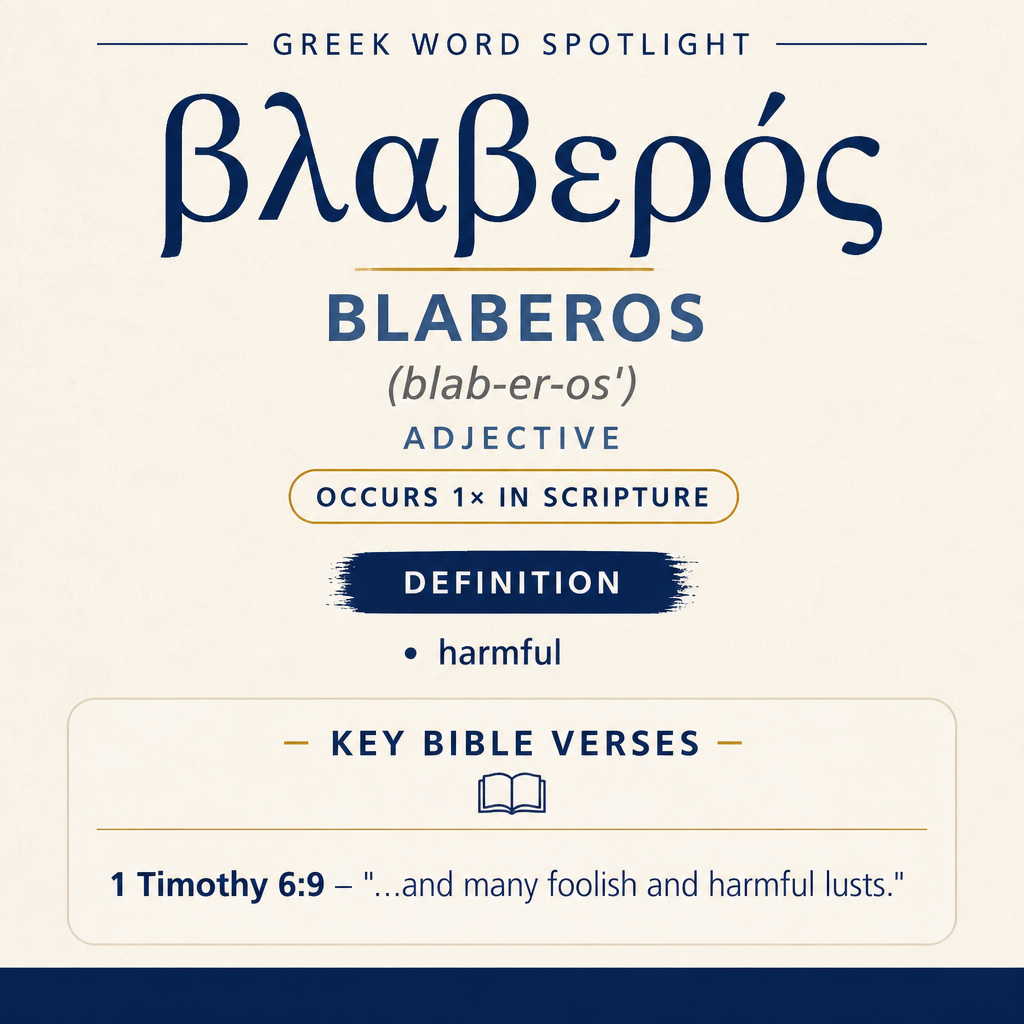
βλαβερός means “harmful” and appears once in Scripture, in 1 Timothy 6:9.
Verse Context
In 1 Timothy 6:9, it describes “harmful lusts” connected with being determined to be rich.
Learn More →βλαβερός describes something as “harmful,” and it appears in a warning about the pursuit of wealth in 1 Timothy 6:9. In that single setting it helps characterize certain desires as dangerous in their effects, not merely misguided.
Root and Related Words
βλαβερός (Blaberos) is related to the verb βλάπτω (blaptō), “to hurt” (Strong’s G984). The adjective form aligns with the idea of causing hurt, and it functions to qualify what is being described by highlighting its damaging impact.

Occurrences
“But those who are determined to be rich fall into a temptation, a snare, and many foolish and harmful lusts, such as drown men in ruin and destruction.” (1 Timothy 6:9)
Here βλαβερός modifies “lusts” within a tightly packed cluster of dangers: “temptation,” “a snare,” and “many foolish and harmful lusts.” The sentence portrays a progression in which a settled resolve—“determined to be rich”—leads not simply to isolated missteps but to a cascade of entanglements. Within that chain, “harmful” gives weight to the moral warning by emphasizing that these desires carry real destructive consequences. They are not presented as neutral preferences or passing impulses; they belong to the same field of peril as a “snare,” implying that what looks attractive can function like a trap.
The wording also places “harmful” alongside “foolish,” linking defective judgment with damaging outcomes. “Foolish” speaks to the character of the desires as senseless; “harmful” speaks to what they do. This pairing keeps the focus on effect: these lusts are the kind that “drown men in ruin and destruction.” In the imagery of drowning, the person is overwhelmed, pulled under, and unable to recover by mere willpower once submerged. βλαβερός supports that vivid portrayal by marking the desires as actively injurious—contributing to an outcome described with two heavy terms, “ruin” and “destruction,” which together intensify the picture of collapse.
Grammatically, βλαβερός operates as a descriptive adjective within a list, and its placement helps the sentence move from internal motives (“lusts”) to external result (“ruin and destruction”). The desires are not merely a private inner experience; in this verse they function as the mechanism by which the person is carried toward harm. By qualifying the lusts in this way, the word underscores the seriousness of the danger that accompanies the resolve “to be rich,” portraying that resolve as the doorway into a set of forces that injure and overwhelm.
Sense and Usage
The sense “harmful” in this passage is concrete in its outcome even though it describes an inner impulse. The desires in view are treated as causative: they lead to drowning “in ruin and destruction.” In other words, harm is not an abstract label attached to the lusts; the verse explains what that harm looks like by linking the lusts to the experience of being overcome and brought to collapse. βλαβερός therefore marks the desires as the kind that damage the person who indulges them, not merely the kind that offend a standard.
Because βλαβερός is applied to “lusts,” its force is evaluative: it assesses a category of desires according to their effect. The verse does not isolate one specific act but speaks of “many” such lusts, suggesting a broad array of impulses that share the same destructive tendency. Within the logic of the sentence, these harmful desires are part of what people “fall into,” along with temptation and a snare; the harm is intertwined with entrapment. The verse’s structure presents harm as something that can be entered, stepped into, and then experienced as an overpowering downward pull.
The phrase “such as drown men” further clarifies how the adjective is to be heard. Harm here is not minor injury but a force that can swallow a life. The word therefore carries a practical warning function in the verse: it names the dangerous quality of certain desires so that the reader can recognize them as threats, not opportunities. In this way βλαβερός strengthens the rhetorical movement from intention (“determined to be rich”) to consequence (“ruin and destruction”), showing that the path is not only morally compromised but personally devastating.
Even within a single occurrence, βλαβερός gains definition by its neighbors. It sits beside “foolish,” and it is framed by images of entrapment (“snare”) and submersion (“drown”). The harm is thus pictured as both deceptive and overpowering: deceptive because it comes through desires that can appear appealing, overpowering because it ends in drowning. The adjective’s contribution is to stamp these lusts with a clear moral and practical assessment: they belong to the domain of things that injure and bring about loss.
Imagery
1 Timothy 6:9 supplies an image of being pulled under—“drown men in ruin and destruction.” βλαβερός fits this imagery by characterizing the desires as dangerous currents rather than harmless wishes: they are forces that do damage, drawing a person downward into outcomes described as total collapse.
Sources: Lexical data from Strong’s Exhaustive Concordance and the Translators Brief Lexicon of Extended Strongs for Greek (STEPBible, CC BY). Occurrence data from the Translators Amalgamated Greek New Testament (STEPBible, CC BY). Scripture quotations from the World English Bible (public domain).





