Understanding the Significance of Blapto in Greek
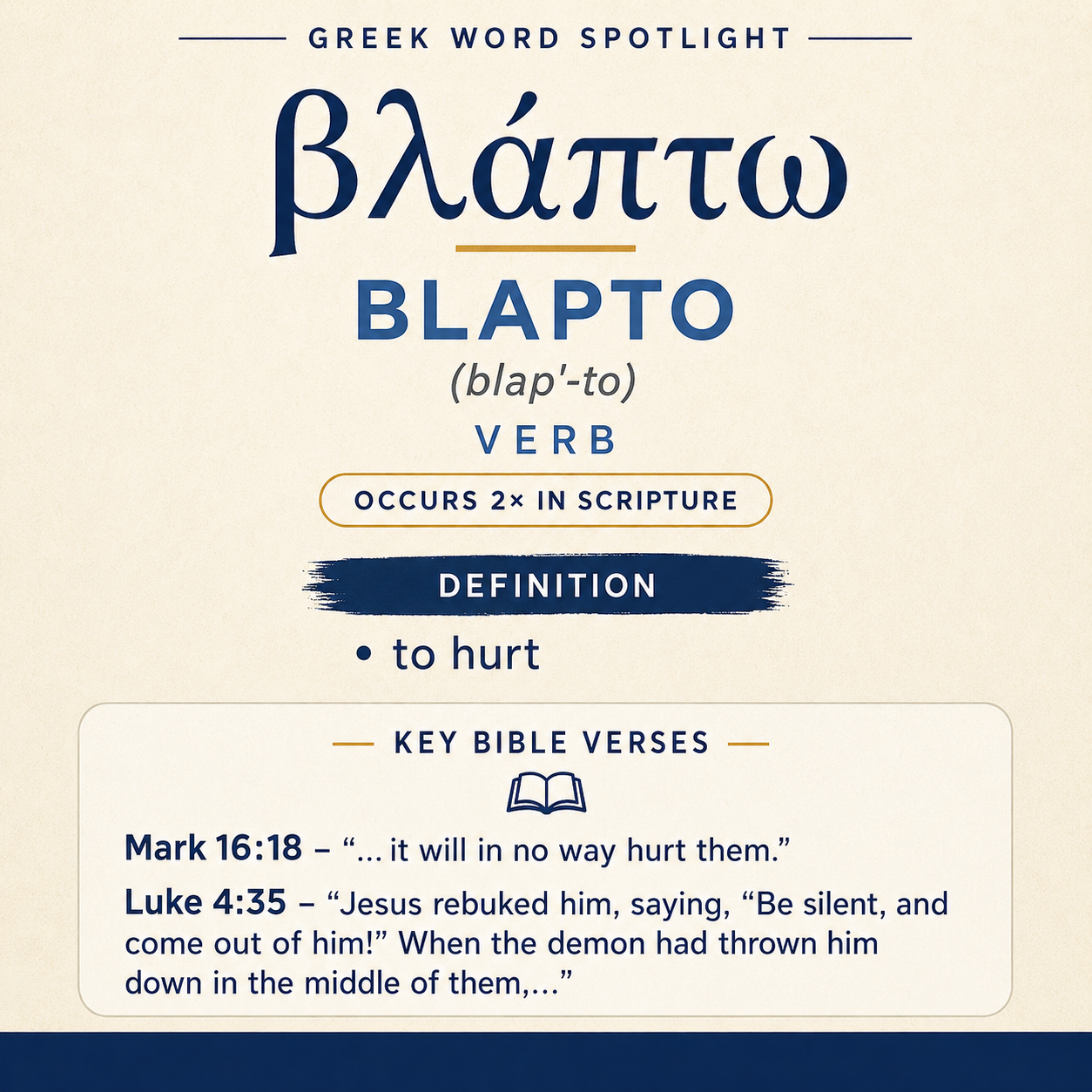
βλάπτω means “to hurt” and appears twice in Scripture: Mark 16:18 and Luke 4:35.
Mark Context
In Mark 16:18, it is used of deadly things that “will in no way hurt” them.
Learn More →βλάπτω means “to hurt,” appearing in two Gospel scenes: one describing protection from deadly dangers, and one describing deliverance from a demon without injury. In both, the word marks concrete harm that could be inflicted on a person, and then stresses its prevention or absence.
Occurrences
“they will take up serpents; and if they drink any deadly thing, it will in no way hurt them; they will lay hands on the sick, and they will recover.” (Mark 16:18)
Here βλάπτω sits in a chain of situations where danger or damage would normally be expected: handling serpents and ingesting “any deadly thing.” The clause “it will in no way hurt them” places the verb at the point where lethal potential would become actual injury. The statement does not linger on the mechanism of danger; instead it highlights the outcome—harm does not reach its target. That emphasis is reinforced by the phrasing “in no way,” which frames hurting as something definitively blocked, not merely reduced.
The verse then moves from threats (serpents, deadly drink) to healing action (“they will lay hands on the sick, and they will recover”). In that movement, βλάπτω functions as the negative counterpart to recovery: the verb represents the feared effect of poison or peril, while the close of the verse describes restoration. The pairing makes “hurt” a clear, bodily category—something that would impede life and health—but here is excluded from taking place.
“Jesus rebuked him, saying, “Be silent, and come out of him!” When the demon had thrown him down in the middle of them, he came out of him, having done him no harm.” (Luke 4:35)
In this account, βλάπτω is tied to an episode of violent disturbance: the demon throws the man down “in the middle of them.” The scene is public and disruptive, and it includes physical impact—being thrown down—where observers might assume injury. The closing assessment, “having done him no harm,” uses the verb to deny that the convulsion and collapse resulted in actual hurting of the man. The wording distinguishes between a frightening display and the lasting effect: the man is not harmed, even though he is visibly thrown down.
Because the verb is placed after the demon’s exit (“he came out of him”), it summarizes the outcome of the confrontation. βλάπτω marks the sort of damage that might remain once the episode ends; Luke’s line closes that possibility. The focus is not on how the man feels or how quickly he recovers, but on the fact that the demon’s final state is non-injury: despite the turmoil, the man is left unharmed.

Sense and Usage
Across these two passages, βλάπτω (“to hurt”) consistently points to real harm that could be inflicted on a person. It is not used for mild inconvenience or social offense in these contexts; the settings are bodily and hazardous. Mark’s wording sets “hurt” in the path of lethal threats—“any deadly thing”—so the verb stands for the expected effect of poison or mortal danger. Luke’s wording puts “hurt” in the wake of a violent spiritual encounter, where being thrown down would naturally raise the question of injury.
Both uses are framed negatively: the verb appears in constructions that deny its occurrence. In Mark, “it will in no way hurt them” denies harm as the result of deadly exposure; in Luke, “having done him no harm” denies harm as the residue of the demon’s violence. This shared pattern makes the verb a boundary-marker: it names the damaging outcome that is anticipated by the circumstances, and then it is explicitly ruled out. The denial does not make the danger unreal; the mention of serpents, deadly drink, and being thrown down underscores that the potential for harm is present, yet the concluding point is that hurting does not take effect.
The two scenes also show βλάπτω functioning as a measure of well-being. In Mark, the line about not being hurt sits alongside recovery of the sick, placing “hurt” and “recover” on opposite sides of a health outcome. In Luke, the man’s being thrown down is a visible event, but “no harm” is the diagnostic statement that tells the reader what to conclude about his condition afterward. Thus the verb can serve as a concise verdict on whether a dangerous episode has produced actual injury.
In both occurrences, the agent of potential hurt is something external: deadly things and serpents in Mark, a demon in Luke. The person in view is the one who might receive harm, and the verb highlights what would happen to that person if the danger succeeded. Yet the narrative force in each passage is protective: the threat is named, and then the expected harm is denied. βλάπτω therefore carries a concrete, this-world sense in these texts—harm that could befall the body—while the surrounding statements emphasize prevention and preservation in the midst of threatening conditions.
Imagery
The imagery surrounding βλάπτω is vivid and physical. Mark places “hurt” beside serpents and “any deadly thing,” evoking moments where life seems a step away from injury, yet the decisive statement is that harm does not occur. Luke places “no harm” after the jolt of a man thrown down before a crowd, using the verb to quiet the fear of lasting damage. Together these passages picture hurting as the expected end of danger—then show that end withheld.
Sources: Lexical data from Strong’s Exhaustive Concordance and the Translators Brief Lexicon of Extended Strongs for Greek (STEPBible, CC BY). Occurrence data from the Translators Amalgamated Greek New Testament (STEPBible, CC BY). Scripture quotations from the World English Bible (public domain).