
Exploring the Meaning of Biastes in Greek
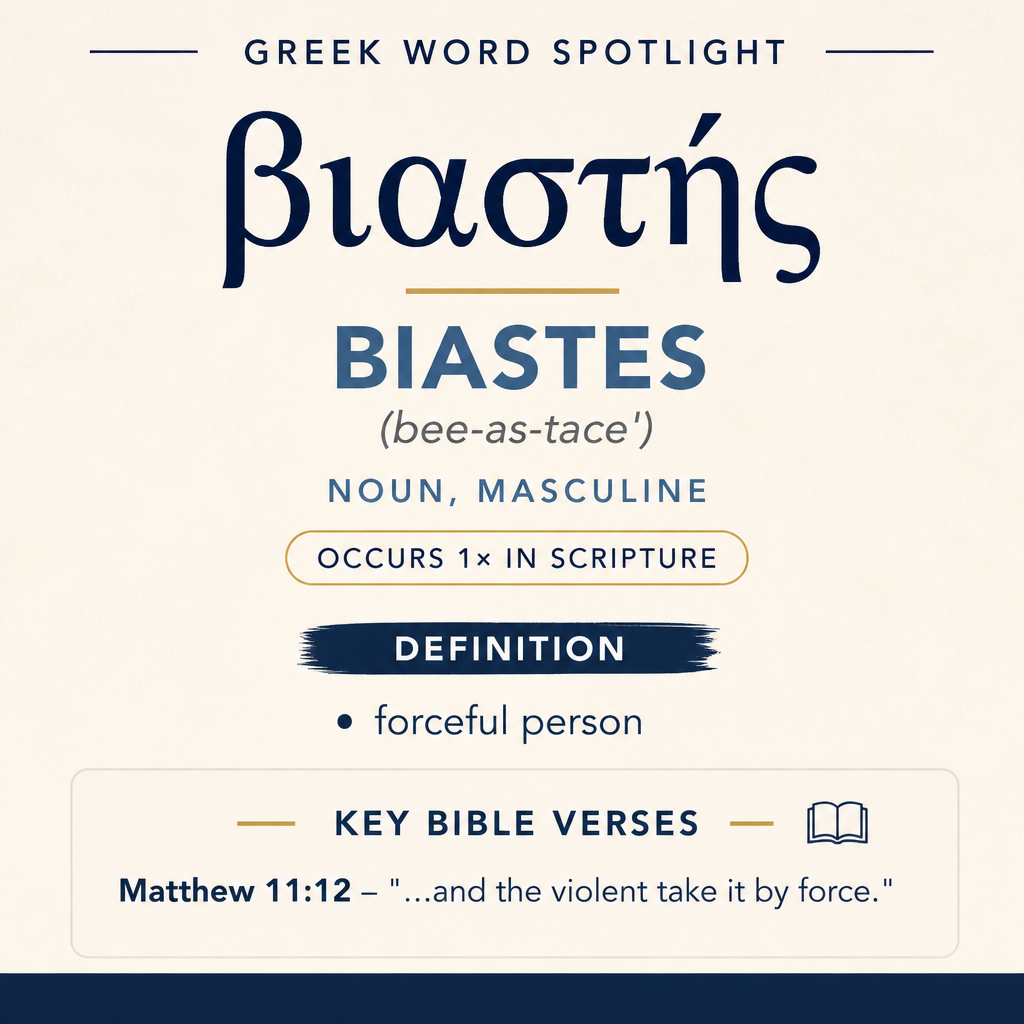
βιαστής means “forceful person” and appears once in Scripture in Matthew 11:12.
Scripture Occurrence
This word occurs 1 time in Scripture. It appears in Matthew 11:12.
Learn More →Verse Context
In Matthew 11:12, “the violent take it by force,” describing forceful people in relation to the Kingdom of Heaven.
Learn More →βιαστής refers to a “forceful person,” and it appears once in the New Testament. Its single occurrence is in Jesus’ saying about the Kingdom of Heaven in Matthew 11:12.
Root and Related Words
βιαστής is related to the verb biazo (βιάζω), meaning “to force” (Strong’s G971). The noun presents the actor characterized by that verbal idea: the person marked by forcing.

Occurrences
“From the days of John the Baptizer until now, the Kingdom of Heaven suffers violence, and the violent take it by force.” (Matthew 11:12)
Here βιαστής stands within a tightly packed set of images: the Kingdom of Heaven is described as undergoing violence, and alongside that condition Jesus speaks of “the violent” as those who “take it by force.” In this setting, βιαστής identifies the kind of person who acts in a forceful way toward the Kingdom—someone defined not by status or title in the sentence, but by the manner of action associated with force. The verse uses two coordinated clauses: first, the Kingdom “suffers violence,” then forceful persons respond with a corresponding action, “take it by force.” βιαστής supplies the human subject for that second clause, placing the focus on agents whose approach is marked by coercive strength in relation to the Kingdom’s present situation “from the days of John the Baptizer until now.”
The immediate literary frame inside the verse is temporal (“from the days… until now”), and within that timeframe the Kingdom is portrayed as the object of aggressive pressure. βιαστής contributes the sense that this pressure is not merely an abstract condition; it is carried out by concrete actors. The description is not content to say that there is violence in the air—rather, it depicts forceful persons who seize. The noun therefore anchors the statement in personal agency: “the violent” are those who correspond to the violence the Kingdom “suffers,” and their defining feature in the sentence is the force with which they act.
Sense and Usage
As a noun denoting a “forceful person,” βιαστής highlights character expressed through action. In Matthew 11:12 it is paired with the idea of taking “by force,” so the word’s forcefulness is not a quiet inner quality but a practical, outward drive that presses toward obtaining. The verse’s wording presents forcefulness as an identifiable way of approaching the Kingdom: it names a type of person by the kind of pressure that person exerts.
The line also sets up a relationship between what happens to the Kingdom and what certain people do with respect to it. The Kingdom “suffers violence,” and forceful persons “take it by force.” This parallelism makes βιαστής more than a label for strong personalities; it functions as the human counterpart to the violence described in the first clause. In other words, the noun belongs to a scene where the Kingdom is under violent pressure, and the people named by βιαστής are the ones exerting that pressure in a way that results in seizure.
Because βιαστής occurs here without further descriptive modifiers, the verse itself supplies the contours of how the term is being used: it is defined by what “the violent” do (“take it by force”) in the timeframe introduced (“From the days of John the Baptizer until now”). The saying therefore uses βιαστής to cast forcefulness as a recognizable posture within the unfolding moment being described. The focus is not on explaining motives or outcomes beyond what the clause states; the noun simply marks those who act in forceful seizure in relation to the Kingdom.
The connection to biazo (βιάζω), “to force,” helps clarify why the statement can move naturally from naming persons to describing their taking. The noun’s forcefulness is at home in a verb of forcing: the people characterized by force are presented as those whose action matches that characterization. In Matthew 11:12, βιαστής thus serves as an agent noun that fits the verse’s repeated language of violence and force, keeping the emphasis on the manner—forceful, coercive—by which the Kingdom is being engaged.
Imagery
Matthew 11:12 gives βιαστής a vivid, almost physical profile: the Kingdom is pictured as a reality that can be assaulted and seized. Within that imagery, βιαστής evokes the presence of people who push, grasp, and take—actors who meet the Kingdom not with passive reception but with forceful grabbing in a scene described in terms of violence and force.
Sources: Lexical data from Strong’s Exhaustive Concordance and the Translators Brief Lexicon of Extended Strongs for Greek (STEPBible, CC BY). Occurrence data from the Translators Amalgamated Greek New Testament (STEPBible, CC BY). Scripture quotations from the World English Bible (public domain).




