
Understanding the Meaning of Biaios in Greek
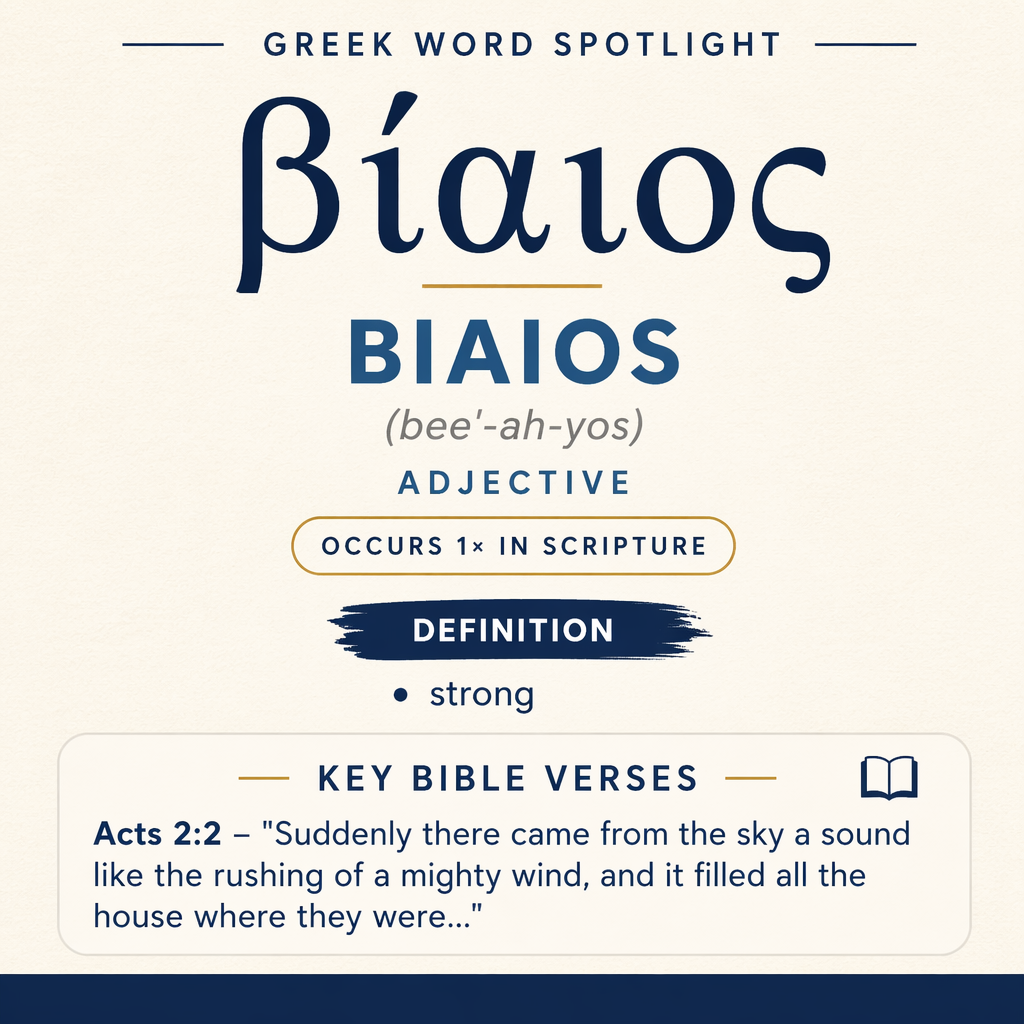
βίαιος means “strong” and appears once in Scripture in Acts 2:2 describing a sound like a rushing mighty wind.
Context in Acts
In Acts 2:2 it describes a sound like the rushing of a mighty wind filling the house.
Learn More →βίαιος expresses “strong” in its single New Testament appearance, describing the character of a sound associated with wind at Pentecost (Acts 2:2). In that scene, the adjective heightens the sensory force of what is heard and how fully it overwhelms the space.
Root and Related Words
βίαιος is related to bia (βία), “force” (Strong’s G970).

Occurrences
“Suddenly there came from the sky a sound like the rushing of a mighty wind, and it filled all the house where they were sitting.” (Acts 2:2)
Here βίαιος qualifies the impression created by the “sound” that comes “from the sky.” The event is introduced with “Suddenly,” setting a tone of abrupt, unsolicited arrival; the adjective “strong” belongs to that same register of intensity. What enters the scene is not described first as wind itself, but as “a sound like the rushing of a mighty wind.” In other words, the narrative foregrounds what the gathered people would immediately register with their senses: the audible, rushing character of the phenomenon.
Within the sentence, the comparison “like the rushing of a mighty wind” uses the wind image as the nearest analogue for describing an overwhelming auditory experience. The adjective directs the reader to hear the sound as powerful rather than gentle or merely noticeable. That force is then reinforced by the effect clause: “and it filled all the house where they were sitting.” The sound is not localized to a corner or confined to an entryway; it saturates the entire interior. The adjective “strong,” paired with the verb “filled,” contributes to a picture of total coverage—an acoustic presence that takes possession of the space and leaves no part of the house untouched.
The verse also keeps the focus on the people’s position: they were “sitting.” That quiet posture provides a contrast that makes the strength of the sound stand out. The adjective thus functions not as a detached description of wind’s usual properties, but as an evaluative descriptor of the perceived magnitude of the sound-event as it intrudes into a settled gathering.
Sense and Usage
The single use of βίαιος shows “strong” operating as a quality that can characterize an experience—specifically, an auditory phenomenon likened to “the rushing of a mighty wind.” In Acts 2:2, the adjective’s force is not abstract; it attaches to something concrete (“a sound”) and is immediately confirmed by its spatial result (“it filled all the house”). Strength, in this usage, is therefore presented as an intensity that can be heard and that can dominate an environment.
Because the verse frames the phenomenon as “a sound like” wind, βίαιος does not merely describe a physical object; it helps shape the comparison itself. The narrative does not ask the reader to picture a breeze moving leaves outside; it evokes the kind of wind whose rush would be unmistakable in volume and presence. The adjective supports that analogy by marking the sound as powerful enough to deserve the wind-comparison and to explain the filling of the house.
The placement of βίαιος within a tightly packed description (“Suddenly… from the sky… a sound… like… rushing… wind… filled”) also highlights how the adjective contributes to pacing. It adds weight to the moment without expanding the narration into extended detail. A single qualifying word intensifies the scene and prepares for the statement that follows, where the sound’s strength is measured by its effect on the whole interior space.
In this context, βίαιος serves a descriptive purpose rather than a moral or evaluative one. The verse offers no judgment about the sound as good or bad; it simply portrays it as powerfully present. The adjective’s role is to make the reader feel the magnitude of the event as it happens: sudden origin, skyward source, roaring comparison, and the house completely filled.
Imagery
The imagery carried by βίαιος in Acts 2:2 is the soundscape of overwhelming power: a rush that arrives without warning and spreads through an enclosed space until it “filled all the house.” The adjective helps cast the moment in terms of sheer sensory dominance—an audible force that comes “from the sky” and cannot be ignored by those sitting within.
Sources: Lexical data from Strong’s Exhaustive Concordance and the Translators Brief Lexicon of Extended Strongs for Greek (STEPBible, CC BY). Occurrence data from the Translators Amalgamated Greek New Testament (STEPBible, CC BY). Scripture quotations from the World English Bible (public domain).




