Exploring the Meaning of Bareos in Greek
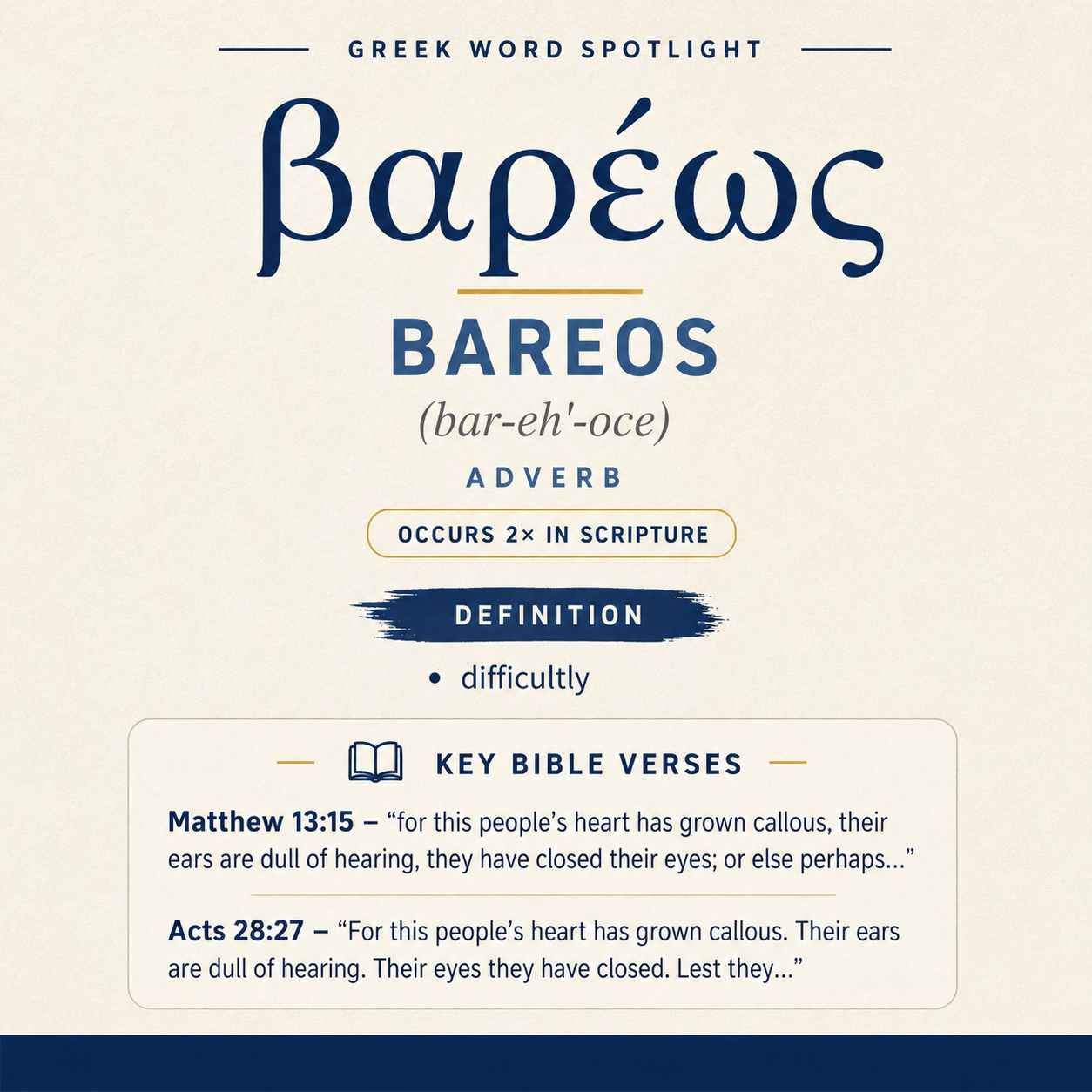
βαρέως means “difficultly” and appears twice in Scripture, in Matthew 13:15 and Acts 28:27.
Context of Use
In both listed verses, it appears in the statement that “their ears are dull of hearing.”
Learn More →βαρέως expresses the idea of something happening with difficulty. It appears in two parallel quotations about a people whose inner responsiveness has become blocked, in Matthew 13:15 and Acts 28:27.
Root and Related Words
βαρέως derives from barys (βαρύς), “weighty” (Strong’s G926). The relationship frames the adverb’s force: the scene describes a kind of heaviness that makes hearing and responding hard.

Occurrences
“for this people’s heart has grown callous, their ears are dull of hearing, they have closed their eyes; or else perhaps they might perceive with their eyes, hear with their ears, understand with their heart, and would turn again; and I would heal them.’” (Matthew 13:15)
Here the word modifies the description of hearing within a cluster of bodily and inward images. The heart “has grown callous,” ears are characterized as hard to hear with, and eyes are deliberately shut. In that setting, βαρέως marks the listening described in this sentence as obstructed—hearing is not presented as a ready, natural reception, but as something made hard. The verse builds a chain from perception (“perceive with their eyes”) to reception (“hear with their ears”), to comprehension (“understand with their heart”), and then to turning and healing. βαρέως contributes to that chain by portraying the “hear” stage as difficult, fitting the surrounding language of callousness and closure. The condition is not merely that information fails to arrive; rather, the text depicts a dulled capacity that makes the act of hearing itself laborious within the person’s present state.
“For this people’s heart has grown callous. Their ears are dull of hearing. Their eyes they have closed. Lest they should see with their eyes, hear with their ears, understand with their heart, and would turn again, then I would heal them.’” (Acts 28:27)
Acts uses the same wording in shorter, stacked sentences before restating the “lest” outcome. βαρέως again sits in the portrayal of the ears: the ears are described in a way that makes hearing difficult, and this is paired with a calloused heart and closed eyes. The structure in Acts is especially forceful because it presents each obstacle as a distinct, clipped statement (“heart… callous. …ears… dull of hearing. …eyes… closed.”), then brings them together in the “lest” clause. Within this framing, βαρέως supports the sense that the barrier is comprehensive: sight, hearing, and inner understanding form a unified process, and difficulty at the level of hearing contributes to the larger failure to “understand with their heart” and “turn again.” The adverb’s contribution is to characterize the auditory reception as encumbered, not simply absent; the ears are portrayed as functioning under a burden that keeps the person from reaching the turning-and-healing outcome described at the end of the quotation.
Sense and Usage
Across both occurrences, βαρέως (“difficultly”) does not stand alone as an abstract comment about effort; it is embedded in a vivid portrayal of dulled faculties. The passages do not treat difficulty as neutral hardship or external pressure, but as an inward condition described with bodily metaphors: a calloused heart, ears that do not readily receive sound, and eyes closed. In both texts, the difficulty of hearing belongs to a sequence: seeing → hearing → understanding → turning → healing. That sequence implies movement from outward perception to inward grasp and then to changed direction. βαρέως contributes by casting the hearing step as resistant—an impaired gateway between perception and understanding.
The immediate neighbors of the term sharpen its nuance. “Heart has grown callous” places the difficulty within the center of will and responsiveness; “they have closed their eyes / Their eyes they have closed” indicates an active shutting; and the conditional result “or else perhaps they might…” / “Lest they should…” shows what would happen if the impediments were removed: perceiving, hearing, understanding, turning, and healing. In that environment, “difficultly” functions as a diagnostic descriptor: it describes the manner in which hearing is experienced under spiritual dullness. The word is therefore closely tied to the theme of inhibited responsiveness, not to intellectual complexity. The difficulty is experiential and moral-psychological within the imagery of the verse: the ears do not receive easily because the whole person is presented as hardened and shut down.
Because Matthew and Acts preserve the same conceptual chain, βαρέως gains interpretive stability: it consistently describes hearing as a hard task within a hardened condition, and it consistently stands opposite the hoped-for alternative in which hearing would proceed to understanding and turning. The adverb thus serves to intensify the description of blockage: it is not merely that the message is missed; the faculty of hearing is portrayed as operating with difficulty as part of an overall closed posture.
Imagery
The imagery surrounding βαρέως is tactile and physical. A “callous” suggests thickened resistance; “closed” eyes suggest a shut gate; and hearing “difficultly” suggests an ear weighed down so that sound does not pass through to understanding. In both quotations, the word participates in a portrait of the human person as sealed off—sight, hearing, and heart-work all constrained—so that the pathway to turning and healing is depicted as blocked at multiple points.
Sources: Lexical data from Strong’s Exhaustive Concordance and the Translators Brief Lexicon of Extended Strongs for Greek (STEPBible, CC BY). Occurrence data from the Translators Amalgamated Greek New Testament (STEPBible, CC BY). Scripture quotations from the World English Bible (public domain).