Exploring the Meaning of Barachias in Greek
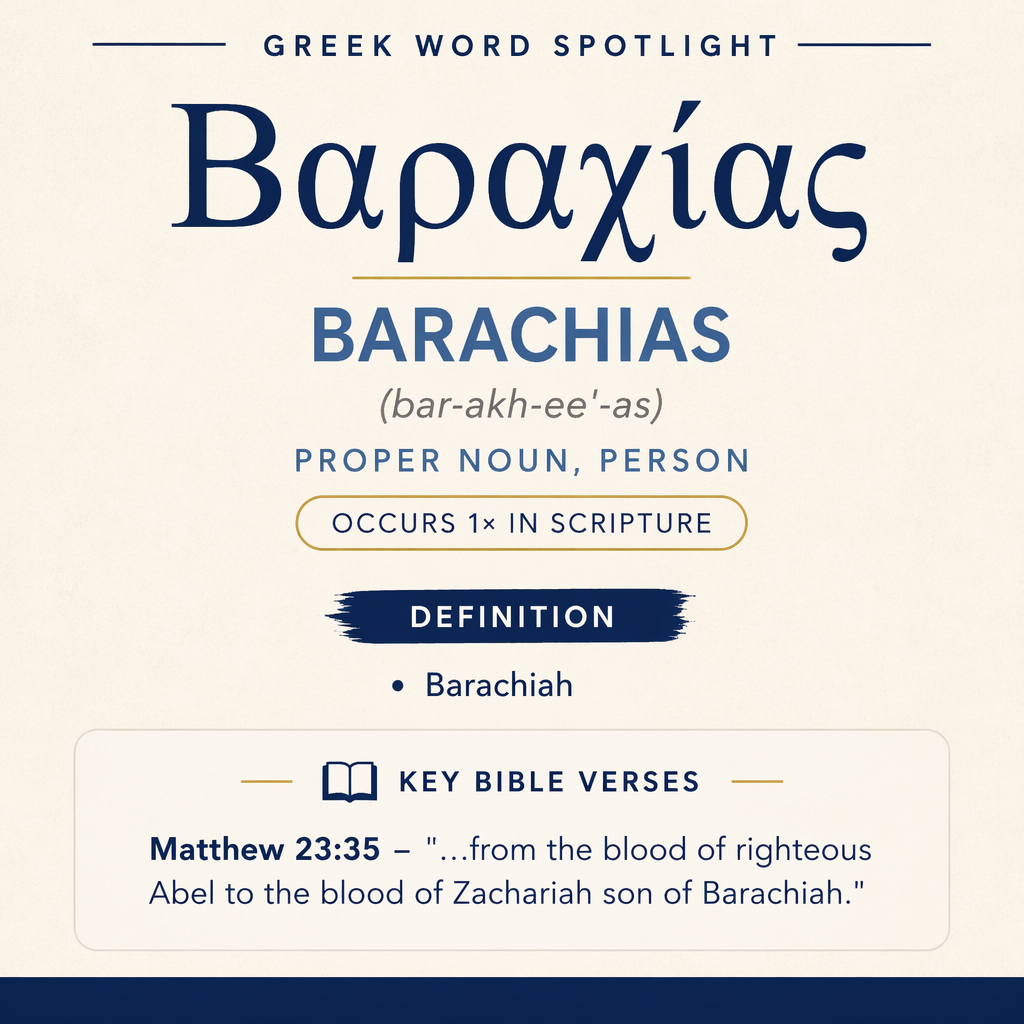
Βαραχίας means “Barachiah” and appears once in Scripture, in Matthew 23:35.
Name & Sense
Βαραχίας is defined as “Barachiah.” It is a Greek proper name for a person.
Learn More →Biblical Occurrence
The word occurs 1 time in Scripture. Its single occurrence is in Matthew 23:35.
Learn More →Verse Context
In Matthew 23:35, it appears in the phrase “the blood of Zachari…,” within a statement about righteous blood shed on the earth.
Learn More →Barachias is the name “Barachiah,” appearing once in the New Testament within a genealogical-style identification. In its single occurrence it functions to specify which Zachariah is meant in a statement about “righteous blood shed on the earth.”
Occurrences
“that on you may come all the righteous blood shed on the earth, from the blood of righteous Abel to the blood of Zachariah son of Barachiah, whom you killed between the sanctuary and the altar.” (Matthew 23:35)
Here Barachias appears inside the phrase “Zachariah son of Barachiah,” where it serves as the second element in a two-part identification: a personal name (Zachariah) is further distinguished by naming his father (Barachiah). In the verse’s larger sentence, the speaker announces the sweeping scope of accountability—“all the righteous blood shed on the earth”—and frames that scope by naming two endpoints: “from the blood of righteous Abel to the blood of Zachariah son of Barachiah.” The insertion of Barachias into the identification does not add a separate action or new event; instead, it narrows the reference so that “Zachariah” is anchored to a particular lineage, intensifying the concreteness of the claim. This anchoring becomes especially pointed because the verse immediately attaches a location-specific accusation—“whom you killed between the sanctuary and the altar”—so the name is not merely a label but a way of placing the victim within a remembered act of violence tied to sacred space.
Because the verse is structured as a direct address (“on you may come… whom you killed…”), the patronymic “son of Barachiah” also bears rhetorical weight. It keeps the discourse from drifting into abstraction by presenting the victim as a particular person with a family connection, not only as an example of “righteous blood.” In the same breath that the speaker ranges across the whole earth and across a wide span marked by Abel and Zachariah, Barachias pulls the focus back down to an identifiable individual: Zachariah is not an anonymous casualty but someone who stands in relation to Barachiah as son to father.

Sense and Usage
As the proper name “Barachiah,” Barachias functions in Matthew 23:35 as a relational identifier within a legal-accusatory statement. Its role is not descriptive (it does not characterize Zachariah by an adjective or title) but referential: it distinguishes and fixes identity through kinship. In ordinary discourse, a single personal name can be insufficient when multiple individuals share it; by adding “son of Barachiah,” the speaker uses a compact, culturally recognizable method of specification. The effect within this sentence is to reinforce that the accusation concerns real, particular bloodshed—blood that belongs to persons whose names and relations can be stated.
The immediate context pairs Barachias with spatial and cultic markers—“between the sanctuary and the altar.” The father’s name is thus embedded in a statement that binds together person, place, and guilt. The clause “whom you killed” assigns responsibility directly to the addressed group, while “between the sanctuary and the altar” locates the killing in proximity to the most sacred precincts. Within that frame, “son of Barachiah” contributes to the sense that the wrongdoing being cited is not vague or generalized; it is the kind of offense that can be narrated with names and with a definite setting. Even though Barachias himself is not portrayed acting in this verse, the mention of his name intensifies the personal dimension of the violence: the killed one is presented not only as “Zachariah” but as someone’s son.
The verse also uses a broad rhetorical range: it begins with “all the righteous blood shed on the earth” and then provides a pair of named examples, Abel and Zachariah. Within that pair, only Zachariah is further specified by a patronymic. Barachias, therefore, functions as part of the verse’s strategy of precision: the speaker is not merely invoking archetypal righteousness and archetypal violence, but naming a specific Zachariah by family connection. The definition “Barachiah” is realized here in the most straightforward way a proper personal name can operate—by designating one person in relation to another and enabling the sentence to point more sharply at a particular historical grievance remembered in communal speech.
In terms of how the name works in the line, Barachias appears in a genitival relationship (“son of Barachiah”), where its function depends on the kinship term “son.” That construction makes the father’s name meaningful within the discourse without requiring any additional narrative about him. The verse does not speak of Barachiah’s deeds, character, or fate; his name is invoked solely to secure the reference of “Zachariah.” This is a common and efficient function of personal names in charged public speech: a patronymic can establish identity with minimal wording, allowing the speaker to keep the focus on the accusation (“whom you killed”) and the setting (“between the sanctuary and the altar”) while still making the victim unmistakably particular.
Imagery
Although Barachias is only a name in this passage, it is bound to striking imagery through the clause that follows: “between the sanctuary and the altar.” The scene evoked is a sacred area where worship and sacrifice belong, now recalled as the setting of a killing. By appearing in the phrase “Zachariah son of Barachiah,” the name Barachias becomes part of the verse’s memorializing force: the accused bloodshed is presented as an event that can be located both in family lineage and in the very spaces meant for holiness. The result is an intensified contrast between what the place signifies (“the sanctuary and the altar”) and what is alleged to have been done there (“whom you killed”).
Sources: Lexical data from Strong’s Exhaustive Concordance and the Translators Brief Lexicon of Extended Strongs for Greek (STEPBible, CC BY). Occurrence data from the Translators Amalgamated Greek New Testament (STEPBible, CC BY). Scripture quotations from the World English Bible (public domain).