Exploring the Meaning of Barak in Greek
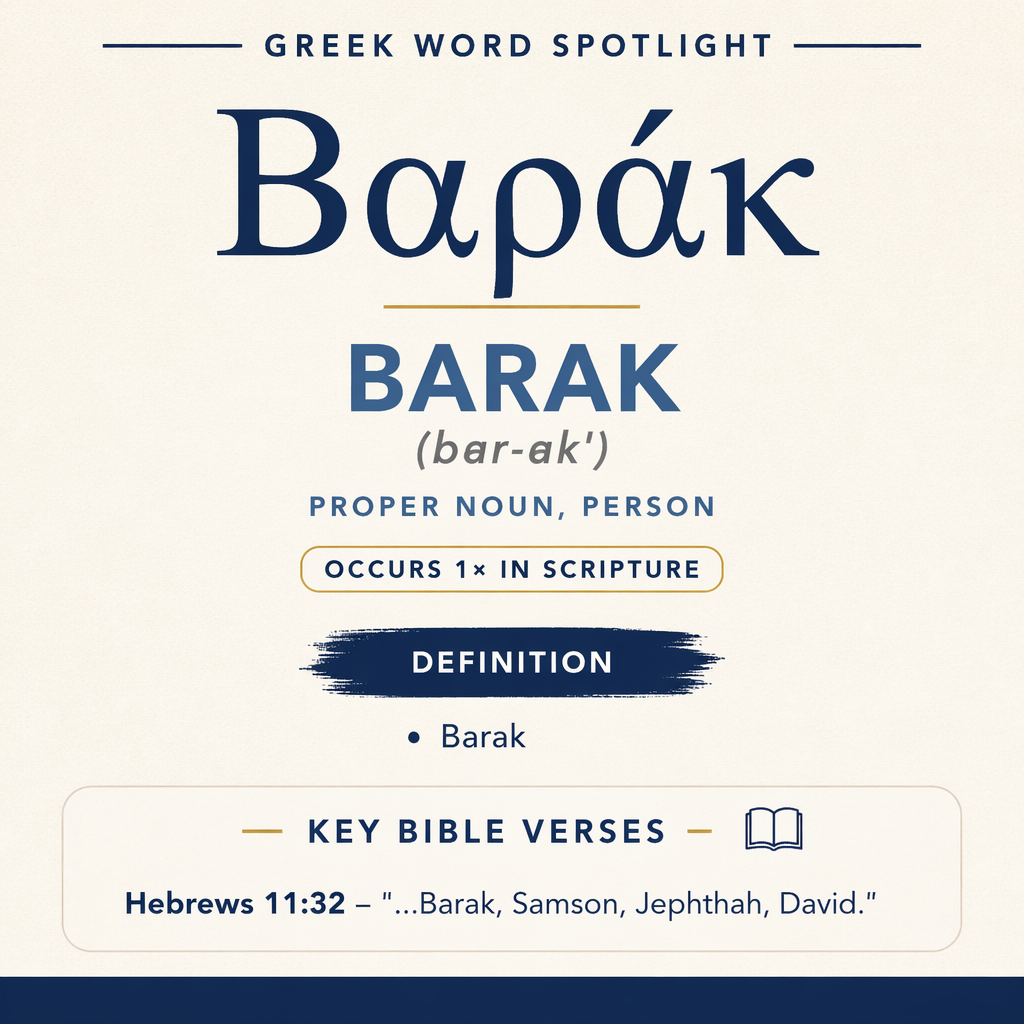
Βαράκ (Barak) means “Barak” and appears once in Scripture, in Hebrews 11:32.
Hebrews Listing
In Hebrews 11:32, Barak is listed among Gideon, Samson, Jephthah, David, and Samuel.
Learn More →Βαράκ is the personal name “Barak.” It appears in Hebrews 11:32 within a rapid list of figures whose stories exemplify faith.
Occurrences
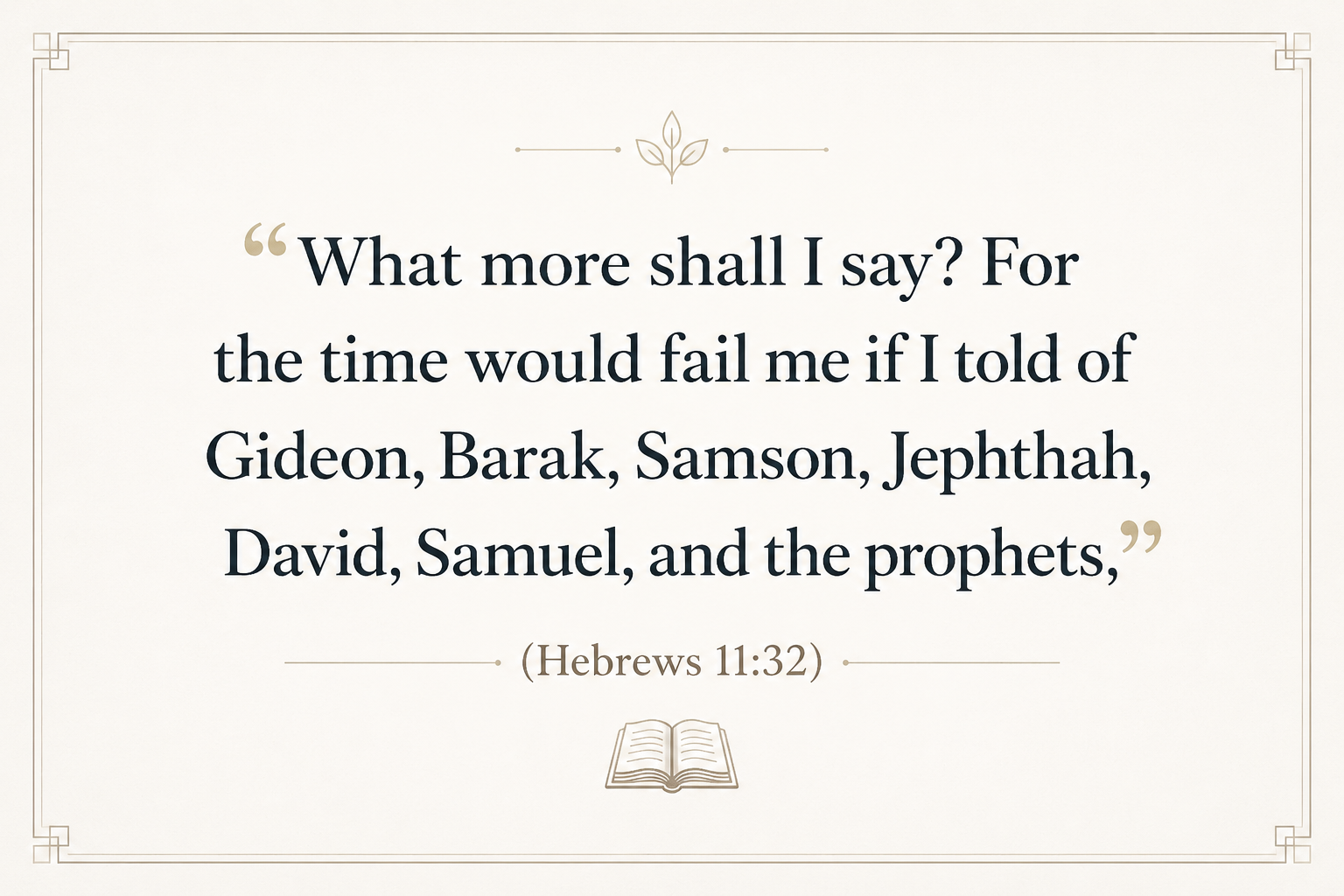
“What more shall I say? For the time would fail me if I told of Gideon, Barak, Samson, Jephthah, David, Samuel, and the prophets,” (Hebrews 11:32)
Here Βαράκ functions as one item in a tightly packed series of names. The sentence is shaped as a rhetorical question followed immediately by a claim of shortage—“the time would fail me”—so the list is offered as a representative sampling rather than a full treatment. Within that framing, “Barak” is not introduced with an explanation, title, or narrative detail; the name is simply placed alongside other well-known figures (“Gideon…Samson…Jephthah…David…Samuel”) and then broadened into a final category (“and the prophets”). The effect is that Βαράκ contributes to the author’s cumulative argument by strengthening the sense of abundance: there are so many examples that the writer cannot pause over each one. “Barak” therefore serves the paragraph’s compressive style—many names, minimal words—where the author relies on recognition of the name to carry weight without elaboration.
The placement of “Barak” between “Gideon” and “Samson” also reinforces how the list is built: individual names appear as discrete entries, separated by commas, so that each name stands on its own as a distinct witness within the larger group. The list then moves from named individuals (“Gideon, Barak, Samson, Jephthah, David, Samuel”) to the collective (“the prophets”), and “Barak” participates in this movement as one of the individual exemplars that lead into a wider, open-ended set. In this verse, Βαράκ is not treated as a minor aside; it is part of the author’s deliberate strategy of naming, where every name helps make the point that the catalog could continue beyond the space available.

Sense and Usage
The sense of Βαράκ in Scripture usage here is straightforwardly nominative: it identifies a person by name, “Barak,” without additional descriptive content in the immediate context. Because Hebrews 11:32 presents the name in a sequence, the word operates less by conveying a lexical idea and more by evoking an associated narrative and reputation—yet the verse itself keeps that evocation implicit. The author does not specify which deeds are in view for Barak, nor does he distinguish Barak from the others by attributing a particular action or virtue to him in this line. Instead, the verse uses the name as a compact pointer, trusting that the mere mention of “Barak” is sufficient for the intended rhetorical force.
The surrounding wording explains why a proper name can carry such force with so little space. The clause “For the time would fail me if I told of…” indicates that each name stands for more than can be recounted. In that environment, “Barak” functions as a compressed reference: a single word that represents a fuller story the author declines to narrate. The list form also shows how the name is used in coordination with other proper nouns; “Barak” shares equal grammatical footing with the other names as one coordinate element in the series. This coordination produces a leveling effect: the verse does not rank the figures or analyze their differences, but it does place Barak firmly among a recognized set of faith exemplars.
Because the verse concludes with “and the prophets,” the sequence suggests two concentric circles: a ring of named examples and a broader, unnamed community. “Barak” belongs to the ring of named examples, where the author’s choice to include this specific name contributes to the breadth of the witness being appealed to. Within the one verse where it appears, then, Βαράκ is used in a manner typical of a litany: it is a brief but weight-bearing mention, designed to expand the reader’s sense of how many instances could be cited. The definition “Barak” fits the usage precisely: the word does the work of naming, and that naming serves the author’s swift accumulation of testimony.
Imagery and Effect
Although Hebrews 11:32 supplies no narrative imagery directly attached to “Barak,” the verse does create a vivid picture of urgency and abundance. The writer’s admission—“the time would fail me”—conjures the sense of a speaker moving quickly through a mental storehouse of accounts, selecting names as shorthand for whole histories. In that rhetorical scene, “Barak” is one of the names spoken almost in passing, yet the very act of including it implies it belongs among those whose accounts are worth telling, even if time does not permit. The imagery is therefore not an image of Barak’s actions, but of a crowded roll of witnesses: a series of names spoken in quick succession, each one implying a larger story beyond the verse’s limited space.
Sources: Lexical data from Strong’s Exhaustive Concordance and the Translators Brief Lexicon of Extended Strongs for Greek (STEPBible, CC BY). Occurrence data from the Translators Amalgamated Greek New Testament (STEPBible, CC BY). Scripture quotations from the World English Bible (public domain).