
Exploring the Meaning of Balantion in Greek
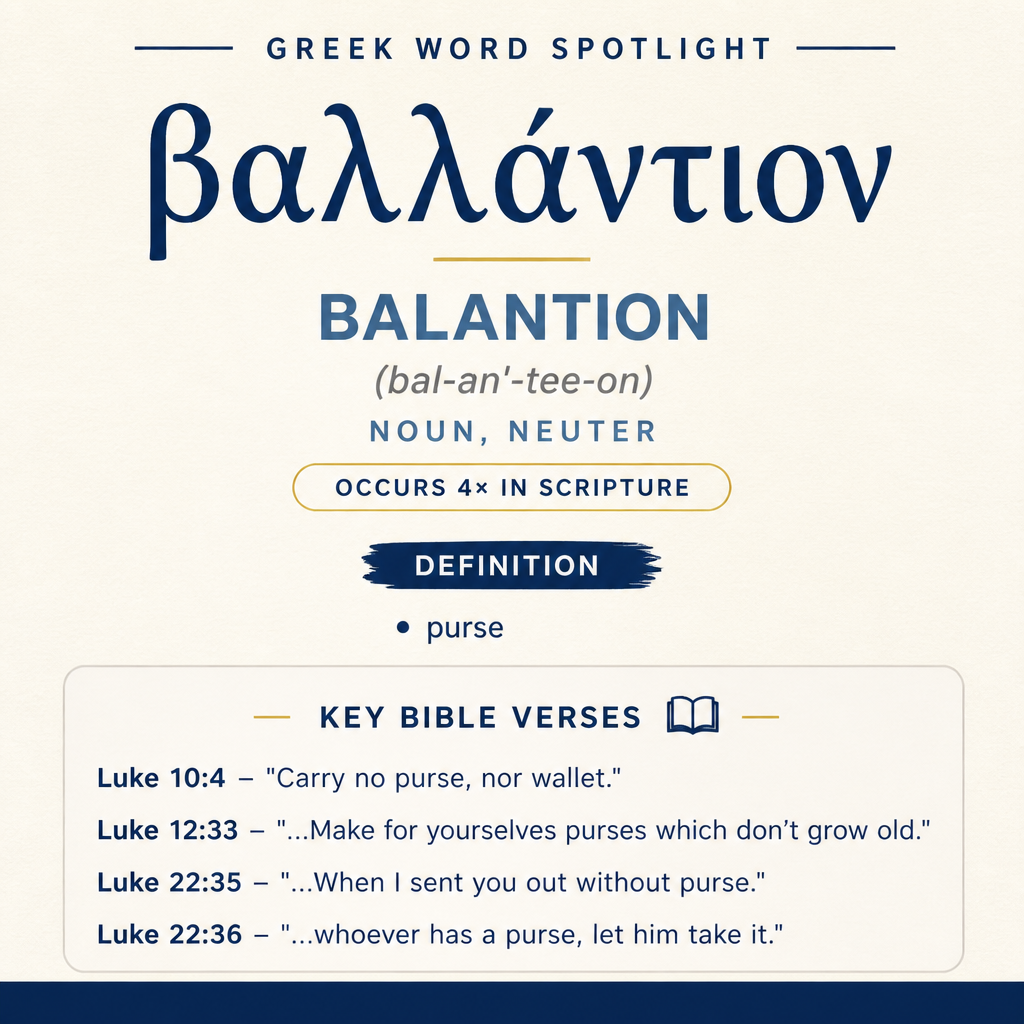
βαλλάντιον (Balantion) means “purse” and appears four times in Scripture, all in Luke (10:4; 12:33; 22:35–36).
In Context
In Luke 10:4 and 22:35, Jesus speaks of being sent without a purse; in 22:36, he tells whoever has a purse to take it.
Learn More →βαλλάντιον means “purse” and appears in four sayings in Luke, each time marking what is carried—or deliberately not carried—on the road and in ordinary provision. In these contexts it becomes a concrete point of instruction about readiness, need, and the handling of material resources.
Root and Related Words
βαλλάντιον is related to the verb ballō (βάλλω), “to throw” (Strong’s G906).

Occurrences
Luke 10:4: “Carry no purse, nor wallet, nor sandals. Greet no one on the way.”
Here “purse” stands first in a tight list of travel items—purse, wallet, sandals—framed by two imperatives. The command “Carry no purse” treats the purse as a normal means of provisioning for a journey, something a traveler would ordinarily take along. Set beside “Greet no one on the way,” the instruction is not merely about objects but about the shape of the mission: the traveler is to move without the usual supports and without the usual slowdowns. Within this saying, the purse functions as a clear, tangible symbol of what one might rely on or plan around while traveling, and the directive removes it as part of the equipment for the road.
Luke 12:33: “Sell that which you have, and give gifts to the needy. Make for yourselves purses which don’t grow old, a treasure in the heavens that doesn’t fail, where no thief approaches, neither moth destroys.”
In this setting, “purses” is plural and sits inside a string of imperatives about possessions and generosity: selling, giving, and then “Make for yourselves purses which don’t grow old.” The purse is still a container for valuables, but the focus is on what kind of purse one “makes” and what it holds. The line “a treasure in the heavens that doesn’t fail” immediately explains the direction of the imagery: the purse language is used to speak about storing value in a way that is not subject to ordinary loss. The verse’s contrast is concrete: thieves and moths threaten what is stored in ordinary life, but the “purses which don’t grow old” correspond to a “treasure” described as secure from those threats. The word therefore contributes a vivid, everyday picture—where valuables are kept—and then uses that picture to frame a reorientation of where treasure is held and how it is protected.
Luke 22:35: “He said to them, “When I sent you out without purse, wallet, and sandals, did you lack anything?” They said, “Nothing.””
This occurrence recalls an earlier sending and ties the purse directly to the question of sufficiency. The phrase “without purse, wallet, and sandals” repeats the earlier list-like pattern and makes the purse part of a remembered condition: they traveled without it. The rhetorical question “did you lack anything?” treats the purse as one of the practical means by which a traveler would normally avoid lack. The reply, “Nothing,” is the punchline of the recollection: in that earlier mission, the absence of the purse did not result in unmet needs. In this line, the purse is not spiritualized; it remains a practical item whose absence would ordinarily be felt, and that ordinary expectation is precisely what the question and answer address.
Luke 22:36: “Then he said to them, “But now, whoever has a purse, let him take it, and likewise a wallet. Whoever has none, let him sell his cloak, and buy a sword.”
Here “purse” becomes part of a sharp pivot: “But now.” In contrast to the earlier “without purse,” the instruction now assumes that some will “have a purse” and should “take it.” The purse is presented as appropriate equipment for the new situation, paired again with “wallet,” maintaining the sense of travel provisions and what one carries for ordinary needs. The parallel line “Whoever has none, let him sell his cloak, and buy a sword” heightens the practical tone: items are taken, lacked, sold, and purchased. Within that concreteness, the purse marks a return to ordinary provisioning—having something to carry resources in—and it sits alongside decisive preparation, as the saying moves from what one does carry (purse, wallet) to what one must obtain (a sword) even at the cost of a cloak.
Sense and Usage
Across these four texts, the purse consistently belongs to the everyday world of carrying and safeguarding personal resources. It is treated as a normal travel item—something one might bring “on the way,” something one might possess and “take,” and something whose presence or absence naturally connects to whether a traveler “lack[s] anything.” That practical baseline allows the sayings to use the purse as a hinge between two kinds of instruction: at times it is deliberately excluded, and at other times it is explicitly taken along.
Luke’s sequence shows the purse operating within paired or clustered lists (purse/wallet/sandals; purse/wallet), which keeps the reader close to the physical reality of what is carried. The repeated pairing with “wallet” suggests a closely related sphere of personal gear: items for managing provisions, money, or valuables while traveling. The purse is never an isolated image; it is embedded in movement (“on the way”), sending (“When I sent you out”), and readiness (“whoever has a purse, let him take it”).
At the same time, Luke 12:33 demonstrates how purse-language can be extended beyond travel equipment into a picture of storing value. “Make for yourselves purses which don’t grow old” draws on the purse as a repository: what matters is what is kept and how safe it is from loss. The verse names concrete threats—“thief” and “moth”—and sets the promise of a “treasure in the heavens that doesn’t fail” over against them. Without changing the word’s basic sense, the saying uses the familiar function of a purse to make the contrast between vulnerable earthly storage and secure heavenly treasure vivid and memorable.
When Luke 10:4 and Luke 22:35 are read together, the purse becomes a marker of a specific mode of travel: going without normal provisions and discovering that lack does not follow. When Luke 22:36 is added, the same item becomes a marker of a different mode: now taking what one has and even securing what one lacks. The purse thus serves Luke as a small but forceful detail that can signal an entire posture toward provision—either traveling without ordinary supports or preparing with ordinary supports in view.
Imagery
The passages attach the purse to road-life and to what is kept safe. A purse can be carried—or deliberately left behind—while moving quickly “on the way,” and it can also represent where “treasure” is stored, with thieves and moths as threats to what people value. In these sayings, the purse is a simple object that frames large questions: what one depends on, what one gives away, what one safeguards, and what one takes up when circumstances change.
Sources: Lexical data from Strong’s Exhaustive Concordance and the Translators Brief Lexicon of Extended Strongs for Greek (STEPBible, CC BY). Occurrence data from the Translators Amalgamated Greek New Testament (STEPBible, CC BY). Scripture quotations from the World English Bible (public domain).





