Exploring the Meaning of Achaia in Greek
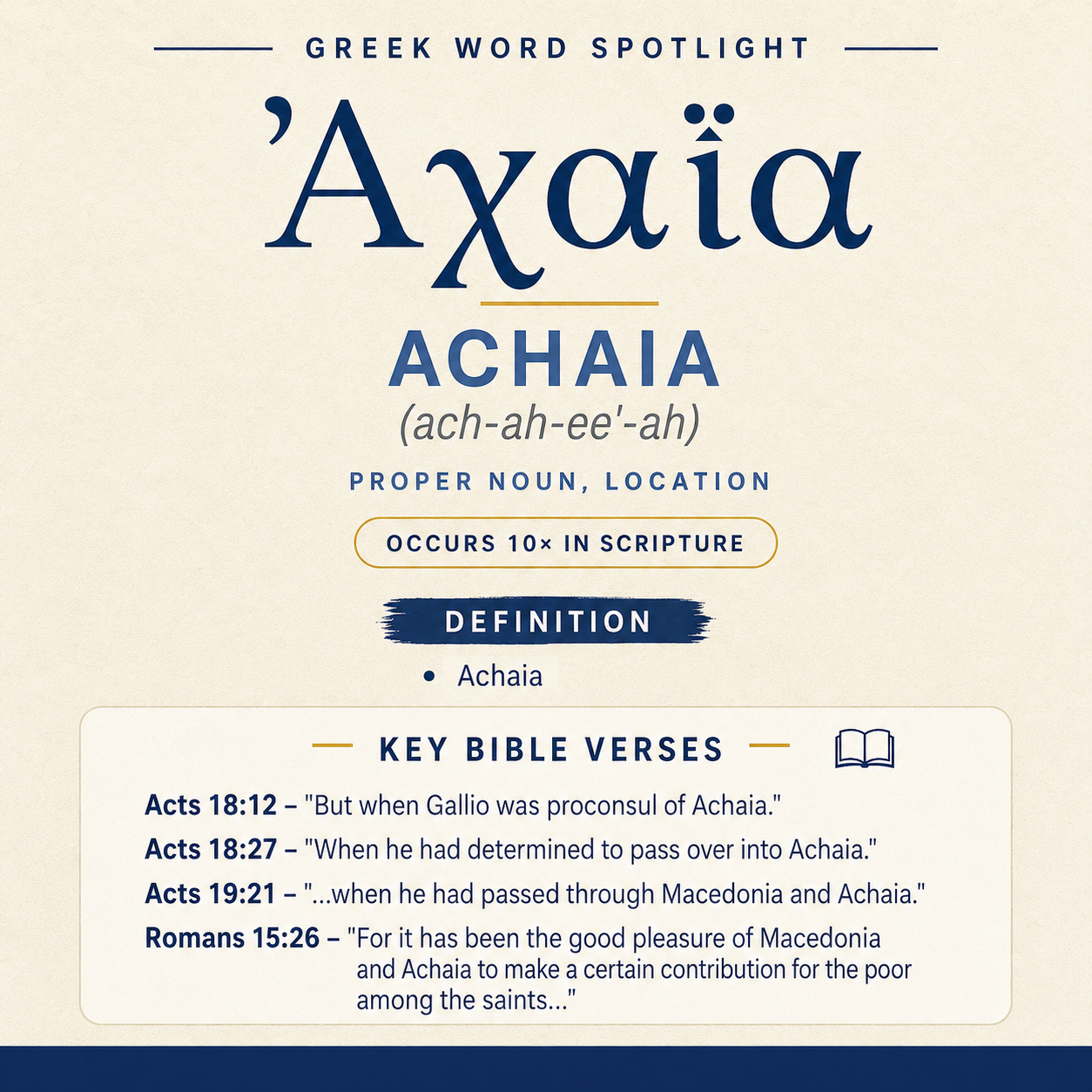
Ἀχαΐα means “Achaia” and appears in the New Testament in Acts, Romans, 1 Corinthians, and 2 Corinthians.
Where It Appears
Ἀχαΐα occurs 10 times in Scripture. It is found in Acts 18–19; Romans 15; 1 Corinthians 16; and 2 Corinthians 1, 9, and 11.
Learn More →Narrative Use
In Acts, Achaia is linked with Gallio’s proconsulship and travel plans involving Paul and others. In the letters, Achaia is mentioned alongside Macedonia in contexts of readiness and contributions.
Learn More →Ἀχαΐα refers to Achaia as a named place. In the New Testament it appears in narrative travel notes in Acts and in letters where churches and regions are addressed, compared, and coordinated.
Occurrences
“But when Gallio was proconsul of Achaia, the Jews with one accord rose up against Paul and brought him before the judgment seat,” (Acts 18:12)
Here Ἀχαΐα anchors the legal setting of the episode: Gallio’s office is defined by the place he governs (“proconsul of Achaia”), and the public hearing (“the judgment seat”) unfolds within that jurisdiction. The word therefore frames Paul’s confrontation with opponents as an event that plays out under a named regional administration.
“When he had determined to pass over into Achaia, the brothers encouraged him, and wrote to the disciples to receive him. When he had come, he greatly helped those who had believed through grace;” (Acts 18:27)
In this travel notice, Ἀχαΐα functions as a destination that already contains “disciples” who can “receive” a newcomer. The word marks a move across space (“pass over into Achaia”) and also signals a connected community network: letters of recommendation are sent ahead, and once arrival happens, ministry activity takes place among believers there.
“Now after these things had ended, Paul determined in the Spirit, when he had passed through Macedonia and Achaia, to go to Jerusalem, saying, “After I have been there, I must also see Rome.”” (Acts 19:21)
Ἀχαΐα appears as one segment in a larger itinerary, paired with “Macedonia” as a region to be “passed through” on the way toward Jerusalem and, beyond that, Rome. The word contributes geographical sequencing: Achaia is one of the places integrated into Paul’s forward-looking plan, set within a chain of movements that connects regions and major cities.
“For it has been the good pleasure of Macedonia and Achaia to make a certain contribution for the poor among the saints who are at Jerusalem.” (Romans 15:26)
In this sentence Ἀχαΐα stands alongside “Macedonia” as a regional giver. The word identifies a place whose people (or assemblies viewed collectively) are described as taking shared action—“good pleasure…to make a certain contribution”—directed toward “the poor among the saints who are at Jerusalem.” Achaia is thus presented not merely as a point on a map, but as a region capable of corporate generosity.
“Now I beg you, brothers—you know the house of Stephanas, that it is the first fruits of Achaia, and that they have set themselves to serve the saints—” (1 Corinthians 16:15)
Here Ἀχαΐα defines the sphere within which “the house of Stephanas” is described as “the first fruits.” The word locates that household’s priority or early status in relation to the region, and it provides a regional frame for their reputation: they are known for having “set themselves to serve the saints.” Achaia is the place-context that makes “first fruits” an intelligible claim about beginnings within a wider area.
“Paul, an apostle of Christ Jesus through the will of God, and Timothy our brother, to the assembly of God which is at Corinth, with all the saints who are in the whole of Achaia:” (2 Corinthians 1:1)
In the letter opening, Ἀχαΐα marks the breadth of the intended audience beyond a single city. Paul addresses “the assembly…at Corinth,” but expands the address “with all the saints who are in the whole of Achaia,” using the regional name to gather multiple local believers into one addressee group. The word therefore functions as a boundary term: it indicates a whole area within which “saints” are distributed, and it widens the letter’s scope.
“for I know your readiness, of which I boast on your behalf to those of Macedonia, that Achaia has been prepared for the past year. Your zeal has stirred up very many of them.” (2 Corinthians 9:2)
Ἀχαΐα is personified as a region characterized by preparedness: “Achaia has been prepared for the past year.” The term operates in a comparative, inter-regional dynamic, since Paul speaks of boasting “to those of Macedonia” about Achaia’s readiness. The word thus helps create a map of encouragement: one region’s “zeal” becomes an influence that “has stirred up very many of them” in another region.
“As the truth of Christ is in me, no one will stop me from this boasting in the regions of Achaia.” (2 Corinthians 11:10)
In this oath-like statement, Ἀχαΐα identifies the area within which Paul’s “boasting” will continue. The word is pluralized in the English phrase “the regions of Achaia,” emphasizing Achaia as a place containing multiple locales, where Paul’s speech and reputation circulate. It provides the spatial limit of an activity—boasting—that is portrayed as publicly ongoing and geographically situated.
“so that you became an example to all who believe in Macedonia and in Achaia.” (1 Thessalonians 1:7)
Ἀχαΐα is paired with Macedonia as the field in which a community’s influence is recognized: they became “an example to all who believe” in those regions. The word marks a destination of imitation; believers in Achaia are included among those who observe and are shaped by what the Thessalonians embody.
“For from you the word of the Lord has been declared, not only in Macedonia and in Achaia, but also in every place your faith toward God has gone out, so that we need not to say anything.” (1 Thessalonians 1:8)
In this description of spread, Ἀχαΐα is one of the named regions reached by proclamation: “the word of the Lord has been declared…in Achaia.” The term contributes to a widening pattern: specific regions are named (“Macedonia…Achaia”) and then the scope expands beyond them (“in every place”), so Achaia functions as a concrete, recognizable marker within a larger account of dissemination.
Sense and Usage
Across these passages, Ἀχαΐα operates as a stable place-name used in several complementary ways. In Acts it is part of the narrative map: it defines an administrative setting (“proconsul of Achaia”) and a destination that can be entered, traversed, and ministered in (“pass over into Achaia”; “passed through…Achaia”). The regional name is not a bare geographical label there; it shapes the reader’s sense of how events are situated—public proceedings occur under a named governance, and mission activity relies on movement between recognizable regions.
In the letters, Ἀχαΐα often becomes a collective reference point for believers and churches. It can be the scope of an address (“all the saints who are in the whole of Achaia”), the sphere within which a household’s significance is measured (“first fruits of Achaia”), or the identity of a donor region acting with shared intent (“good pleasure…to make a certain contribution”). The place-name thus supports a way of speaking where geography and community are tightly linked: a region can be spoken of as prepared, zealous, or active, because it stands for the people within it acting together.
Several occurrences pair Achaia with Macedonia, and that pairing highlights how Ἀχαΐα functions in inter-regional comparison and mutual influence. One region can be the audience of news about another (“boast…to those of Macedonia, that Achaia has been prepared”), and one community can serve as an “example” recognized within both regions. In these contexts, Achaia is a named space through which reputation, encouragement, proclamation, and material support move. The word’s contribution is therefore frequently relational: it helps specify who is connected to whom, and across what distances, without requiring the reader to reduce everything to individual city names.
Imagery
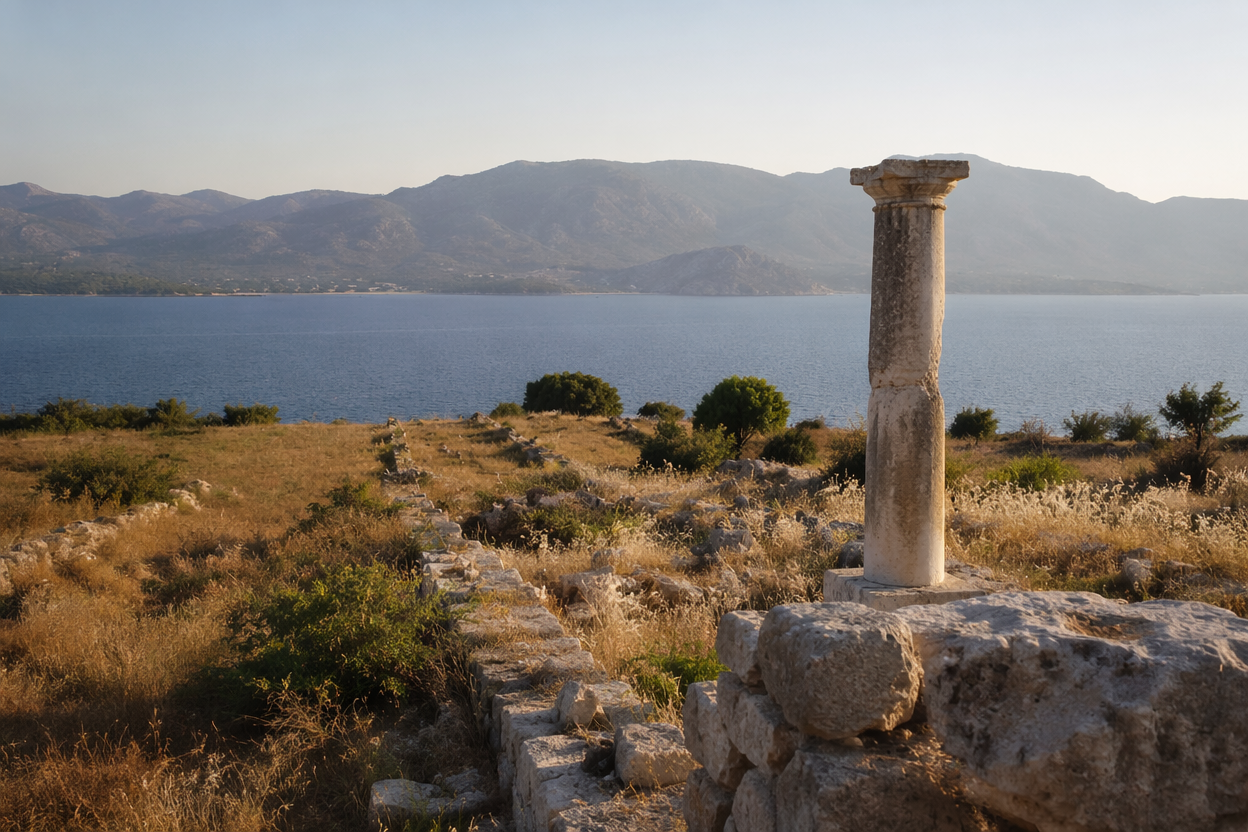
The passages attach Achaia to tangible scenes: a public “judgment seat” under a “proconsul,” travel that “pass[es] through” regions on the way to Jerusalem and Rome, and the organized flow of letters, readiness, boasting, and contributions among believers. Achaia appears as a traversed landscape and a shared civic and ecclesial space—broad enough to be spoken of as “the whole of Achaia,” yet concrete enough to be the setting where people arrive, are received, and act together.
Sources: Lexical data from Strong’s Exhaustive Concordance and the Translators Brief Lexicon of Extended Strongs for Greek (STEPBible, CC BY). Occurrence data from the Translators Amalgamated Greek New Testament (STEPBible, CC BY). Scripture quotations from the World English Bible (public domain).