Exploring the Meaning of Achaz in Greek
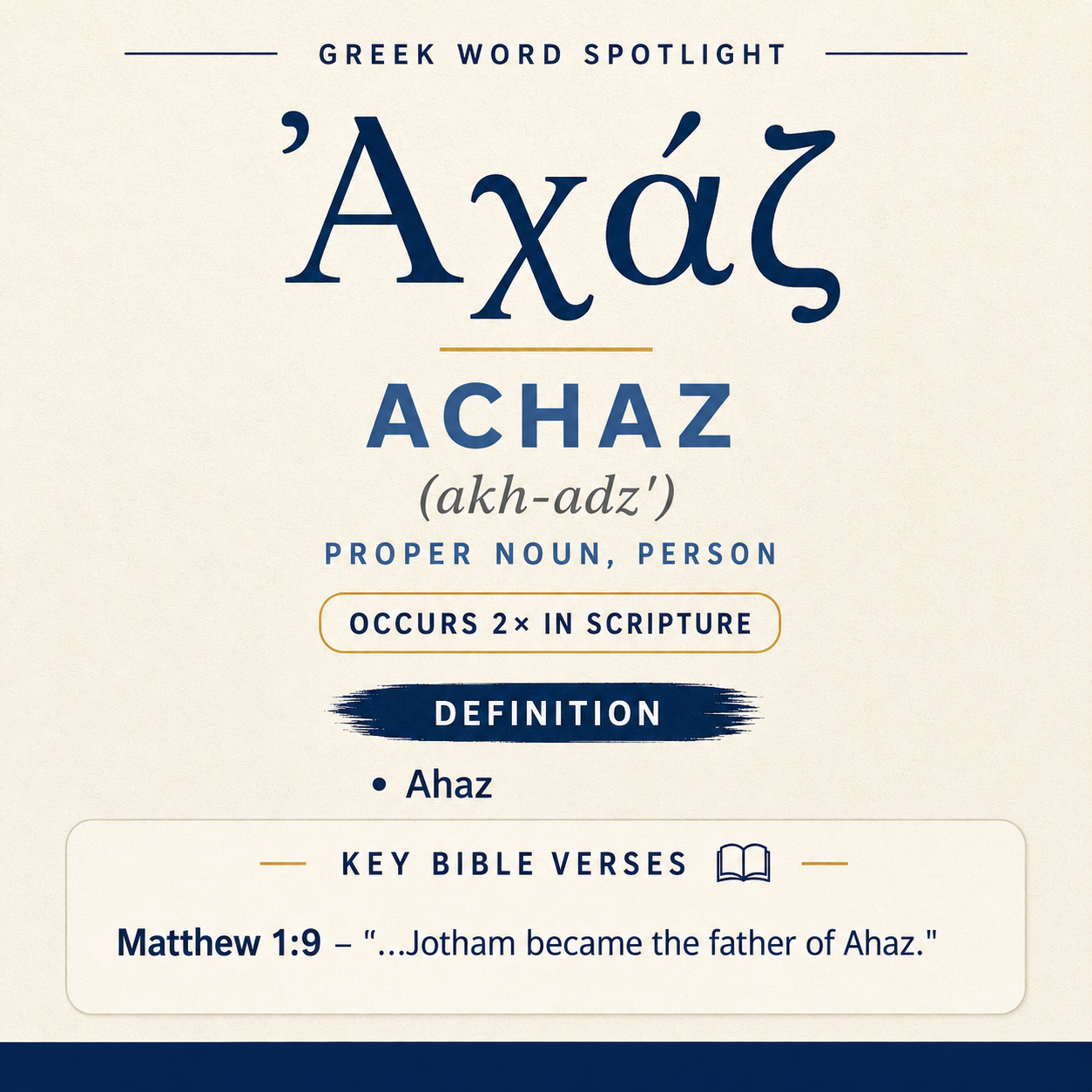
Ἀχάζ means “Ahaz” and appears twice in Scripture, including Matthew 1:9 in Jesus’ genealogy.
Scripture Occurrences
This name occurs 2 times in Scripture. One occurrence is in Matthew 1:9.
Learn More →Genealogy Context
In Matthew 1:9, Ahaz is listed between Jotham and Hezekiah. The verse presents a father-to-son sequence: Jotham, Ahaz, Hezekiah.
Learn More →Ἀχάζ means “Ahaz” and appears in Matthew’s genealogy of Jesus. In this setting it functions as a named link in a chain of descent, placing Ahaz within a father-to-son sequence that is presented in a tightly patterned way.
Occurrences
“Uzziah became the father of Jotham. Jotham became the father of Ahaz. Ahaz became the father of Hezekiah.” (Matthew 1:9)
Here Ἀχάζ is the personal name that anchors the middle of three consecutive generational statements. The verse is structured as a series of short, parallel sentences, each built on the repeated formula “became the father of,” and Ahaz appears twice within that pattern: first as the son of Jotham and then as the father of Hezekiah. In this way the name does not stand alone as an isolated mention; it operates relationally, defined by the immediate familial links on both sides. The effect is to make Ahaz a hinge-point in the line: the reader meets him as someone who has been begotten and who, in turn, begets, with the flow of the genealogy moving through him without pause.
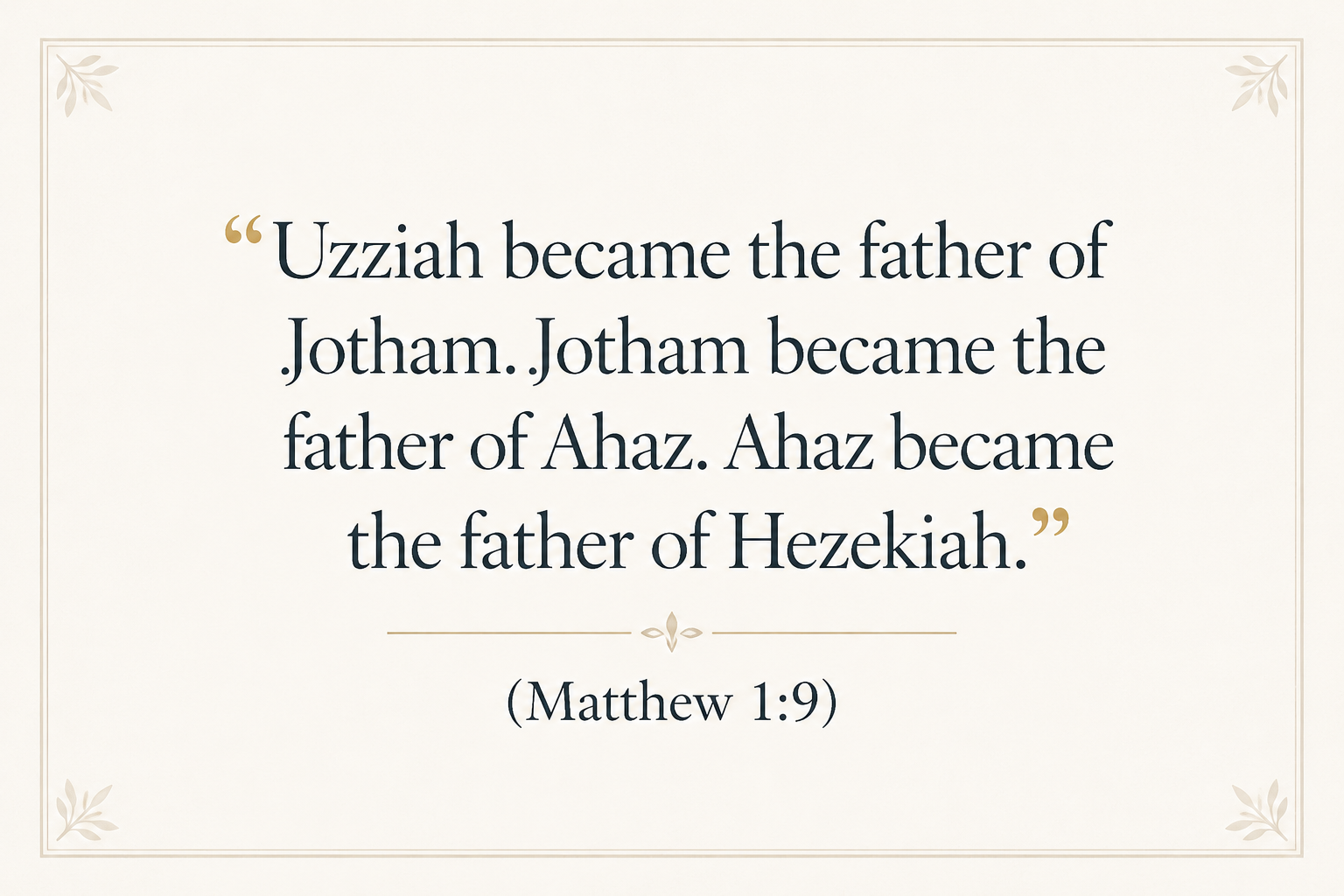
The surrounding names reinforce that function. The verse begins with Uzziah and ends with Hezekiah, and Ahaz is the connecting element that keeps the sequence continuous: “Jotham became the father of Ahaz. Ahaz became the father of Hezekiah.” The repetition of the name across the two adjacent clauses serves a practical purpose in the genealogy’s cadence: it prevents any ambiguity about the transition between generations and maintains the step-by-step progression. Matthew 1:9 thus presents Ἀχάζ as a stable identifier within a formal list whose primary concern is succession.
Sense and Usage
As a proper name meaning “Ahaz,” Ἀχάζ functions in Matthew 1:9 as a reference to a particular individual situated within a documented lineage. In a genealogy, a name’s main work is not to describe qualities or actions but to mark identity and continuity. The verse’s repeated fathering formula turns the name into a genealogical coordinate: it locates Ahaz precisely between “Jotham” and “Hezekiah,” giving him significance through placement. The sense is therefore concrete and referential—this is the “Ahaz” who belongs in that exact slot in the generational chain presented by the text.
The double placement of the name within a single verse also shapes how the reader encounters it. First, Ahaz is introduced as the outcome of a prior relationship (“Jotham became the father of Ahaz”), and immediately thereafter Ahaz is presented as the source of the next (“Ahaz became the father of Hezekiah”). The name is therefore framed by two directional movements—backward to the father and forward to the son—so that its usage is inseparable from family connection and temporal sequence. In this format, Ἀχάζ is not merely a label but part of the genealogy’s mechanism for showing transmission across generations.
The verse’s grammar and rhythm further underscore that genealogical role. Each sentence is short and declarative; there are no descriptive titles, epithets, or narrative asides attached to Ahaz in this line. That restraint keeps the focus on the ordered progression of descent. In such a list, the proper noun carries the weight of identification: it tells the reader which person is being referenced, and the repeated formula tells the reader what kind of connection is being asserted. The usage of Ἀχάζ here is thus tightly bounded to ancestry, succession, and the orderly naming of persons.
Because Matthew 1:9 places Ahaz in immediate proximity to both his predecessor and his successor, the name also contributes to the genealogy’s sense of interlocking continuity. The verse reads as a chain with no gaps: Uzziah → Jotham → Ahaz → Hezekiah. The appearance of Ἀχάζ ensures that the link between Jotham and Hezekiah is not implied but explicitly stated. The genealogy advances by naming each step; the presence of Ahaz, spoken twice, makes that step fully articulated.
Genealogical Imagery
Matthew 1:9 presents Ἀχάζ within the imagery of a living line of descent—one generation giving rise to the next through fatherhood. The verse does not depict events from Ahaz’s life; it depicts succession itself. In this setting, the name “Ahaz” carries the quiet force of a remembered link in an ordered family record, a single node through which the line passes: “Jotham became the father of Ahaz. Ahaz became the father of Hezekiah.”
Sources: Lexical data from Strong’s Exhaustive Concordance and the Translators Brief Lexicon of Extended Strongs for Greek (STEPBible, CC BY). Occurrence data from the Translators Amalgamated Greek New Testament (STEPBible, CC BY). Scripture quotations from the World English Bible (public domain).