
Exploring the Meaning of Aphilagathos in Greek
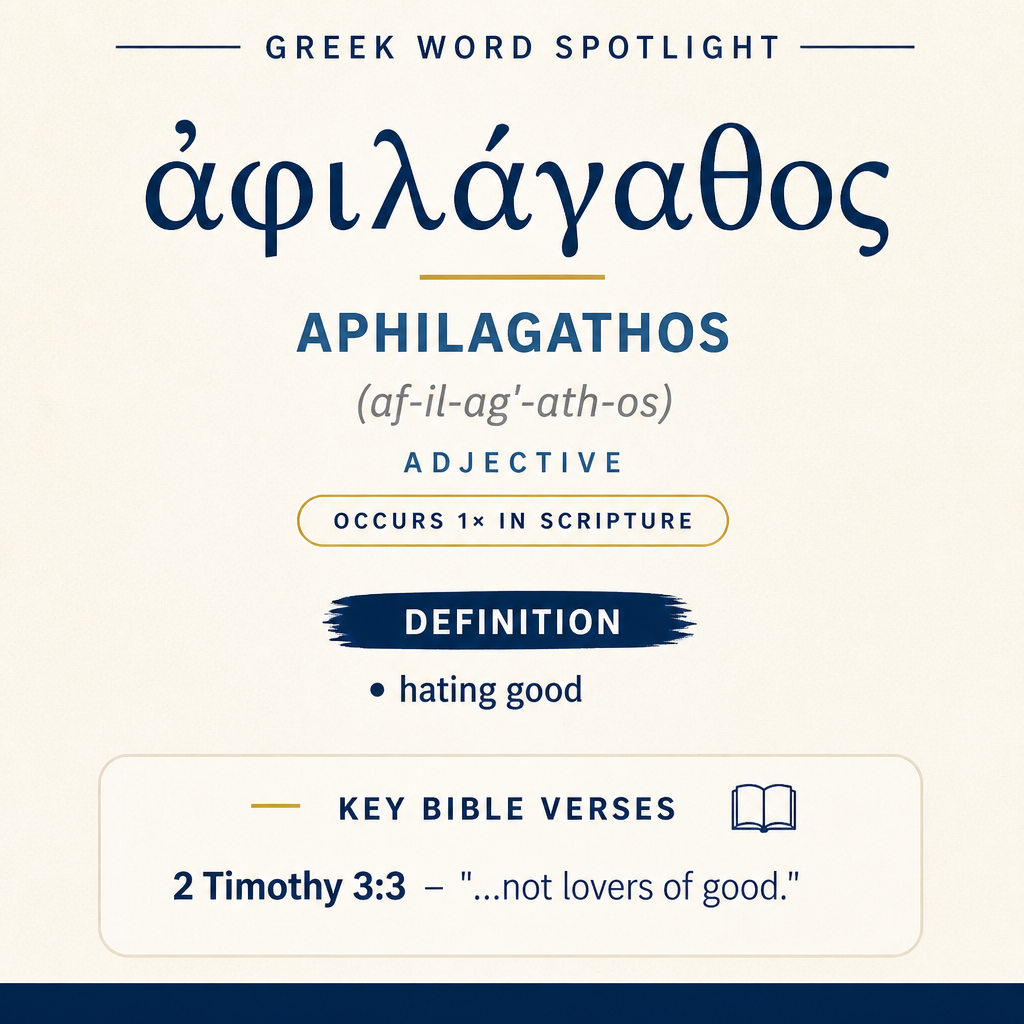
ἀφιλάγαθος means “hating good” and appears once in Scripture, in 2 Timothy 3:3.
Scripture Occurrence
This word occurs 1 time in Scripture. Its single occurrence is in 2 Timothy 3:3.
Learn More →Verse Context
In 2 Timothy 3:3 it is rendered “not lovers of good” within a list of negative traits.
Learn More →ἀφιλάγαθος means “hating good” and appears once in the New Testament, in Paul’s description of disordered character in 2 Timothy 3:3. There it functions as one item in a tightly packed list of vices, helping define the moral climate being portrayed.
Root and Related Words
ἀφιλάγαθος is presented in relation to philagathos (φιλάγαθος), “lover of good” (Strong’s G5358), and to A (α, Ἀλφα), “Alpha” (Strong’s G1).

Occurrences
“without natural affection, unforgiving, slanderers, without self-control, fierce, not lovers of good,” (2 Timothy 3:3)
In this line, ἀφιλάγαθος appears at the end of a series of descriptors: “without natural affection, unforgiving, slanderers, without self-control, fierce, not lovers of good.” The word contributes a final moral shading to the list by characterizing the persons in view as set against what is “good.” Positioned after relational and social breakdown (“without natural affection,” “unforgiving,” “slanderers”) and after failures of restraint (“without self-control”) and temperament (“fierce”), it gathers these traits into a broader stance: not merely doing harm in particular ways, but holding an antipathy toward good itself.

The immediate context of the wording reinforces this effect. The list moves from violations of close bonds (“without natural affection”) to a refusal to release debts or offenses (“unforgiving”), then to damaging speech (“slanderers”). It then names a lack of internal governance (“without self-control”) and an aggressive spirit (“fierce”). With ἀφιλάγαθος the portrait is not softened by any counterbalance; instead, the sequence closes by identifying a negative orientation toward good. In this placement, the word acts like a capstone: it does not replace the preceding items but makes clear that the vices described are consistent with a settled hostility toward what is good.
Because the phrase is framed in English as “not lovers of good,” the word functions as a categorical label. It is not an isolated insult but a moral classification within a list where each element marks a failure in affection, mercy, speech, self-mastery, or disposition. The result is a portrait of character that is socially disruptive and morally inverted: the persons described are not merely careless about good, but opposed to it.
Sense and Usage
Across its single attestation, ἀφιλάγαθος carries the force of a settled attitude. The definition “hating good” speaks to an active posture rather than a passive omission. In 2 Timothy 3:3, the surrounding terms intensify that idea: the persons described are “fierce,” marked by a lack of “self-control,” and their speech is harmful (“slanderers”). Against that background, “hating good” is not a theoretical stance but a moral disposition that fits a pattern of harm to relationships, reputations, and communal peace.
The placement of the term at the end of the sequence gives it rhetorical weight. Lists of character traits can work by accumulation; each descriptor adds a facet until a composite picture emerges. Here, “hating good” functions as a broad moral summary that aligns with the list’s trajectory. If “without natural affection” names a fracture of appropriate love, and “unforgiving” names a hardening of mercy, and “slanderers” names destructive speech, then “hating good” situates these fractures under a wider umbrella: a disposition that does not simply fail to choose the good but resists it. Within the verse’s flow, the phrase “not lovers of good” therefore sharpens the reader’s sense that the listed behaviors are not accidents but expressions of a deeper antipathy.
The term also helps distinguish between weakness and hostility. “Without self-control” can describe a lack of restraint; “fierce” can describe an aggressive temperament. ἀφιλάγαθος, by contrast, describes the moral direction of the heart toward good. In the verse’s portrait, it suggests that the issue is not merely impulsiveness or temperament, but a more fundamental moral aversion that can underpin the other vices named. The definition “hating good” thus makes the list ethically cohesive: the different failures named are consistent with an underlying resistance to what is good.
Imagery
The verse’s imagery is not visual in the sense of objects or scenes; it is moral and relational. Yet the clustering of descriptors evokes the feel of a community where natural bonds are neglected, offenses are nursed rather than released, words are used to wound, and inner restraint is absent. In that atmosphere, ἀφιλάγαθος supplies the darkest hue: a stance that rejects good as something to be desired, welcomed, or pursued.
Sources: Lexical data from Strong’s Exhaustive Concordance and the Translators Brief Lexicon of Extended Strongs for Greek (STEPBible, CC BY). Occurrence data from the Translators Amalgamated Greek New Testament (STEPBible, CC BY). Scripture quotations from the World English Bible (public domain).





