Exploring the Meaning of Aphtharsia in Greek
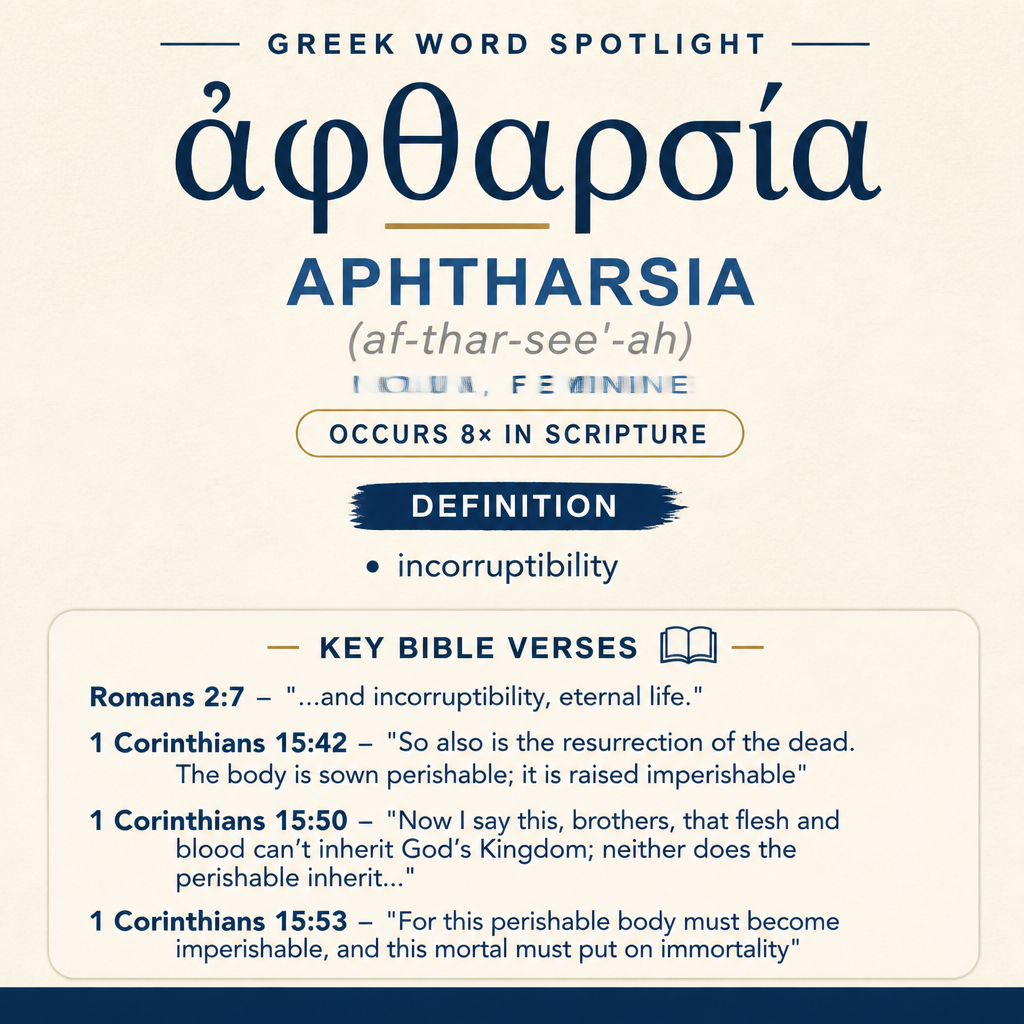
ἀφθαρσία (Aphtharsia) means “incorruptibility” and occurs 8 times in Scripture, including Romans 2:7, 1 Corinthians 15, Ephesians 6:24, 2 Timothy 1:10, and Titus 2:7.
Core Meaning
ἀφθαρσία is defined as “incorruptibility.” It is contrasted with what is perishable in 1 Corinthians 15.
Learn More →Resurrection Context
In 1 Corinthians 15:42, the body is raised imperishable. In 1 Corinthians 15:53–54, the perishable body must become imperishable.
Learn More →Ethical Emphasis
Romans 2:7 speaks of seeking glory, honor, and incorruptibility through perseverance in well-doing. Titus 2:7 includes incorruptibility in teaching alongside integrity and seriousness.
Learn More →ἀφθαρσία means “incorruptibility.” It appears in Paul’s letters in contexts ranging from the moral aims of perseverance to the transformed state of the resurrection body, as well as qualities of love and teaching.
Occurrences
Romans 2:7 — “to those who by perseverance in well-doing seek for glory, honor, and incorruptibility, eternal life;”
Here ἀφθαρσία is placed among the objects of deliberate pursuit: “glory, honor, and incorruptibility.” Within the line, it stands as a desired quality aligned with “perseverance in well-doing” and oriented toward “eternal life.” The term contributes a specific goal that is not merely recognition (“glory, honor”) but a condition fit for what endures; it frames the moral perseverance described as aiming at a life characterized by what cannot be corrupted.

1 Corinthians 15:42 — “So also is the resurrection of the dead. The body is sown perishable; it is raised imperishable.”
In the resurrection argument, ἀφθαρσία marks the contrast between the body’s present condition (“sown perishable”) and its raised condition (“raised imperishable”). The word belongs to the “raised” side of the comparison and helps define resurrection not as mere continuation but as a decisive change in the body’s condition. The pairing “perishable/imperishable” makes incorruptibility the key descriptor of the body’s future state in this passage’s imagery of sowing and raising.
1 Corinthians 15:50 — “Now I say this, brothers, that flesh and blood can’t inherit God’s Kingdom; neither does the perishable inherit imperishable.”
In this statement about inheritance, ἀφθαρσία defines what is fit to be inherited: “the imperishable.” The phrase “flesh and blood can’t inherit God’s Kingdom” is immediately matched by a second clause that restates the point in terms of perishable versus imperishable. The word therefore functions as a boundary-marker: what is “perishable” does not receive what belongs to “imperishable,” and the kingdom inheritance is aligned with incorruptibility rather than with the conditions summed up as “flesh and blood.”
1 Corinthians 15:53 — “For this perishable body must become imperishable, and this mortal must put on immortality.”
ἀφθαρσία is the required outcome for “this perishable body”: it “must become imperishable.” The necessity (“must”) makes incorruptibility not optional but essential to the transformation being described. The verse also parallels two changes—perishable to imperishable, mortal to immortality—so incorruptibility stands as the body’s transformation in relation to decay or corruption, alongside the mortal’s change in relation to death.
1 Corinthians 15:54 — “But when this perishable body will have become imperishable, and this mortal will have put on immortality, then what is written will happen: “Death is swallowed up in victory.””
This verse revisits the transformation as a completed condition (“will have become imperishable”). ἀφθαρσία contributes to the timing and logic of the climax: once the perishable has entered the imperishable state, the declaration about death being overcome follows. Incorruptibility is thus treated as part of the concrete change that accompanies the victory over death announced at the end of the sentence.
Ephesians 6:24 — “Grace be with all those who love our Lord Jesus Christ with incorruptible love. Amen.”
Here ἀφθαρσία modifies “love,” describing the manner or quality of love toward “our Lord Jesus Christ.” The word’s force is to characterize this love as not subject to corruption; it portrays love as enduring and unstained in its devotion. Within the closing blessing, incorruptibility functions as a distinguishing feature of the love that accompanies those who receive the grace invoked.
2 Timothy 1:10 — “but has now been revealed by the appearing of our Savior, Christ Jesus, who abolished death, and brought life and immortality to light through the Good News.”
In this proclamation, ἀφθαρσία is paired with “life” and is said to be brought “to light through the Good News.” The term participates in a revelation theme: something previously hidden is now illuminated by the appearing of Christ Jesus. Within the same sentence, the abolition of death sets the backdrop, and incorruptibility belongs to the unveiled reality associated with the life that the Good News brings into view.
Titus 2:7 — “In all things be showing yourself an example of good works. In your teaching, be showing integrity, seriousness, incorruptibility,”
In the instructions about conduct and teaching, ἀφθαρσία stands as a quality to be displayed “in your teaching” alongside “integrity” and “seriousness.” The placement suggests incorruptibility as a stabilizing, preserving quality in instruction—teaching that is not compromised or degraded. The term thus moves from resurrection and eschatological inheritance into the sphere of present ministry, where it marks the character of what is taught and how it is carried.

Sense and Usage
Across these passages, ἀφθαρσία consistently names a condition that stands over against what is “perishable.” In 1 Corinthians 15, the word is woven into a sequence of contrasts and necessities: “sown perishable… raised imperishable” (15:42), “neither does the perishable inherit imperishable” (15:50), and “this perishable body must become imperishable” (15:53). The repeated juxtaposition with “perishable” gives the term a clear profile in that chapter: incorruptibility is not a vague ideal but the defining feature of the resurrection body’s new condition, and it is also the sphere into which inheritance in God’s kingdom belongs.
Even where the body is not the immediate subject, the word keeps its orientation toward what endures without being spoiled. Romans 2:7 presents incorruptibility as something sought through “perseverance in well-doing,” coordinated with “glory” and “honor,” and pointing to “eternal life.” The pursuit language makes incorruptibility an aim that shapes present conduct, binding moral perseverance to a future characterized by what cannot be corrupted.
Ephesians 6:24 and Titus 2:7 place ἀφθαρσία in relational and ethical contexts. The “incorruptible love” of Ephesians is not defined by comparison to a perishable body but by its steadfast quality toward the Lord Jesus Christ; the closing benediction implies this incorruptible quality as a hallmark of the love in view. Titus directs the term toward pedagogy: it belongs to the manner of teaching, together with integrity and seriousness, and it marks instruction that retains its soundness rather than being undermined.
In 2 Timothy 1:10, ἀφθαρσία appears in a revelatory frame: Christ Jesus “brought life and immortality to light through the Good News.” The word participates in the announcement that death has been dealt with (“abolished death”) and that a new visibility has been granted to life characterized by incorruptibility. In that sentence, incorruptibility is not merely a future hope but something made known through the appearing of Christ and the proclamation of the Good News.
Imagery
The dominant imagery attached to ἀφθαρσία in these verses is the movement from a vulnerable present state into a preserved future one. In 1 Corinthians 15 the picture is agricultural and bodily: what is “sown” in perishability is “raised” in incorruptibility (15:42), and what cannot inherit is replaced by what must “become” (15:50, 15:53). That same incorruptible quality then shades into the present life of the community—love described as incorruptible (Ephesians 6:24) and teaching characterized by incorruptibility (Titus 2:7)—so the word can carry both the future transformation of the body and the present shape of devotion and instruction, while still retaining its core sense of what is untouched by corruption.
Sources: Lexical data from Strong’s Exhaustive Concordance and the Translators Brief Lexicon of Extended Strongs for Greek (STEPBible, CC BY). Occurrence data from the Translators Amalgamated Greek New Testament (STEPBible, CC BY). Scripture quotations from the World English Bible (public domain).