
Exploring the Meaning of Autos in Greek
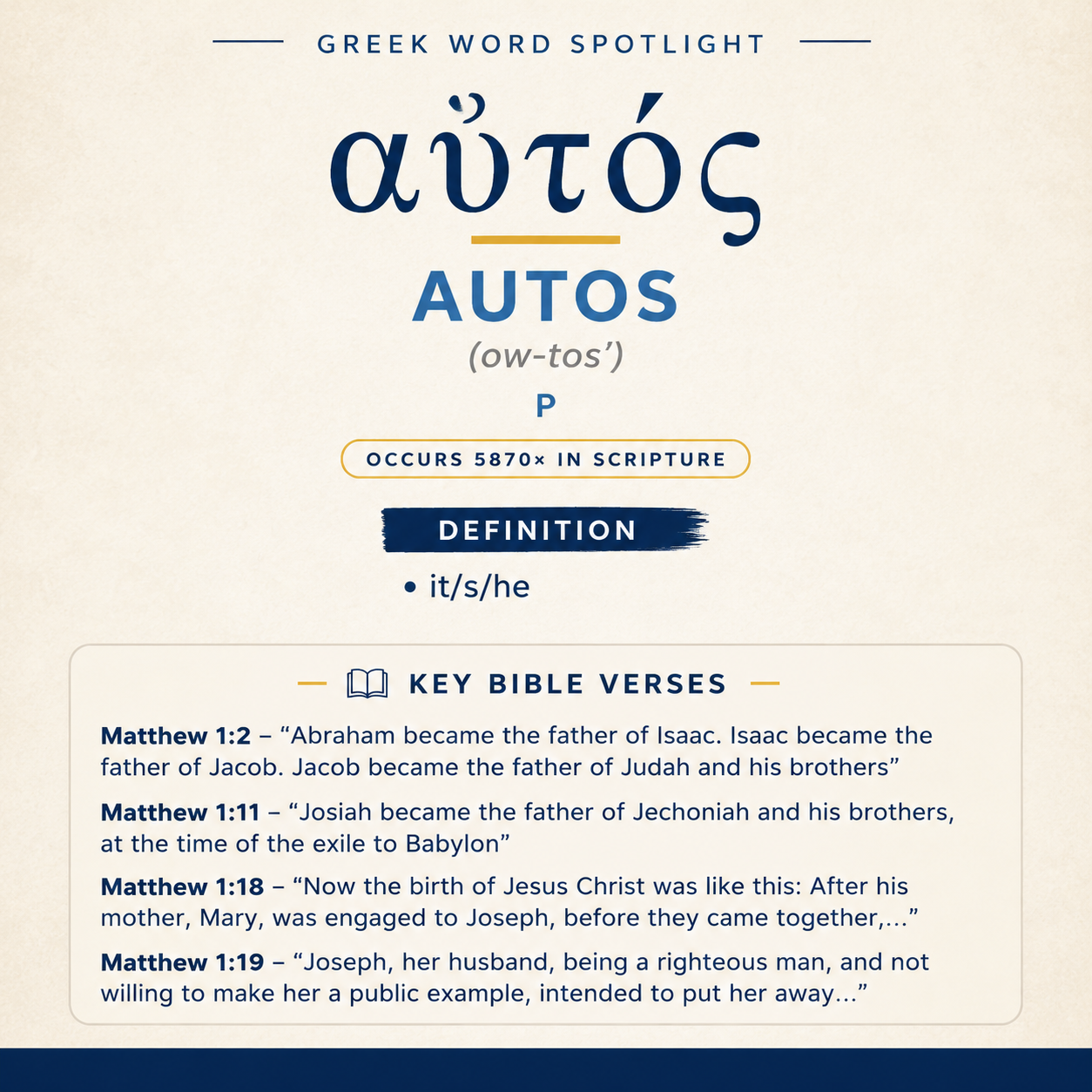
αὐτός (Autos) means “it/s/he” and appears 5,870 times in Scripture, including Matthew 1:2, 1:11, and 1:18–24.
Core Meaning
αὐτός means “it/s/he.” It functions as a reference to a person or thing in context.
Learn More →Scripture Frequency
This word occurs 5,870 times in Scripture. It is one of the most frequently appearing Greek words.
Learn More →Matthew 1 Examples
In Matthew 1:21 it appears in “for it is he who shall save his people from their sins.” It also occurs in Matthew 1:2, 1:11, and 1:18–24.
Learn More →Autos expresses “it/s/he” as a pointer back to a previously mentioned person or thing. In the verses cited here, it threads through genealogical notices and birth narratives in Matthew, keeping reference clear as the story moves from one named figure to another.
Occurrences
Matthew 1:2 — “Abraham became the father of Isaac. Isaac became the father of Jacob. Jacob became the father of Judah and his brothers.”
In this sequence of fathers and sons, autos serves the basic work of a pronoun: it/s/he refers back to the individual just named so the line can continue without repeatedly restating names. The verse moves quickly from Abraham to Isaac to Jacob to Judah; autos supports that chain-like movement by letting the narrative keep pointing to the relevant “he” at each step.

Matthew 1:11 — “Josiah became the father of Jechoniah and his brothers, at the time of the exile to Babylon.”
Here autos functions within a compressed historical note. The verse gives a single father-son link and then marks a turning point (“at the time of the exile to Babylon”). Autos contributes by holding the focus on the named individuals as the narrative ties genealogy to a specific crisis, keeping “he” anchored to Josiah/Jechoniah in a statement that is otherwise brief and event-marked.
Matthew 1:18 — “Now the birth of Jesus Christ was like this: After his mother, Mary, was engaged to Joseph, before they came together, she was found pregnant by the Holy Spirit.”
This sentence introduces multiple participants—Jesus Christ, Mary, Joseph—and describes a discovery about Mary. Autos enables the text to indicate “he” or “she” without confusion as the narrative shifts from naming Jesus Christ to speaking about “his mother, Mary,” and then to describing what “she” was found to be. The pronoun’s referential force helps the reader track which person is being described at each clause.
Matthew 1:19 — “Joseph, her husband, being a righteous man, and not willing to make her a public example, intended to put her away secretly.”
The verse is centered on Joseph’s intention toward Mary. Autos contributes by tightening the relational references: “her husband” and the repeated “her” bind Joseph’s identity and his contemplated action to Mary’s situation. The pronoun use keeps the ethical portrait (“righteous man”) and the proposed response (“put her away secretly”) directed toward the same woman already in view.
Matthew 1:20 — “But when he thought about these things, behold, an angel of the Lord appeared to him in a dream, saying, “Joseph, son of David, don’t be afraid to take to yourself Mary, your wife, for that which is conceived in her is of the Holy Spirit.”
This verse alternates between Joseph’s inner deliberation, the angel’s appearance, and the angel’s direct address. Autos does heavy referential work: “he” points to Joseph as the thinker; “to him” marks Joseph as the recipient of the dream-appearance; “to yourself” keeps the instruction personal; and “in her” identifies Mary as the one in whom conception has occurred. The pronoun network holds together multiple actions and relationships without reintroducing names at each turn.
Matthew 1:21 — “She shall give birth to a son. You shall name him Jesus, for it is he who shall save his people from their sins.”
Autos intensifies focus in a sentence full of roles and outcomes. “She” points to Mary as the one who will give birth; “him” points to the son to be named; “it is he” singles out the same individual as the one who will save; and “his people” keeps that saving work attached to him. The pronoun usage binds naming, identity, and mission tightly to a single referent so the reader does not lose track of who is acting and who is acted upon.
Matthew 1:23 — ““Behold, the virgin shall be with child, and shall give birth to a son. They shall call his name Immanuel;” which is, being interpreted, “God with us.”
Within the quoted prophecy and its interpretation, autos functions to keep reference stable: “his name” points to the son just mentioned, and the naming formula (“They shall call his name…”) uses the pronoun to connect the child to the title given. Autos allows the line to move from childbirth to naming without repeating “the son” as a noun.
Matthew 1:24 — “Joseph arose from his sleep, and did as the angel of the Lord commanded him, and took his wife to himself;”
This verse narrates Joseph’s obedient action after the dream. Autos links command and compliance: “his sleep” identifies the sleep as Joseph’s; “commanded him” keeps Joseph as the commanded party; “his wife” refers to Mary in her relationship to Joseph; and “to himself” shows that the action of taking her is oriented to Joseph personally and decisively. The pronouns move the account from command to action without breaking the narrative flow.
Matthew 1:25 — “and didn’t know her sexually until she had given birth to her firstborn son. He named him Jesus.”
Autos provides compact clarity in a verse that moves from marital restraint to childbirth to naming. “Her” and “she” keep Mary as the subject of giving birth; “her firstborn son” identifies the child in relation to her; “He” shifts the subject back to Joseph for the act of naming; and “him” points to the newborn as the one named Jesus. Autos manages the handoff of agency—Mary gives birth; Joseph names—while keeping the newborn consistently in view.
Matthew 2:2 — ““Where is he who is born King of the Jews? For we saw his star in the east, and have come to worship him.””
In the question of the visitors, autos makes the target of their search explicit. “He who is born King of the Jews” signals a specific person; “his star” attaches the observed sign to that same individual; and “worship him” keeps the intended act directed toward him. Autos therefore ties together identity (“King of the Jews”), sign (“his star”), and response (“worship him”) as aspects of one referent.
Matthew 2:3 — “When King Herod heard it, he was troubled, and all Jerusalem with him.”
This verse describes a reaction that spreads from a ruler to a city. Autos anchors the emotional disturbance: “he was troubled” keeps Herod as the one affected, and “with him” links “all Jerusalem” to Herod’s agitation, presenting the city’s response as accompanying his. The pronouns make the contagion of concern read as a shared disturbance centered on him.
Matthew 2:4 — “Gathering together all the chief priests and scribes of the people, he asked them where the Christ would be born.”
Autos organizes a scene with multiple groups and a single questioner. “He” points back to King Herod as the one who gathers and asks; “them” identifies the assembled chief priests and scribes as the ones questioned. Autos keeps the power dynamics clear: one “he” interrogates “them” about the birthplace of the Christ.

Sense and Usage
Across these passages, autos functions as a tightly referential word—“it/s/he”—that holds together identity, relationship, and action as the narrative moves. In the genealogy (Matthew 1:2; 1:11), autos supports rapid succession: one named person leads to the next with minimal verbal weight, letting the line of descent remain the main content. In the birth narrative (Matthew 1:18–25), autos keeps several closely connected figures distinct—Mary, Joseph, the child—while allowing the text to alternate subjects quickly (Joseph deliberates; an angel speaks; Mary conceives and gives birth; Joseph acts and names). In Matthew 1:21, autos concentrates attention on a single figure through multiple clauses (“name him… it is he… his people”), showing how pronouns can build a coherent profile without repeating a name in each line.
In the early scenes of chapter 2 (Matthew 2:2–4), autos is essential for discourse coherence in reported speech and royal inquiry. The visitors’ “he… his… him” creates a single, consistent object of search, sign, and worship. Herod’s “he… with him” and “he… them” then frames reaction and investigation: a ruler becomes the reference point for the city’s trouble and for the questioning of leaders. Autos thereby functions less as a mere substitute for a noun and more as a tool for tracking the central “he” across shifting speakers, groups, and actions.
Imagery
In these verses, autos repeatedly draws attention back to a particular person in moments of transition: a genealogy stepping from father to son; a household crisis turning to a dream-command and an obedient response; visitors seeking a newborn king; a troubled court gathering advisors. The word’s effect is like a narrative finger pointing—keeping “he” and “him” steady while events and speakers change around that referent.
Sources: Lexical data from Strong’s Exhaustive Concordance and the Translators Brief Lexicon of Extended Strongs for Greek (STEPBible, CC BY). Occurrence data from the Translators Amalgamated Greek New Testament (STEPBible, CC BY). Scripture quotations from the World English Bible (public domain).




