
Exploring the Meaning of Atimia in Greek
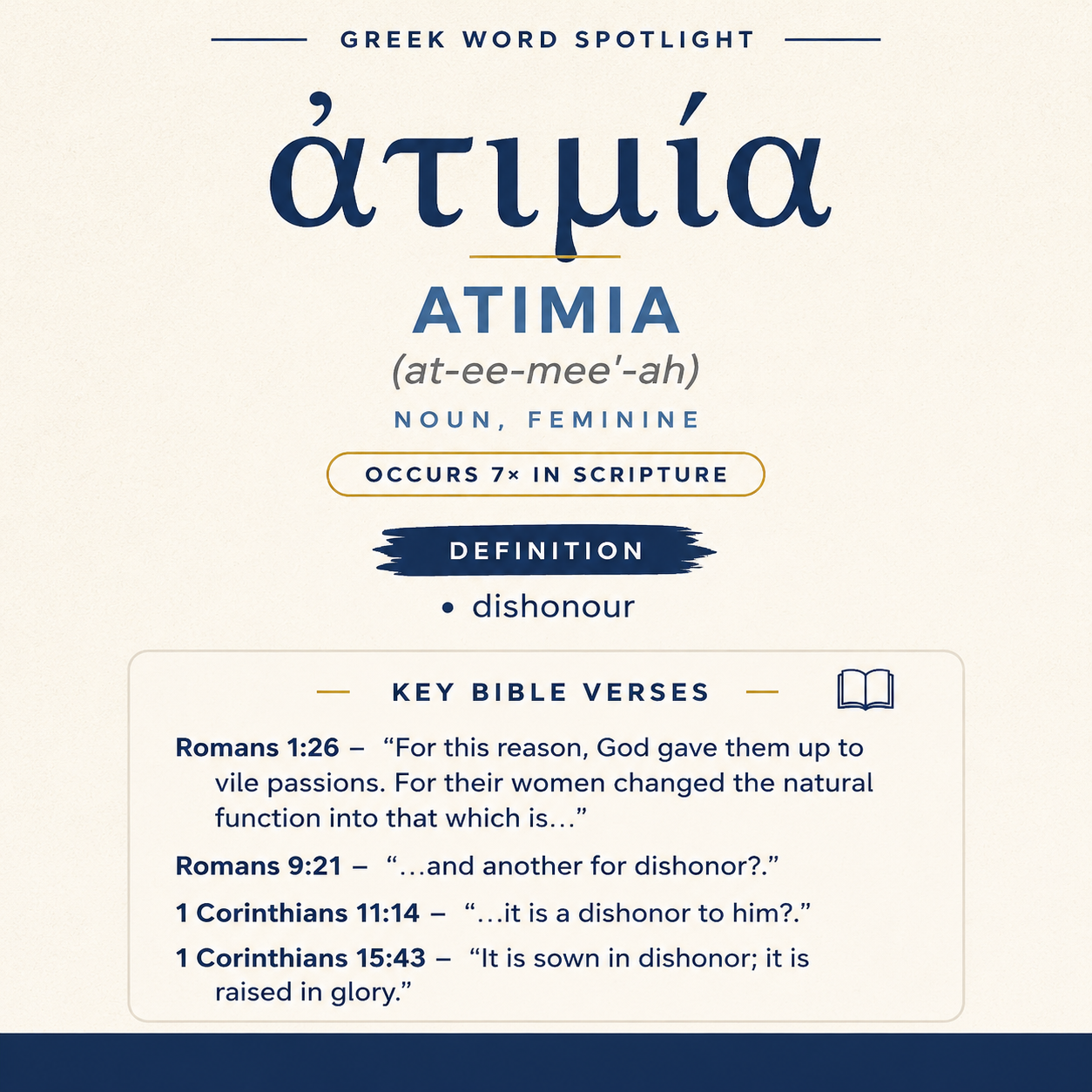
ἀτιμία means “dishonour” and occurs 7 times in Scripture: Romans 1:26; Romans 9:21; 1 Corinthians 11:14; 1 Corinthians 15:43; 2 Corinthians 6:8; 2 Corinthians 11:21; 2 Timothy 2:20.
Core Meaning
ἀτιμία is defined as “dishonour.” It appears in contexts contrasting honor and dishonor.
Learn More →Key Occurrences
ἀτιμία occurs in Romans, 1 Corinthians, 2 Corinthians, and 2 Timothy. Specific references include Romans 9:21 and 2 Timothy 2:20.
Learn More →Usage Examples
In 1 Corinthians 11:14, it describes long hair on a man as a dishonor. In 1 Corinthians 15:43, it contrasts being “sown in dishonor” with being raised in glory.
Learn More →ἀτιμία expresses “dishonour” in a range of settings that include bodily conduct, social reputation, moral evaluation, and vivid metaphors about what is fitting. It appears in Paul’s letters and in a Pastoral epistle, where it is regularly set against “honor” and “glory” to mark a status or condition viewed as degrading.
Occurrences
“For this reason, God gave them up to vile passions. For their women changed the natural function into that which is against nature.” (Romans 1:26)
Here ἀτιμία frames the description of “vile passions” and a “changed” “natural function” as a condition marked by dishonour. The verse presents an evaluative perspective on what is occurring: the actions described are not merely different but are portrayed as a descent into a shameful state. In this context, ἀτιμία belongs to a passage that speaks of being “gave…up,” so dishonour is tied to a judicial or consequential handing-over, not simply to social disapproval.

“Or hasn’t the potter a right over the clay, from the same lump to make one part a vessel for honor, and another for dishonor?” (Romans 9:21)
In the potter-and-clay image, ἀτιμία functions as a category of use or status: some vessels are made “for honor,” others “for dishonor.” Dishonour is not described as a feeling but as an assigned role within the analogy. The rhetorical question emphasizes the potter’s right “over the clay,” making “dishonor” part of a contrast that highlights unequal outcomes from “the same lump.” The word thus attaches to an object (“a vessel”) and signals its suitability for a lower, dispreferred purpose.
“Doesn’t even nature itself teach you that if a man has long hair, it is a dishonor to him?” (1 Corinthians 11:14)
In this discussion of appearance and propriety, ἀτιμία identifies the effect long hair is said to have “to him”: it is “a dishonor.” Dishonour is presented as a verdict about what is fitting, grounded in what “nature itself” is claimed to “teach.” The word therefore marks an assessment of public presentation; it frames a particular practice as bringing lowered regard upon the person in view.
“It is sown in dishonor; it is raised in glory. It is sown in weakness; it is raised in power.” (1 Corinthians 15:43)
In the paired clauses “sown…raised,” ἀτιμία labels the condition associated with the present mode of existence described as “sown.” Dishonour here is juxtaposed with “glory,” and it stands alongside another contrast, “weakness…power.” The word contributes to an ordered set of oppositions: dishonour belongs to what is perishable and low, while the raised state is characterized by exalted qualities. Even without expanding the imagery beyond the verse’s own language, ἀτιμία clearly functions as the negative pole in a transformation from one condition to another.
“by glory and dishonor, by evil report and good report; as deceivers, and yet true;” (2 Corinthians 6:8)
In this list of opposites, ἀτιμία sits beside “glory” and corresponds to the experience of being regarded unfavorably. The surrounding pairs (“evil report and good report”; “as deceivers, and yet true”) show that dishonour is part of the apostolic public profile: they are spoken of in competing ways, and dishonour is one of the realities they endure. The word thus describes a social valuation—how one is treated or spoken of—without making that valuation the final measure of what is true (“and yet true”).
“I speak by way of disparagement, as though we had been weak. Yet in whatever way anyone is bold (I speak in foolishness), I am bold also.” (2 Corinthians 11:21)
Here ἀτιμία belongs to Paul’s rhetorical posture: “I speak by way of disparagement.” Dishonour is tied to a self-conscious lowering of tone, as though conceding an inferior standing (“as though we had been weak”). Within the verse, the word contributes to irony and contrast: Paul adopts language that sounds like devaluation, then pivots—“Yet…”—to claim equal boldness. Dishonour functions as a verbal frame, a way of speaking that places the speaker in an apparently diminished position for argumentative effect.
“Now in a large house there are not only vessels of gold and of silver, but also of wood and of clay. Some are for honor, and some for dishonor.” (2 Timothy 2:20)
As in Romans 9:21, ἀτιμία marks a class of “vessels,” here within the domestic picture of “a large house.” The difference in materials (“gold…silver” versus “wood…clay”) reinforces an intuitive hierarchy, and “dishonor” names the lower category in the closing summary. The word contributes to a sense of differentiation within one household: not all items share the same dignity or purpose, and “dishonor” signals the less esteemed function.

Sense and Usage
Across these passages, ἀτιμία consistently signals a lowered standing—an ascribed condition that carries negative evaluation. The word can describe dishonour attached to conduct (Romans 1:26), to a perceived violation of propriety (1 Corinthians 11:14), to a present condition contrasted with a future or transformed state (1 Corinthians 15:43), and to public reputation that swings between extremes (2 Corinthians 6:8). It can also name a category within metaphors of differentiated objects: “vessels…for honor…for dishonor” (Romans 9:21; 2 Timothy 2:20). In such images, dishonour is not a fleeting emotion but a stable designation that marks what something is “for.”
The word frequently gains its force from explicit contrasts. Two different pairings recur: (1) “honor…dishonor” in the vessel imagery (Romans 9:21; 2 Timothy 2:20), and (2) “glory…dishonor” in contexts that emphasize reversal or competing evaluations (1 Corinthians 15:43; 2 Corinthians 6:8). These contrasts show that ἀτιμία operates as the negative counterpart in a spectrum of worth. The verses do not treat dishonour as merely subjective; it has outward visibility—seen in “function,” hair, public “report,” and the observable status of objects in a house.
At the same time, ἀτιμία can be presented as something endured without conceding the deeper truth of a person’s identity or message. In 2 Corinthians 6:8, dishonour appears alongside mischaracterization (“as deceivers, and yet true”), placing it within the tension between reputation and reality. In 2 Corinthians 11:21, dishonour is taken up as “disparagement,” a rhetorical lowering that sets up a counterclaim of boldness. These uses demonstrate that the term can function both descriptively (how one is regarded) and strategically (how one chooses to speak), while still retaining its basic sense of diminished esteem.
Imagery
Two images anchor the word’s concrete feel in these texts. First, the potter’s workshop and the household storage of vessels give dishonour a tactile dimension: ordinary materials and ordinary objects become a way to speak about relative status (“a vessel for honor…another for dishonor”; “vessels of gold…of wood and of clay…for dishonor”). Second, the seed-and-harvest contrast “sown…raised” frames dishonour as a condition from which a striking reversal can occur (“It is sown in dishonor; it is raised in glory”). In both kinds of imagery, ἀτιμία marks the low side of a meaningful divide—what is degraded, less esteemed, or assigned to a lesser role.
Sources: Lexical data from Strong’s Exhaustive Concordance and the Translators Brief Lexicon of Extended Strongs for Greek (STEPBible, CC BY). Occurrence data from the Translators Amalgamated Greek New Testament (STEPBible, CC BY). Scripture quotations from the World English Bible (public domain).





