Exploring the Meaning of Asunthetos in Greek
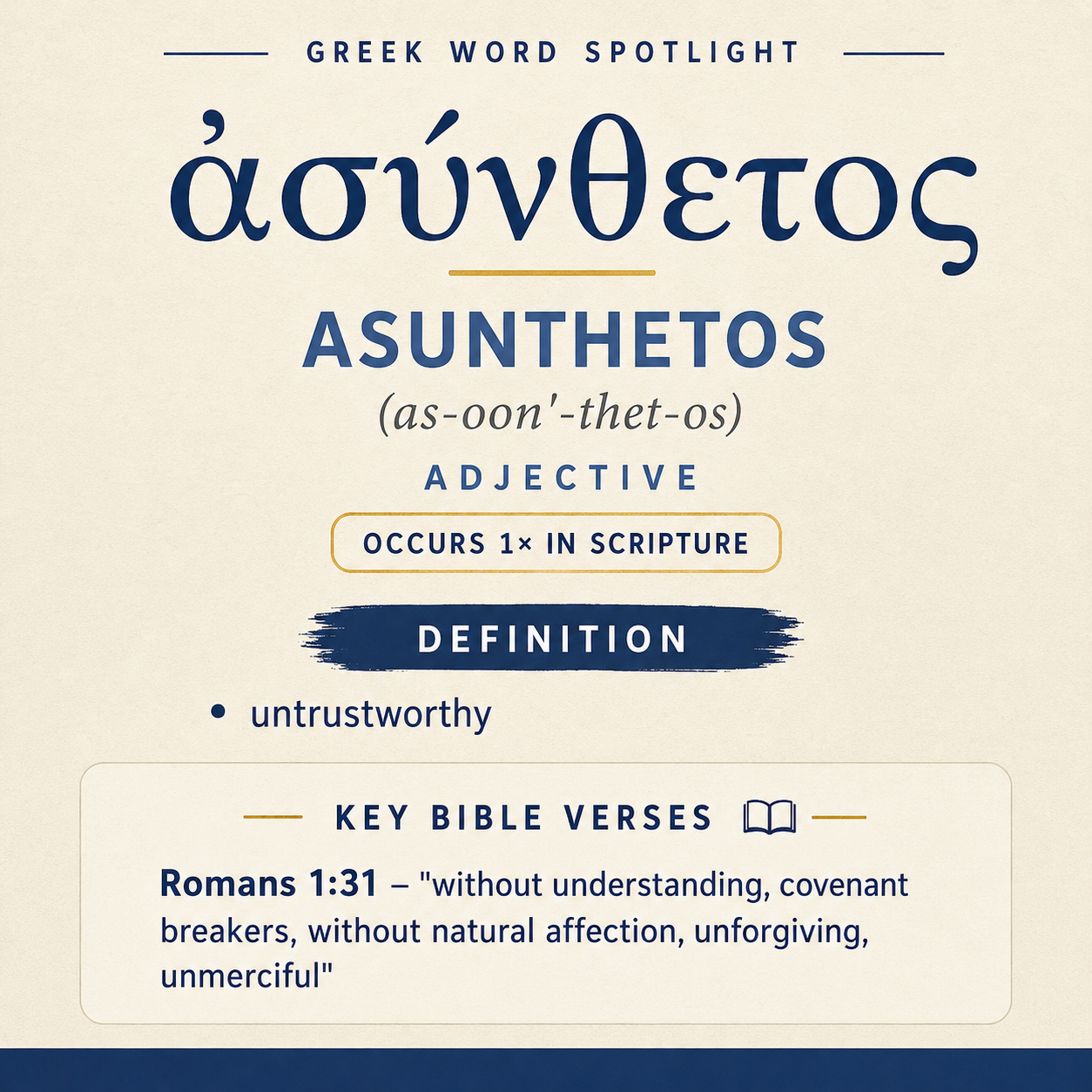
ἀσύνθετος means “untrustworthy” and appears once in Scripture, in Romans 1:31.
Scripture Occurrence
It occurs 1 time in Scripture. The single occurrence is Romans 1:31.
Learn More →Verse Context
In Romans 1:31 it appears in a list: “without understanding, covenant breakers, without natural affection, unforgiving, unmerciful;”
Learn More →ἀσύνθετος means “untrustworthy” and appears once in the New Testament, in Paul’s vice list in Romans 1:31. In that compressed sequence of descriptors, it marks a breakdown of reliability within human bonds and obligations.
Root and Related Words
ἀσύνθετος (Asunthetos) is related, per Strong’s, to the Greek letter name A (α, Ἀλφα), “Alpha” (Strong’s G1), and to the verb συντίθημι (syntithemai), “to agree” (Strong’s G4934). The relationship to συντίθημι places the adjective in a semantic neighborhood where agreement and the keeping of settled arrangements are in view.

Occurrences
“without understanding, covenant breakers, without natural affection, unforgiving, unmerciful;” (Romans 1:31)
In Romans 1:31, ἀσύνθετος is presented as one element in a rapid chain of moral and relational failures. The surrounding descriptors are largely social in their impact: “without understanding” frames a deficiency in discernment; “covenant breakers” points to ruptured commitments; “without natural affection” names the collapse of expected human attachment; “unforgiving” and “unmerciful” describe a hardening of posture toward others. Within that sequence, ἀσύνθετος contributes the idea of a person whose word or commitments cannot be relied upon—someone whose stance toward agreements and obligations is marked by unreliability.
Because the term is placed immediately after “without understanding” and alongside items that describe violated bonds (“covenant breakers,” “without natural affection”), it functions in the list as a relational indictment rather than a merely private fault. Paul’s phrasing does not isolate the trait as a momentary lapse; it is one component of a broader portrait in which interpersonal life is rendered unsafe—where promises, loyalties, and ordinary expectations of human care have been weakened or reversed. The word therefore sharpens the vice list by naming the kind of character that makes stable relationships difficult: where trust would normally be warranted, it is undermined.
Sense and Usage
As used in Romans 1:31, “untrustworthy” is not treated as a technical label but as a practical moral description with consequences. It sits among terms that describe failure to understand, failure to keep covenants, failure of affection, and failure of mercy; taken together they depict a network of relationships in which dependable commitments have eroded. In that setting, “untrustworthy” is not merely the opposite of truthful speech; it is the opposite of being a safe party to an agreement—someone others can count on when obligations are assumed.
The placement of ἀσύνθετος beside “covenant breakers” gives the reader a concrete axis for what “untrustworthy” looks like in lived terms: it manifests in broken commitments. The vice list also frames this unreliability as socially contagious. Where people are “unforgiving” and “unmerciful,” reconciliation and repair are resisted; where people are also “untrustworthy,” even the formation of new commitments becomes precarious. The word thus functions as a concise descriptor of relational instability—one that helps explain why the surrounding traits produce fractured communities and damaged bonds.
Because the term occurs only here, its New Testament usage is tightly bound to the rhetoric of this list: a piling up of descriptors that, in the aggregate, portray a human environment in which trust is stripped away. In that environment, “untrustworthy” describes not a single breach but a settled quality of character that makes covenant faithfulness and ordinary human fidelity difficult to sustain.
Imagery
Romans 1:31 evokes the picture of social life with its binding ties loosened: covenants broken, natural affections absent, mercy withheld. In that landscape, ἀσύνθετος carries the imagery of agreements that no longer hold—arrangements that ought to anchor relationships but instead fail, leaving others exposed to disappointment and harm.
Sources: Lexical data from Strong’s Exhaustive Concordance and the Translators Brief Lexicon of Extended Strongs for Greek (STEPBible, CC BY). Occurrence data from the Translators Amalgamated Greek New Testament (STEPBible, CC BY). Scripture quotations from the World English Bible (public domain).