Exploring the Meaning of Asunetos in Greek
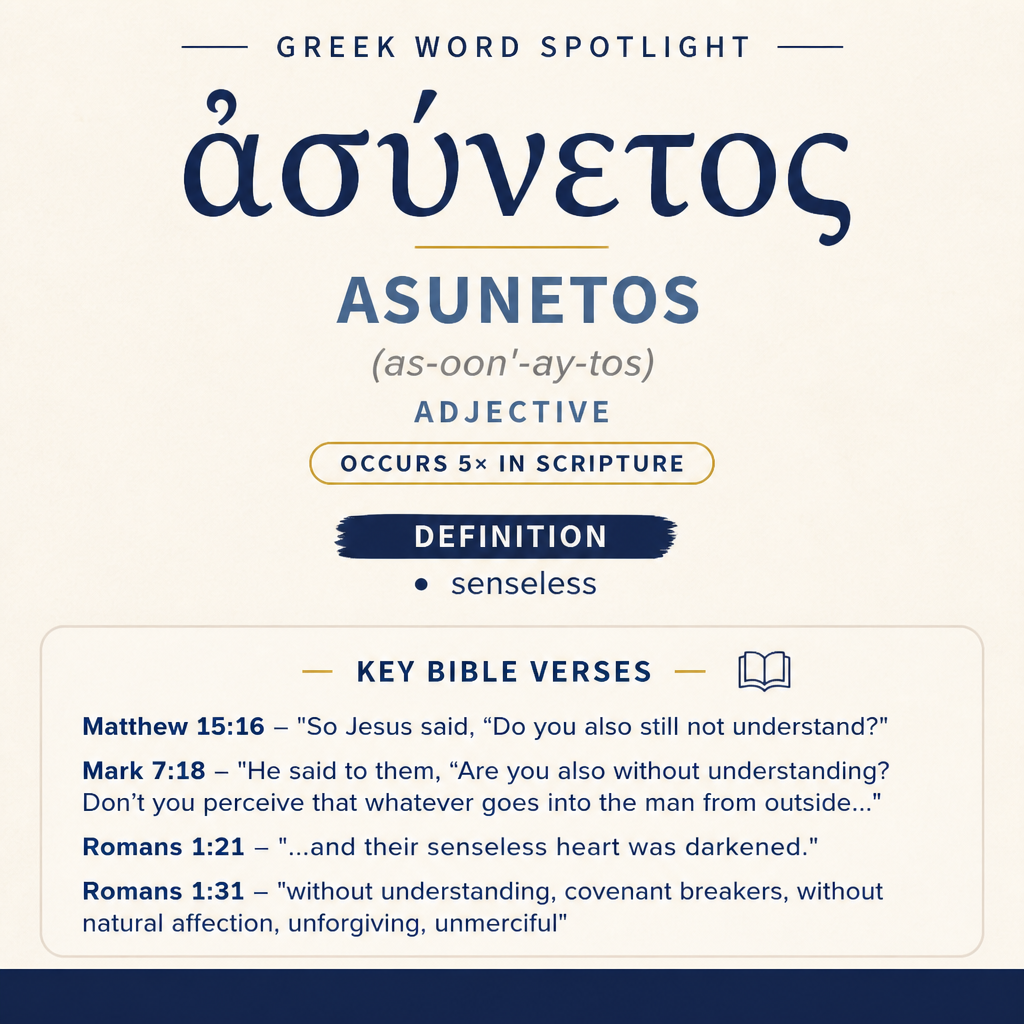
ἀσύνετος means “senseless” and appears five times: Matthew 15:16; Mark 7:18; Romans 1:21, 1:31; Romans 10:19.
Gospel Usage
In Matthew 15:16 and Mark 7:18, Jesus challenges his hearers about not understanding.
Learn More →Romans Context
Romans uses ἀσύνετος in discussions of reasoning (Romans 1:21), a list of sins (Romans 1:31), and Israel’s knowing (Romans 10:19).
Learn More →ἀσύνετος describes a condition of being senseless. In the New Testament it appears in Gospel dialogue about understanding and in Romans in both moral diagnosis and Israel’s response to God.
Root and Related Words
ἀσύνετος is related to συνετός (synetos), “intelligent” (Strong’s G4908). Strong’s also connects it with α (Alpha; α, Ἀλφα), “Alpha” (Strong’s G1).

Occurrences
“So Jesus said, “Do you also still not understand?”” (Matthew 15:16)
Here the word functions as a direct challenge from Jesus to his disciples. The question frames their problem as more than missing a detail: they are being addressed as people who remain senseless in the moment, unable to grasp what Jesus expects them to grasp. The force of “still” sharpens the rebuke; their lack of understanding is treated as ongoing rather than momentary.
“He said to them, “Are you also without understanding? Don’t you perceive that whatever goes into the man from outside can’t defile him,”” (Mark 7:18)
In Mark the adjective appears in a pair of questions that press the same point from two angles: “without understanding” and “Don’t you perceive….” The senselessness is shown as a failure to take in what is being taught, even when the teaching is stated in a concrete way (“whatever goes into the man from outside can’t defile him”). The word contributes a diagnosis of the hearers’ mental and perceptual dullness within the conversation, casting their difficulty as an inability to apprehend what should be clear.
“Because knowing God, they didn’t glorify him as God, and didn’t give thanks, but became vain in their reasoning, and their senseless heart was darkened.” (Romans 1:21)
Romans uses the term in a moral-spiritual portrait: people “knowing God” refuse fitting responses (“didn’t glorify… didn’t give thanks”), and the result is a collapse of inner reasoning and inner life. Senselessness is located in the “heart,” and it is paired with darkness: “their senseless heart was darkened.” In this sentence the word depicts an interior condition that accompanies vain reasoning; it is not mere ignorance but a senselessness that belongs to the center of the person and is associated with loss of light.
“without understanding, covenant breakers, without natural affection, unforgiving, unmerciful;” (Romans 1:31)
Here ἀσύνετος is one element in a stark list of traits. The placement is important: “without understanding” stands alongside relational and moral failures (“covenant breakers… unforgiving… unmerciful”). The word therefore contributes to the portrait of a disordered life by naming senselessness as part of a cluster of hardened behaviors. It reads as a foundational defect that accompanies and perhaps helps explain the breakdown in faithfulness and compassion described by the surrounding terms.
“But I ask, didn’t Israel know? First Moses says, “I will provoke you to jealousy with that which is no nation. I will make you angry with a nation void of understanding.”” (Romans 10:19)
In this rhetorical exchange Paul frames the question in terms of knowledge: “didn’t Israel know?” The citation then introduces “a nation void of understanding.” Senselessness here is not directed at Israel but attributed to the “no nation” used to provoke Israel to jealousy and anger. The word contributes a striking contrast: those described as lacking understanding become the means by which Israel is stirred. Within the quotation, “void of understanding” characterizes the nation as senseless, highlighting the unexpectedness of Israel being provoked by such an agent.
Sense and Usage
Across these five passages, ἀσύνετος consistently marks senselessness as a real deficiency in grasping what is set before someone. In the Gospel settings (Matthew 15:16; Mark 7:18) it is spoken to listeners during instruction: the term belongs to the teaching moment, where failure to understand is treated as culpable and surprising. The questions “Do you also still not understand?” and “Are you also without understanding?” position senselessness as a barrier that keeps hearers from perceiving the point of Jesus’ words.
Romans broadens the frame. In Romans 1:21 senselessness moves inward to the “heart” and is tied to a progression: refusal to honor and thank God leads to vain reasoning and then to darkness. In Romans 1:31 it becomes one descriptor among many, showing how senselessness can be named as part of a larger moral profile rather than as an isolated intellectual shortcoming. Romans 10:19 then uses the term as a label in a quotation: a “nation void of understanding” becomes the instrument in a provocative reversal, where those characterized by senselessness play a role in confronting Israel’s presumed knowledge.
The passages therefore present senselessness in three overlapping arenas: (1) immediate comprehension in dialogue, (2) the inner condition of the heart in relation to God, and (3) a collective characterization (“a nation”) used to make a point about knowing. The word’s rhetorical effect is sharp in every setting: it exposes a gap between what could be understood and what is actually grasped, whether in disciples listening to Jesus or in humanity’s response to the knowledge of God.
Imagery in Context
Romans 1:21 supplies the most vivid picture associated with ἀσύνετος: “their senseless heart was darkened.” Senselessness is portrayed not simply as absence but as an interior dimming, a heart losing light in tandem with “vain… reasoning.” In the Gospels the imagery is more conversational than visual, but the repeated questions (“not understand… without understanding… Don’t you perceive”) still evoke the scene of instruction where understanding ought to dawn and yet does not.
Sources: Lexical data from Strong’s Exhaustive Concordance and the Translators Brief Lexicon of Extended Strongs for Greek (STEPBible, CC BY). Occurrence data from the Translators Amalgamated Greek New Testament (STEPBible, CC BY). Scripture quotations from the World English Bible (public domain).