Exploring the Meaning of Asugkritos in Greek
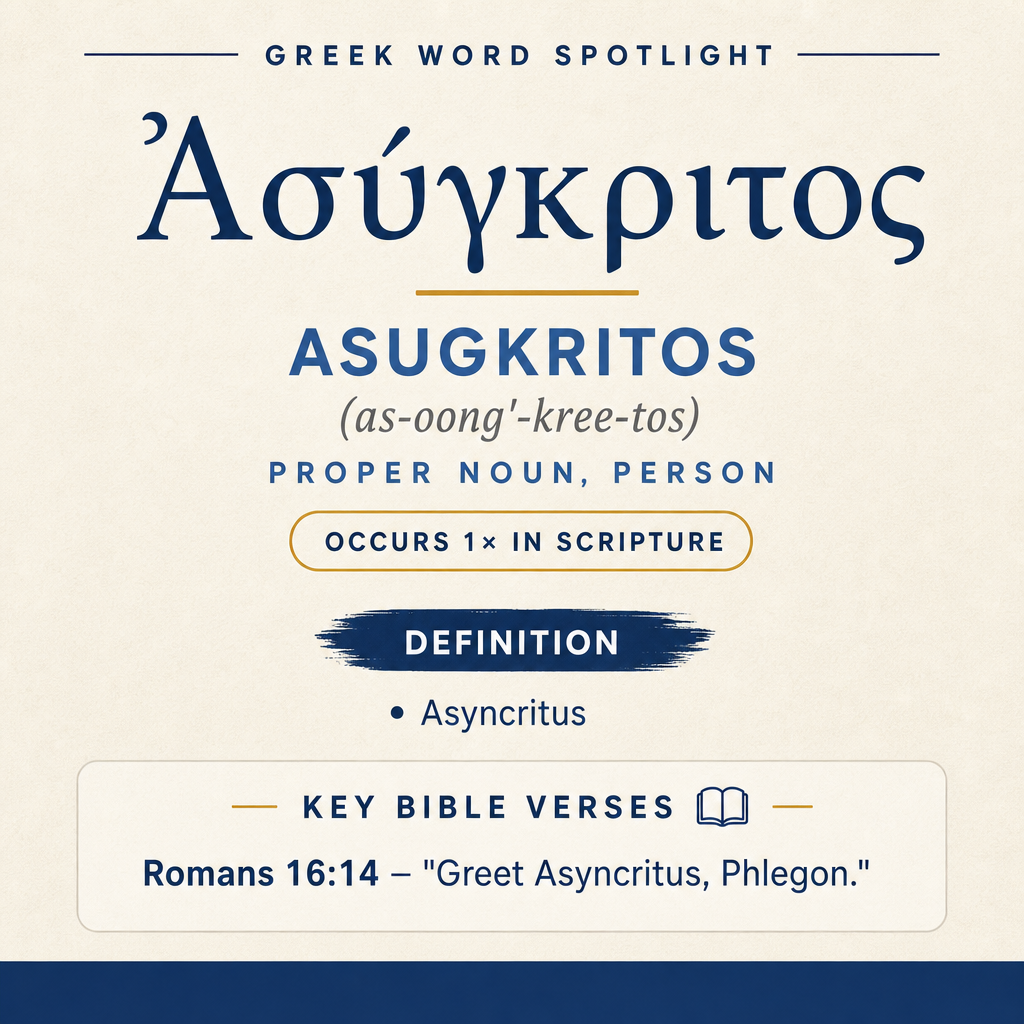
Ἀσύγκριτος (Asugkritos) means Asyncritus and appears once in Scripture in Romans 16:14.
Biblical Occurrence
This name occurs 1 time in Scripture. It appears in Romans 16:14.
Learn More →Context in Romans
In Romans 16:14, Paul writes, “Greet Asyncritus, Phlegon, Hermes, Patrobas, Hermas, and the brothers who are with them.”
Learn More →Ἀσύγκριτος means “Asyncritus” and appears in Paul’s closing greetings in Romans. The name occurs as part of a short list of believers greeted together.
Root and Related Words
Strong’s connects Ἀσύγκριτος with the letter-name ἄλφα (alpha), “Alpha” (Strong’s G1), and with the verb συγκρίνω (synkrinō), “to compare” (Strong’s G4793). These relationships identify the name’s lexical associations as presented in Greek word study tradition, linking it both to a basic Greek element (alpha) and to a common verbal idea expressed by synkrinō.

Occurrences
“Greet Asyncritus, Phlegon, Hermes, Patrobas, Hermas, and the brothers who are with them.” (Romans 16:14)
Here Ἀσύγκριτος functions as a personal name placed at the head of a small cluster of greetings. Paul’s imperative “Greet” introduces a group rather than an individual alone: Asyncritus is named alongside “Phlegon, Hermes, Patrobas, Hermas,” and then broadened to include “the brothers who are with them.” In this sentence, the name identifies one recognizable member of a wider fellowship; it anchors the greeting list in concrete relationships, signaling that the address is intended to reach an identifiable circle of believers rather than remaining a general or abstract salute. The wording also implies that Asyncritus belongs to a relational network—he is not merely a solitary contact, but part of a set that includes named individuals and an unnamed company described collectively.

Sense and Usage
Because Ἀσύγκριτος is a proper name, its primary contribution in Romans 16:14 is referential: it points to a specific person known to Paul and to the Roman recipients who are to deliver the greeting. In a greetings context, naming is itself a communicative act. The single word “Asyncritus” marks personal recognition and social location, especially because it appears in a sequence of names and then expands to “the brothers who are with them.” The structure suggests that Asyncritus and the others are sufficiently prominent, accessible, or representative that greeting them is a way of greeting an entire associated group.
The definition “Asyncritus” indicates that translation does not aim to render a descriptive sense but to preserve identity. Within the verse, the name’s function is therefore shaped by the surrounding verbs and nouns: the command “Greet” frames Asyncritus as a recipient of communal acknowledgment; the accompanying list frames him as one among peers; and the phrase “the brothers who are with them” situates him within shared life and fellowship. The verse’s economy—one imperative, several names, one collective designation—shows how a proper noun can carry weight beyond mere labeling: it serves as a point of connection between the letter writer, the congregation, and the smaller gatherings or circles within it.
Imagery
Romans 16:14 evokes the scene of greetings being delivered through a community: a named set of individuals, together with “the brothers who are with them,” receiving recognition as a group. Ἀσύγκριτος contributes to that picture by putting a single, concrete identity at the front of the cluster, making the greeting feel addressed to real people in a real social setting rather than to an anonymous audience.
Sources: Lexical data from Strong’s Exhaustive Concordance and the Translators Brief Lexicon of Extended Strongs for Greek (STEPBible, CC BY). Occurrence data from the Translators Amalgamated Greek New Testament (STEPBible, CC BY). Scripture quotations from the World English Bible (public domain).