Understanding the Significance of Aroma in Greek
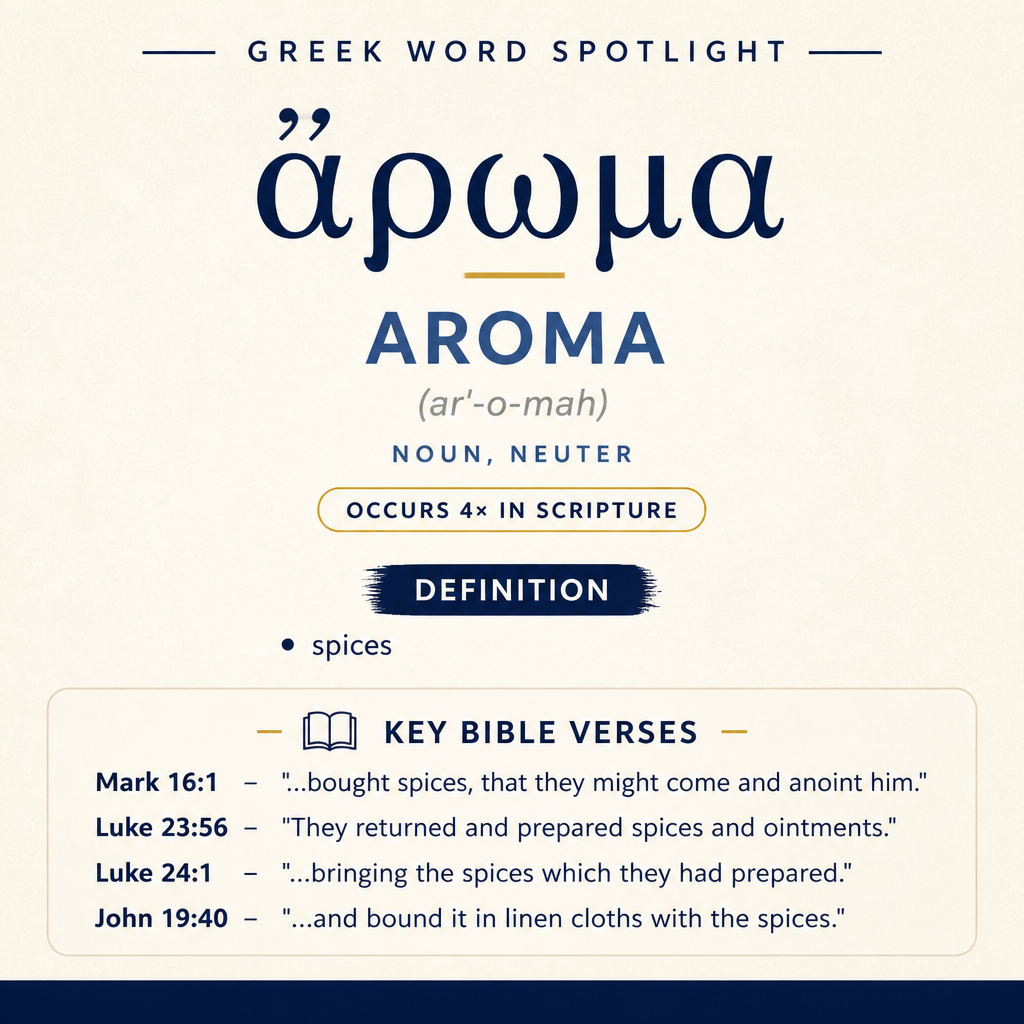
ἄρωμα means “spices” and appears four times in Scripture: Mark 16:1; Luke 23:56; Luke 24:1; John 19:40.
Basic Meaning
ἄρωμα is defined as “spices.” In the listed passages, spices are prepared or brought in connection with burial.
Learn More →Gospel Occurrences
ἄρωμα occurs in Mark, Luke (twice), and John. Each reference comes from the Gospel narratives surrounding Jesus’ burial and the visit to the tomb.
Learn More →Burial Context
In John 19:40, Jesus’ body is bound in linen cloths with spices, following Jewish burial custom. In Mark 16:1 and Luke 24:1, women bring spices to the tomb.
Learn More →ἄρωμα refers to “spices” and appears in the burial-and-tomb narratives surrounding Jesus’ death and resurrection. In these scenes it names tangible materials that are bought, prepared, carried, and wrapped with the body.
Root and Related Words
ἄρωμα is related to the verb airo (αἴρω), “to take up” (Strong’s G142).
Occurrences
Mark 16:1: “When the Sabbath was past, Mary Magdalene, and Mary the mother of James, and Salome, bought spices, that they might come and anoint him.”
Here ἄρωμα stands at the point of decision and preparation: it is something purchased after the Sabbath and intended for a specific action at the tomb—“that they might come and anoint him.” The word ties the women’s movement (“come”) to a concrete purpose expressed in the planned treatment of Jesus’ body. Spices are not described in detail, but their role is clear from the sentence: they are the means by which the women intend to honor the dead through anointing.
Luke 23:56: “They returned and prepared spices and ointments. On the Sabbath they rested according to the commandment.”
In Luke’s account, ἄρωμα is paired with “ointments,” and the verbs control the scene: “returned,” “prepared,” and then “rested.” Spices belong to the work that can be done before the Sabbath rest begins; they are part of careful readiness, not a spontaneous gesture. The juxtaposition of preparation with resting also places ἄρωμα within a rhythm of action and restraint: the materials are made ready, but their use waits because “On the Sabbath they rested according to the commandment.”
Luke 24:1: “But on the first day of the week, at early dawn, they and some others came to the tomb, bringing the spices which they had prepared.”
This occurrence completes the movement implied in Luke 23:56. ἄρωμα is now what they physically “bring” as they “came to the tomb” “at early dawn.” The phrase “which they had prepared” points back to earlier preparation and shows continuity of intention across days. Spices are the carried burden that makes their errand intelligible: they come not empty-handed but with the prepared materials appropriate to tending a body.
John 19:40: “So they took Jesus’ body, and bound it in linen cloths with the spices, as the custom of the Jews is to bury.”
In John, ἄρωμα is set within the immediate handling of Jesus’ body. The verb sequence is direct and practical: “took… bound… with the spices.” Here the word is integrated into the wrapping itself—spices accompany the linen cloths as part of the burial procedure. The final clause (“as the custom of the Jews is to bury”) frames the action as customary and recognizable, placing ἄρωμα within an established pattern of burial rather than an improvised response.
Sense and Usage
Across these four passages, ἄρωμα functions as a material element in burial care. It can be bought (Mark 16:1), prepared (Luke 23:56), carried to the tomb (Luke 24:1), and used in the binding of the body (John 19:40). The word therefore operates in more than one stage of the same kind of work: acquisition, preparation, transport, and application.
The narratives consistently connect spices with purposeful, embodied actions. In Mark, the purchase is motivated by the intention “to anoint him,” so the word points to planned devotion expressed through physical means. In Luke, spices appear in a two-day sequence—prepared before Sabbath rest, then brought at “early dawn” afterward—so the word becomes part of the temporal structure of waiting and returning. In John, spices are not merely carried or intended but actually incorporated “with” the linen cloths as the body is bound, highlighting their role within the burial practice itself.
Although the same term is used, each context shades its function slightly: in Mark and Luke the focus lies on what the women intend to do at the tomb, while in John the focus lies on what is done to the body prior to the tomb. Taken together, these uses keep ἄρωμα anchored in the physical realities of death—preparing a body for burial—and in the concrete expressions of care that attend that reality.
Imagery
The imagery carried by ἄρωμα in these passages is ordinary and tactile: purchased goods, prepared materials, items carried in the dawn, and substances placed among linen wrappings. The word evokes hands at work—buying, mixing, bringing, binding—and so it gives these scenes a grounded, bodily texture even when the larger storyline turns on events at the tomb.
Sources: Lexical data from Strong’s Exhaustive Concordance and the Translators Brief Lexicon of Extended Strongs for Greek (STEPBible, CC BY). Occurrence data from the Translators Amalgamated Greek New Testament (STEPBible, CC BY). Scripture quotations from the World English Bible (public domain).