Understanding the Meaning of Archippos in Greek
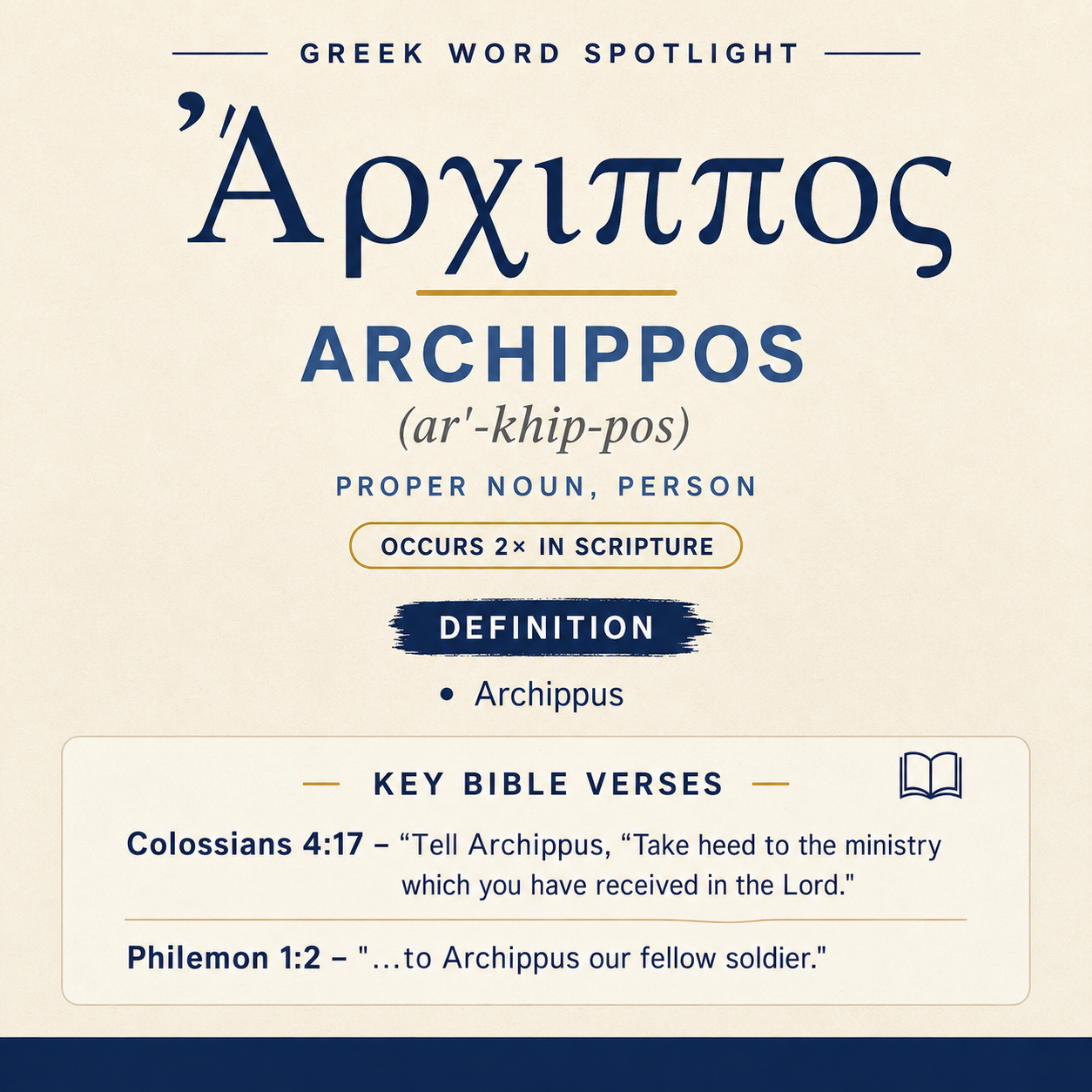
Ἄρχιππος (Archippos) means “Archippus” and appears twice in Scripture: Colossians 4:17 and Philemon 1:2.
Scripture Occurrences
The name occurs 2 times in Scripture. It appears in Colossians 4:17 and Philemon 1:2.
Learn More →Context Notes
In Colossians 4:17, Archippus is told to fulfill the ministry received in the Lord. In Philemon 1:2, Archippus is called “our fellow soldier.”
Learn More →Archippos is the personal name “Archippus,” appearing in two New Testament letter closings: once in a direct admonition and once in a greeting that frames him by a role among fellow believers. In both places, the name functions to single out a particular individual whose relationship to the writers and their communities is assumed and made explicit by brief descriptors.
Root and Related Words
Archippos is connected, by derivation, with two Greek words: archē (ἀρχή), “beginning,” and hippos (ἵππος), “horse.” These related terms stand behind the form of the name as it is transmitted in Greek letters.

Occurrences
Colossians 4:17: “Tell Archippus, “Take heed to the ministry which you have received in the Lord, that you fulfill it.””
Here Archippus is addressed indirectly: the letter instructs others (“Tell Archippus”) to deliver a pointed charge to him. The name anchors the exhortation in a real pastoral situation—this is not a general reminder to an anonymous audience, but a directed word to one person. The content of the message frames Archippus as someone entrusted with “the ministry,” and that ministry is described as something “you have received in the Lord.” The imperative language (“Take heed… that you fulfill it”) places his name in the context of accountability and completion: Archippus is publicly identified as the one responsible to give careful attention to a specific task and to carry it through to its intended end.

The phrasing also places Archippus under the same Lord-centered horizon as the community: his ministry is not self-appointed in the wording of the sentence, but received, and the measure of faithfulness in view is “that you fulfill it.” Within this verse, then, Archippus functions as a focal point for the letter’s concern that an entrusted ministry be attended to and completed. The name marks the concrete addressee of that concern.
Philemon 1:2: “to the beloved Apphia, to Archippus our fellow soldier, and to the assembly in your house:”
In this greeting Archippus is named alongside Apphia and “the assembly in your house,” which situates him within a network that includes particular individuals and a gathered community. The name is accompanied by an explicit designation: “our fellow soldier.” That descriptor sets Archippus in a posture of shared service and solidarity with the writer(s). Even though this verse is only the opening address, it does more than identify a recipient; it characterizes Archippus by a relationship (“our”) and by a role expressed through the metaphor of soldiering.
Because the greeting moves from individuals (“the beloved Apphia,” “Archippus”) to a wider group (“the assembly in your house”), Archippus appears as someone who stands close enough to the life of that house-assembly to be singled out. The title “fellow soldier” gives the name a communal weight: he is not merely a contact person but someone regarded as sharing in a common struggle or work with the letter’s senders. In this verse, the name contributes personal specificity and relational warmth, while the accompanying epithet places him among trusted co-laborers.
Sense and Usage
Across both occurrences, the definition “Archippus” functions straightforwardly as a proper personal designation, yet the two contexts show how a name can carry distinct rhetorical force depending on how it is deployed. In Philemon 1:2, Archippus is incorporated into an address list; the name helps establish the social and ecclesial setting of the letter by tying it to identifiable people and a local gathering (“the assembly in your house”). The added phrase “our fellow soldier” shapes how the reader is to hear the name: Archippus is presented as aligned with the letter’s authors, sharing their aims and standing with them in the work that frames their correspondence.
In Colossians 4:17, by contrast, the name stands at the head of a directive that is meant to be passed along. The verse does not merely greet Archippus; it calls for action aimed at him. Because he is named, the exhortation is sharpened: the community is instructed to speak to him directly, and the content of the message is tailored to his responsibilities (“the ministry which you have received in the Lord”). The name here functions almost like a summons, drawing attention to a particular person’s duty to “take heed” and to “fulfill” what has been entrusted.
Together, these uses show Archippus as a known figure within early Christian community life as reflected in the letters’ closing and opening frameworks. His name is not left bare: one text frames him by solidarity (“our fellow soldier”), and the other frames him by stewardship (“the ministry… received… fulfill it”). The effect is that the proper name becomes a fixed point around which communal expectations are articulated—both the expectation of shared commitment with the senders and the expectation of faithful completion of an assigned ministry.
Imagery in Context
The two passages attach distinct images to Archippus through their surrounding language. Philemon 1:2 places him under the martial metaphor of companionship in service by calling him “our fellow soldier,” presenting his identity within a shared campaign rather than an isolated task. Colossians 4:17, in turn, casts his situation in the imagery of careful watchfulness and follow-through: “Take heed to the ministry… that you fulfill it.” In these brief but pointed lines, Archippus is portrayed as both a comrade in a demanding work and a minister under obligation to complete what has been received “in the Lord.”
Sources: Lexical data from Strong’s Exhaustive Concordance and the Translators Brief Lexicon of Extended Strongs for Greek (STEPBible, CC BY). Occurrence data from the Translators Amalgamated Greek New Testament (STEPBible, CC BY). Scripture quotations from the World English Bible (public domain).