
Understanding the Significance of Archiereus in Greek
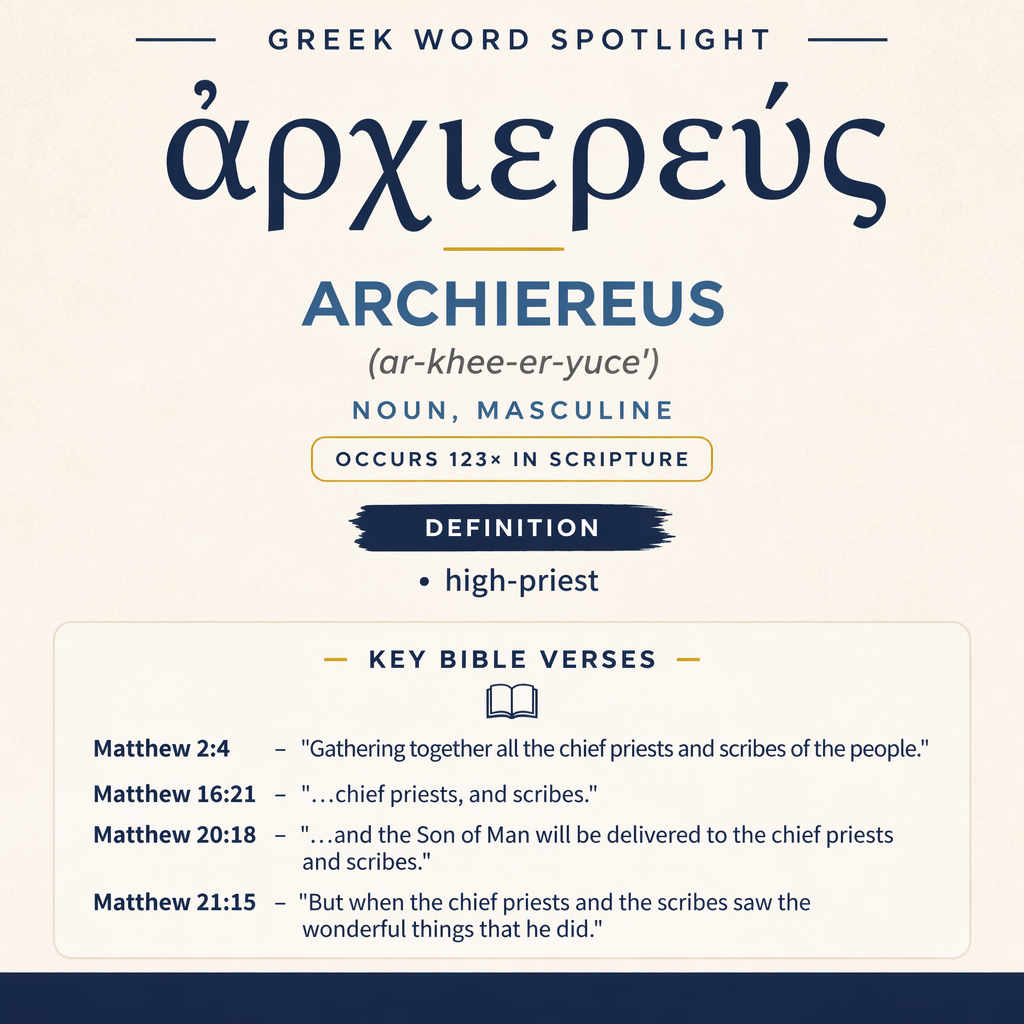
ἀρχιερεύς means “high-priest” and appears 123 times in Scripture, including Matthew 2:4; 16:21; 20:18; 21:15, 21:23, 21:45; 26:3; 26:14.
Core Meaning
ἀρχιερεύς is defined as “high-priest.” In the provided passages, it is rendered “chief priests” and “high priest.”
Learn More →Matthew Contexts
In Matthew, ἀρχιερεύς appears in scenes involving leaders gathering, questioning, and reacting to Jesus (e.g., 21:15; 21:23; 21:45). It also appears in settings leading to Jesus’ suffering (16:21; 20:18; 26:3; 26:14).
Learn More →Occurrence Snapshot
This word occurs 123 times in Scripture. The listed examples show it used repeatedly across Matthew’s narrative.
Learn More →ἀρχιερεύς means “high-priest,” a title that surfaces in Matthew where religious leadership repeatedly intersects with the question of who Jesus is and what authority he bears. In these scenes the word marks both individual officeholders (such as Caiaphas) and an influential group whose judgments and actions shape the narrative.
Occurrences
Matthew 2:4 — “Gathering together all the chief priests and scribes of the people, he asked them where the Christ would be born.”
Here ἀρχιερεύς identifies a class of recognized religious authorities (“chief priests”) assembled alongside “scribes.” Their role in this sentence is advisory: they are gathered so that a ruler can “ask” them a specific question about the Messiah’s birthplace. The word therefore contributes the sense of a leadership tier expected to possess, or at least to provide, authoritative direction on matters of religious expectation.
Matthew 16:21 — “From that time, Jesus began to show his disciples that he must go to Jerusalem and suffer many things from the elders, chief priests, and scribes, and be killed, and the third day be raised up.”
In this prediction ἀρχιερεύς stands within a triad of groups—“elders, chief priests, and scribes”—who together form the human agents of Jesus’ coming “suffer[ing].” The word contributes an institutional weight: the suffering is not attributed to an unnamed crowd, but to identifiable leadership bodies associated with Jerusalem, and the “chief priests” are named as part of the aligned opposition that culminates in death.
Matthew 20:18 — ““Behold, we are going up to Jerusalem, and the Son of Man will be delivered to the chief priests and scribes, and they will condemn him to death,”
Again the word appears in the context of Jerusalem, but now with a procedural emphasis: the Son of Man will be “delivered to the chief priests and scribes,” and a verdict follows (“they will condemn him to death”). ἀρχιερεύς marks those who receive custody and then participate in formal condemnation. In this framing, “chief priests” are not merely observers; they are presented as decisive actors in an official outcome.
Matthew 21:15 — “But when the chief priests and the scribes saw the wonderful things that he did, and the children who were crying in the temple and saying, “Hosanna to the son of David!” they were indignant,”
Here ἀρχιερεύς appears within the temple setting and is linked to perception and reaction: they “saw the wonderful things” Jesus did and heard children acclaiming him, and “they were indignant.” The word contributes the idea of guardianship over temple life and its meanings; “chief priests” are portrayed as those whose approval or displeasure matters in that sacred space, and whose indignation signals a collision between Jesus’ reception and established leadership sensibilities.
Matthew 21:23 — “When he had come into the temple, the chief priests and the elders of the people came to him as he was teaching, and said, “By what authority do you do these things? Who gave you this authority?””
In this confrontation ἀρχιερεύς highlights an official challenge. The “chief priests” approach Jesus “as he was teaching” in the temple and interrogate the source of his authority: “By what authority…? Who gave you this authority?” The word thus functions to locate the question within an arena of recognized authority structures; the speakers are not simply curious individuals but those positioned to question legitimacy and authorization.
Matthew 21:45 — “When the chief priests and the Pharisees heard his parables, they perceived that he spoke about them.”
Here ἀρχιερεύς identifies a group capable of self-recognition in Jesus’ teaching. The key action is interpretive: they “heard his parables” and “perceived that he spoke about them.” The word contributes a social and moral target: the “chief priests,” alongside “Pharisees,” understand themselves as addressed by the parables, which tightens the narrative tension between Jesus’ speech and the leadership who discern its implications.
Matthew 26:3 — “Then the chief priests, the scribes, and the elders of the people were gathered together in the court of the high priest, who was called Caiaphas.”
This verse uses ἀρχιερεύς in two related ways: as a plural group (“chief priests”) and as a singular office (“the high priest”) embodied in a named individual, “Caiaphas.” The gathering “in the court of the high priest” situates the leadership meeting on the high priest’s premises, giving the setting a formal and centralized character. The word therefore contributes both collective leadership presence and the focal point of highest priestly office around which other leaders assemble.
Matthew 26:14 — “Then one of the twelve, who was called Judas Iscariot, went to the chief priests,”
Here ἀρχιερεύς marks the destination of Judas’ initiative. The brevity of the sentence gives the title narrative force: Judas chooses the “chief priests” as the ones to approach, implying they are the appropriate and effective contact point for what follows. The word contributes the sense of institutional access and influence—Judas’ action is directed toward leadership with power to act.
Matthew 26:47 — “While he was still speaking, behold, Judas, one of the twelve, came, and with him a great multitude with swords and clubs, from the chief priests and elders of the people.”
In this arrest scene ἀρχιερεύς is connected to tangible force. The “great multitude with swords and clubs” is described as coming “from the chief priests and elders of the people,” presenting the armed group as commissioned or sent. The word thereby contributes the idea that priestly leadership can mobilize enforcement; their authority reaches beyond deliberation into coordinated action that affects events on the ground.
Matthew 26:51 — “Behold, one of those who were with Jesus stretched out his hand, and drew his sword, and struck the servant of the high priest, and struck off his ear.”
Here ἀρχιερεύς appears as the relational marker in “the servant of the high priest.” The high priest is not in direct speech or action, but his household is implicated: violence done in the moment is directed at someone belonging to the high priest’s service. The word contributes a social proximity to power—injury to the high priest’s servant intensifies the seriousness of the clash by tying it to the high priest’s immediate sphere.
Matthew 26:57 — “Those who had taken Jesus led him away to Caiaphas the high priest, where the scribes and the elders were gathered together.”
In this transfer ἀρχιερεύς again names Caiaphas and establishes him as the central figure to whom Jesus is brought. The setting is not isolated: “the scribes and the elders were gathered together,” suggesting a prepared venue for examination or decision-making. The word contributes a sense of official locus—bringing Jesus to “the high priest” gathers the narrative into a site where leadership is assembled and ready to act.
Matthew 26:58 — “But Peter followed him from a distance, to the court of the high priest, and entered in and sat with the officers, to see the end.”
Here ἀρχιερεύς locates Peter’s risky proximity: he comes “to the court of the high priest” and sits “with the officers.” The word contributes the atmosphere of authority and danger surrounding the proceedings. The “court of the high priest” is portrayed as a controlled space staffed by “officers,” and Peter’s presence there frames him as a watcher at the center of official power where the outcome (“the end”) will be decided.
Sense and Usage
Across these passages, ἀρχιερεύς consistently functions as a title of religious authority concentrated in Jerusalem and especially in the temple context. In Matthew 2:4, the title signals trusted expertise called upon to answer a messianic question. As the narrative advances (Matthew 16:21; 20:18), the title becomes linked to the machinery of suffering and condemnation: the “chief priests” appear as part of a leadership coalition that receives the delivered Son of Man and participates in a death sentence.
In the temple scenes (Matthew 21:15; 21:23), the title frames a struggle over authority and proper response to what is seen and heard there. The “chief priests” are not depicted as passive custodians; they react strongly (“they were indignant”) and actively interrogate Jesus’ authorization (“Who gave you this authority?”). Matthew 21:45 adds that they can interpret Jesus’ parables as directed toward them, which sharpens the sense that ἀρχιερεύς names a group conscious of its public role and vulnerable to prophetic critique.
In the passion narrative (Matthew 26:3, 14, 47, 51, 57, 58), ἀρχιερεύς alternates between plural leadership (“chief priests”) and the singular figure of “the high priest,” identified as Caiaphas. This dual use allows Matthew to show both corporate decision-making and a focal office with a physical domain: “the court of the high priest.” The title is associated with gatherings of leaders, the sending of an armed crowd, the presence of servants and officers, and the movement of Jesus into an official setting where leaders are already assembled. In these ways, ἀρχιερεύς carries the sense of concentrated religious leadership that can advise, judge, convene, and deploy agents.
Imagery
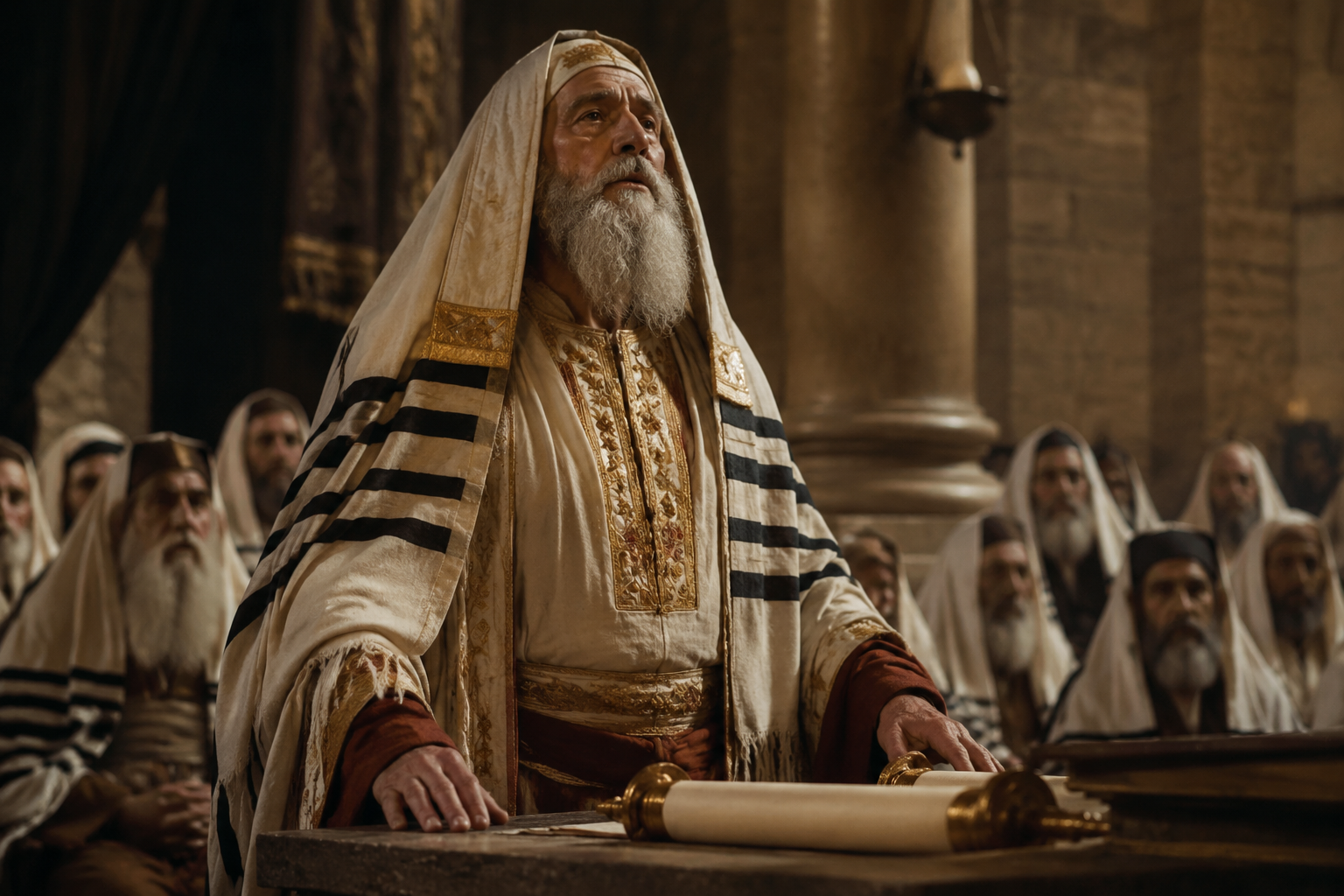
The word’s imagery in these verses is often architectural and procedural: the temple where authority is questioned, and the high priest’s court where leaders gather and officers watch. Alongside that setting is the stark image of delegated force—“a great multitude with swords and clubs, from the chief priests and elders of the people” (Matthew 26:47)—and the intimate household detail of “the servant of the high priest” struck in the chaos (Matthew 26:51). Together these scenes present the high-priestly sphere as both a center of decision and a center of action.
Sources: Lexical data from Strong’s Exhaustive Concordance and the Translators Brief Lexicon of Extended Strongs for Greek (STEPBible, CC BY). Occurrence data from the Translators Amalgamated Greek New Testament (STEPBible, CC BY). Scripture quotations from the World English Bible (public domain).





