Understanding the Significance of Archegos in Greek
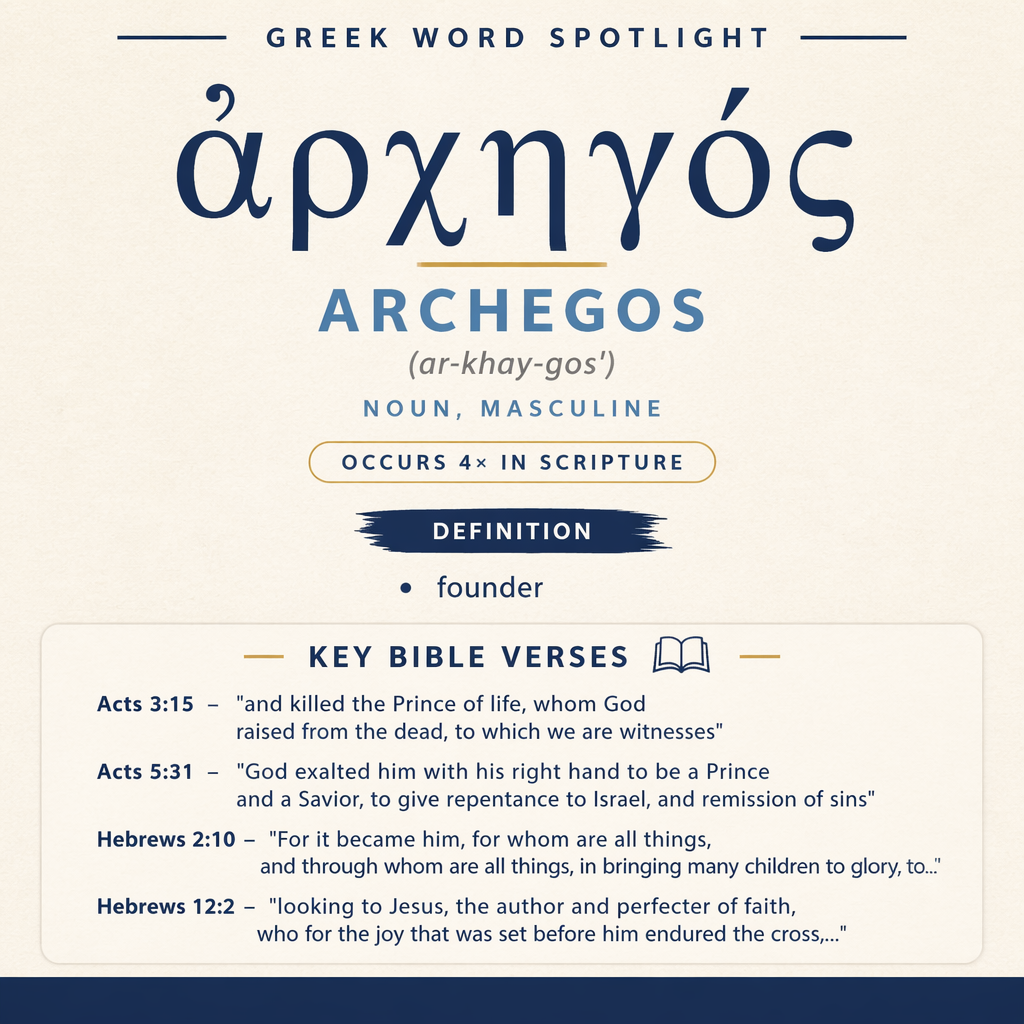
ἀρχηγός (Archegos) means “founder” and appears four times in Scripture: Acts 3:15; Acts 5:31; Hebrews 2:10; Hebrews 12:2.
Scripture Occurrences
This word occurs 4 times in Scripture: Acts 3:15; Acts 5:31; Hebrews 2:10; Hebrews 12:2.
Learn More →Context Highlights
In Acts, it is used of Jesus as “Prince” (Acts 3:15; 5:31). In Hebrews, it appears as “author” (Hebrews 12:2).
Learn More →ἀρχηγός names a “founder,” a title applied to Jesus in four New Testament passages. In these contexts it is used to speak of his decisive role in life, salvation, and faith, set within scenes of death and resurrection, exaltation, and endurance.
Root and Related Words
ἀρχηγός is connected with ἀρχή (arche), “beginning” (Strong’s G746), and ἄγω (ago), “to bring” (Strong’s G71). Together these related ideas supply a natural linguistic frame for why ἀρχηγός can function as a title of initiating leadership within the passages where it appears.

Occurrences
“and killed the Prince of life, whom God raised from the dead, to which we are witnesses.” (Acts 3:15)
Here ἀρχηγός stands in sharp contrast with the actions described around it. The hearers are charged with having “killed” the one designated “the Prince of life,” yet the sentence immediately counters death with God’s act: “whom God raised from the dead.” The title therefore carries weight in a scene where human violence and divine reversal meet. Calling Jesus ἀρχηγός in relation to “life” sets him at the headwaters of what the verse names; life is not merely something associated with him, but something anchored in his identity even when he is put to death. The closing clause, “to which we are witnesses,” places this claim in the public sphere of testimony: the title is not used as private reverence but as part of an announced interpretation of resurrection.
“God exalted him with his right hand to be a Prince and a Savior, to give repentance to Israel, and remission of sins.” (Acts 5:31)
In Acts 5:31 ἀρχηγός appears in a statement about God’s exaltation of Jesus and the purpose of that exaltation. The verse presents a movement upward—“God exalted him”—and then assigns roles: “to be a Prince and a Savior.” The title is paired with “a Savior,” and the following infinitives explain what this princely-savior role accomplishes: “to give repentance to Israel, and remission of sins.” Within this sentence, ἀρχηγός is not an abstract honorific; it is tied to giving. The verse depicts Jesus, in his exalted status, as the one through whom decisive change (“repentance”) and release (“remission of sins”) are granted to a people named explicitly (“Israel”). The wording also locates the source of this appointment in God’s action, framing ἀρχηγός as a role conferred in exaltation and expressed in generosity.
“For it became him, for whom are all things, and through whom are all things, in bringing many children to glory, to make the author of their salvation perfect through sufferings.” (Hebrews 2:10)
Hebrews 2:10 uses ἀρχηγός in a carefully reasoned sentence about fittingness: “For it became him.” The one in view is described in expansive terms—“for whom are all things, and through whom are all things”—and the sentence then focuses on a goal: “in bringing many children to glory.” Within that purpose clause, ἀρχηγός is applied to salvation: “the author of their salvation.” The title is set within a process: “to make … perfect through sufferings.” The verse thus places the “founder” language alongside movement (bringing many to glory) and completion (being made perfect), and it connects that completion specifically with “sufferings.” In this scene, ἀρχηγός contributes the idea of an origin-point or establishing figure for “their salvation,” while the verse simultaneously insists that the path of this founding work runs through suffering on the way to a perfected outcome.
“looking to Jesus, the author and perfecter of faith, who for the joy that was set before him endured the cross, despising its shame, and has sat down at the right hand of the throne of God.” (Hebrews 12:2)
In Hebrews 12:2 ἀρχηγός appears in an exhortational setting: “looking to Jesus.” The title is joined with another descriptor—“the author and perfecter of faith”—so that Jesus is presented both as the one who founds and the one who brings to completion within the sphere named by the verse (“faith”). The remainder of the sentence fills out the profile in concrete terms: joy set before him, endurance of “the cross,” disregard for its “shame,” and the final posture of enthronement—“has sat down at the right hand of the throne of God.” Within this flow, ἀρχηγός signals that faith is not merely a human project sustained by effort; its beginning-point is located in Jesus, whose endurance and enthronement the verse presents as the narrative context for that founding role. The title gains texture from the sequence: suffering (“endured the cross”) leading to exalted seated authority (“sat down at the right hand”).
Sense and Usage
Across these four passages, ἀρχηγός (“founder”) is used as a christological title that attaches Jesus to the initiating establishment of what the text then names: “life” (Acts 3:15), the realities given in exaltation (“repentance” and “remission of sins,” Acts 5:31), “salvation” (Hebrews 2:10), and “faith” (Hebrews 12:2). The word’s force in these contexts is directional: it points back to an originating agent rather than merely describing an outcome. Each passage, however, does more than attach the title to a noun; it frames the founding work within a narrative of action.
In Acts, the title is proclaimed in public speech and is tightly coupled to God’s decisive interventions. In Acts 3:15, the contrast between killing and resurrection sets a strong tension that the title must bear: the “Prince of life” is the one put to death, yet vindicated by God’s raising, and that vindication is presented as witnessed fact. In Acts 5:31, the title is explicitly linked to exaltation and to concrete gifts granted to a defined people. In both, ἀρχηγός functions in sentences where God acts (raising, exalting) and where the resulting status of Jesus is interpreted in terms of its effect on others.
In Hebrews, ἀρχηγός is embedded in theological exposition and exhortation and is paired with trajectories of completion. Hebrews 2:10 speaks of “bringing many children to glory” and then places the “author of their salvation” within the pattern of being made “perfect through sufferings.” Hebrews 12:2 urges sustained attention toward Jesus and describes him as “author and perfecter of faith,” then narrates the path of endurance to enthronement. In these two verses the founding role is not presented as instantaneous; it is narrated along a path that includes suffering and culminates in completion and honor.
The result is a consistent portrayal: ἀρχηγός identifies Jesus as the establishing source for realities central to the Christian proclamation in these books, and the surrounding clauses specify how that founding role is displayed—through resurrection after death, exaltation to a position of authority, and endurance of suffering that leads to perfected completion.
Imagery
The passages supply vivid settings around the title. The “Prince of life” is named at the moment when death and resurrection are set against each other (Acts 3:15). The “Prince and a Savior” is pictured in exaltation at God’s right hand, dispensing repentance and remission of sins (Acts 5:31). In Hebrews, the founder language is placed on a road marked by sufferings and by the cross, yet ending in glory and in being seated “at the right hand of the throne of God” (Hebrews 2:10; 12:2). In each scene, ἀρχηγός is heard not as a static label but as a title illuminated by movement: raising, exalting, bringing to glory, enduring, and sitting down.
Sources: Lexical data from Strong’s Exhaustive Concordance and the Translators Brief Lexicon of Extended Strongs for Greek (STEPBible, CC BY). Occurrence data from the Translators Amalgamated Greek New Testament (STEPBible, CC BY). Scripture quotations from the World English Bible (public domain).