
Exploring the Meaning of Arrhetos in Greek
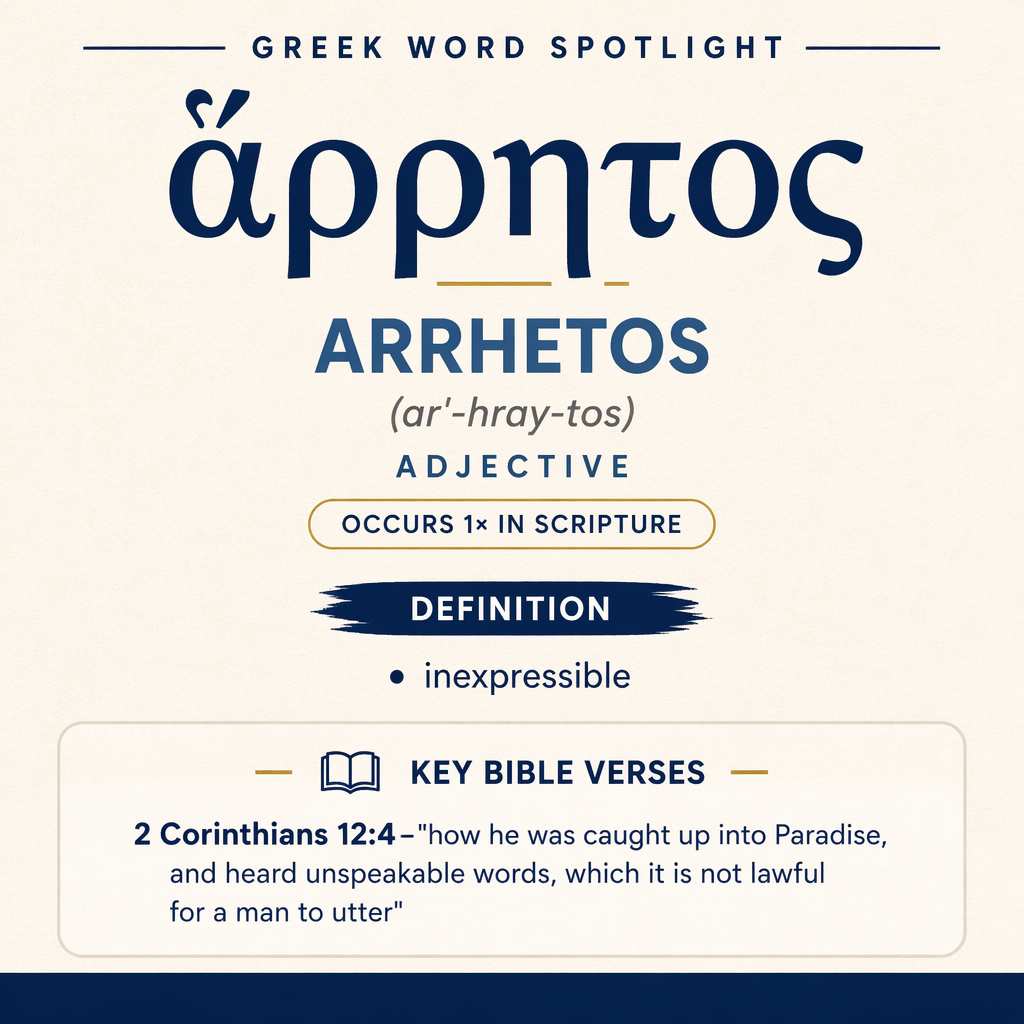
ἄρρητος means “inexpressible” and appears in 2 Corinthians 12:4.
Verse Context
In 2 Corinthians 12:4, it describes “unspeakable words” heard in Paradise that are not lawful for a man to utter.
Learn More →ἄρρητος means “inexpressible” and appears in Paul’s account of being “caught up into Paradise” in 2 Corinthians 12:4. In that setting it characterizes the kind of speech he says he heard there.
Root and Related Words
ἄρρητος (Arrhētos) is connected with ῥητῶς (rhetōs), “expressly” (Strong’s G4490). Strong’s also links it with Alpha, Α (a), “Alpha” (Strong’s G1).

Occurrences
“how he was caught up into Paradise, and heard unspeakable words, which it is not lawful for a man to utter.” (2 Corinthians 12:4)
In this verse, ἄρρητος qualifies the “words” Paul says he “heard” in Paradise. The adjective functions to mark a boundary around what can be put into speech. Paul does not merely report that he heard remarkable content; he frames it as speech that falls under a constraint: it is “unspeakable,” and the verse immediately reinforces that idea with a second clause, “which it is not lawful for a man to utter.” Taken together, the description links the experience of hearing with the impossibility (or prohibition) of repeating what was heard. The effect is to present the “words” as real and heard, yet not transferable into ordinary human telling.

The placement of the term within the narrative heightens the contrast between access and restraint. Paul reports being “caught up into Paradise,” language that portrays a movement into a realm where such speech is encountered. But the adjective ἄρρητος, paired with the statement about what is “lawful,” prevents the account from becoming a disclosure of the words themselves. Instead, the verse locates the weight of the experience not in quotation but in the character of the heard speech: it belongs to a category of utterance that cannot be given voice by “a man.”
Sense and Usage
The sense “inexpressible” in ἄρρητος is applied here to articulated “words,” not to feelings, visions, or general impressions. That detail matters for how the adjective works: it is not a claim that nothing happened or that the experience was vague, but that what was heard exceeds what may be spoken. The verse keeps both elements in view: Paul “heard” words, yet those words remain outside the sphere of lawful human utterance. In this way ἄρρητος describes a limit on expression without denying the reality of the content as “words.”
The immediate wording also clarifies that “inexpressible” is not simply a matter of personal inability (as though Paul lacked skill or vocabulary). The verse grounds the restraint in what is “lawful” for a human being: “which it is not lawful for a man to utter.” The adjective thus functions in a moral or permitted/forbidden frame within the sentence itself. The category of “inexpressible” here is tied to the propriety of speaking, not merely to the difficulty of describing. The meaning stays anchored to expression—speech that cannot be voiced—while the verse supplies the reason in terms of what is allowed for “a man.”
Because the term occurs in a report of being “caught up into Paradise,” its use also establishes a distance between that realm and ordinary discourse. The adjective demarcates Paradise as a place where communication may be heard but not repeated. By choosing a descriptor for the words rather than giving their content, the verse uses ἄρρητος to preserve the integrity of the experience while withholding disclosure. The narrative remains testimonial (“heard … words”) but also self-limiting (“unspeakable … not lawful … to utter”).
In this single attested context, ἄρρητος contributes a specific kind of emphasis: it points to speech that is genuinely verbal (“words”) yet fenced off from repetition. The verse does not invite speculation about what was said; instead, it uses the adjective to insist that the proper response is silence. The result is a rhetorical restraint that simultaneously authenticates the experience as something heard and asserts that it lies beyond permitted telling.
Imagery
The imagery surrounding ἄρρητος in 2 Corinthians 12:4 is that of ascent into “Paradise” followed by an encounter with speech that must not be passed along. The word therefore carries the picture of a listener who has heard real “words,” yet must leave them unspoken—speech received, but kept within the boundaries set by what is “lawful.”
Sources: Lexical data from Strong’s Exhaustive Concordance and the Translators Brief Lexicon of Extended Strongs for Greek (STEPBible, CC BY). Occurrence data from the Translators Amalgamated Greek New Testament (STEPBible, CC BY). Scripture quotations from the World English Bible (public domain).




