
Exploring the Meaning of Arrhaphos in Greek
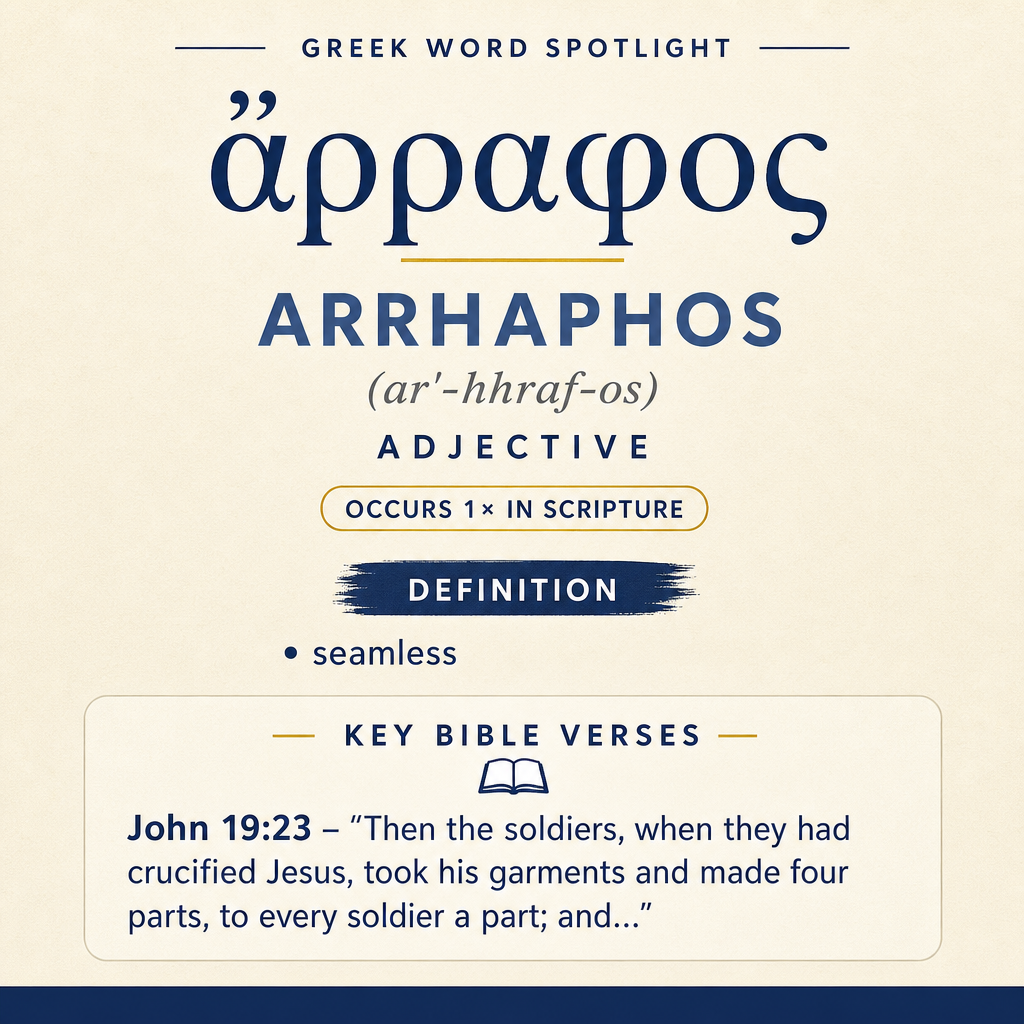
ἄρραφος means “seamless” and appears once in Scripture, in John 19:23.
Context Snapshot
In John 19:23, it appears in the account of the soldiers taking Jesus’ garments after His crucifixion.
Learn More →ἄρραφος describes something “seamless,” and it appears in the crucifixion narrative when the soldiers handle Jesus’ clothing. In its lone New Testament occurrence, the word characterizes a particular garment by how it is made.
Root and Related Words
Strong’s connects ἄρραφος (Arrhaphos) with A (α, Ἀλφα) — “Alpha” (Strong’s G1) and with ῥαφίς (rhaphis) — “needle” (Strong’s G4476). The association with “needle” anchors the adjective in the concrete world of stitching and garment-making rather than in an abstract description.

Occurrences
“Then the soldiers, when they had crucified Jesus, took his garments and made four parts, to every soldier a part; and also the coat. Now the coat was without seam, woven from the top throughout.” (John 19:23)
In John 19:23, ἄρραφος supplies a manufacturing detail: the “coat” is characterized as “without seam,” and the sentence immediately clarifies this with the additional description “woven from the top throughout.” The narrative places this description inside a scene of division and allocation—“took his garments and made four parts, to every soldier a part”—so the seamlessness functions as a distinguishing feature of one item among “garments.” The text contrasts the ordinary distributability of the clothing (“four parts”) with a garment singled out by its construction. By calling attention to the coat’s being seamless, the verse presents it as a unified piece, not described in terms of color, length, or value, but in terms of how it is put together.
The placement of the description is also significant within the flow of the sentence. The soldiers’ actions are narrated first (“took,” “made four parts”), then the coat is introduced as an additional item (“and also the coat”), and only then does the narrator pause to describe it. The adjective thus functions as an aside that slows the action long enough to let the reader see the coat as a particular object, one whose structure matters for what is happening to it in the moment. The word does not introduce a new action; it frames the object at the center of the soldiers’ handling, and the accompanying phrase “woven from the top throughout” keeps the focus on its single-piece character.
Sense and Usage
The sense “seamless” in this passage is tactile and concrete. It pertains to a garment as a physical object: a coat that lacks seams and is described as continuously woven. In this usage, seamlessness is not an aesthetic judgment but a structural fact about the coat. The narrative’s attention to construction signals that the garment’s integrity—its being in one continuous piece—is an important feature for understanding the situation in which it appears.
Because John 19:23 places the adjective in the context of soldiers dividing clothing into “four parts,” seamlessness naturally stands out as a property that distinguishes one article from others. The verse itself does not analyze motives or outcomes; it simply narrates an allocation and then highlights one garment’s make. Within that narration, ἄρραφος functions as a precise descriptor that differentiates the coat from the other “garments” that are treated as divisible portions. The word’s force, as used here, is to mark a single item as a unified whole within a scene otherwise characterized by partition.
The coupling of “without seam” and “woven from the top throughout” shows how the adjective is supported by an explanatory clause. The reader is not left with a vague impression; seamlessness is linked to a manner of weaving. This combination keeps the sense anchored in craft: the coat’s lack of seams is not merely asserted but pictured as the result of a continuous weave. In this way, ἄρραφος contributes to the narrative’s concreteness, adding a small but vivid material detail to the crucifixion scene’s description of what the soldiers did with Jesus’ clothing.
Imagery
In John 19:23, the imagery carried by ἄρραφος is the image of an undivided garment held in contrast with clothing that is separated into portions. The word invites the reader to picture a single woven coat—“woven from the top throughout”—in the soldiers’ hands at the foot of the cross, an object defined by its unbroken construction in the midst of an act of dividing and distributing.
Sources: Lexical data from Strong’s Exhaustive Concordance and the Translators Brief Lexicon of Extended Strongs for Greek (STEPBible, CC BY). Occurrence data from the Translators Amalgamated Greek New Testament (STEPBible, CC BY). Scripture quotations from the World English Bible (public domain).





