Exploring the Meaning of Argos in Greek
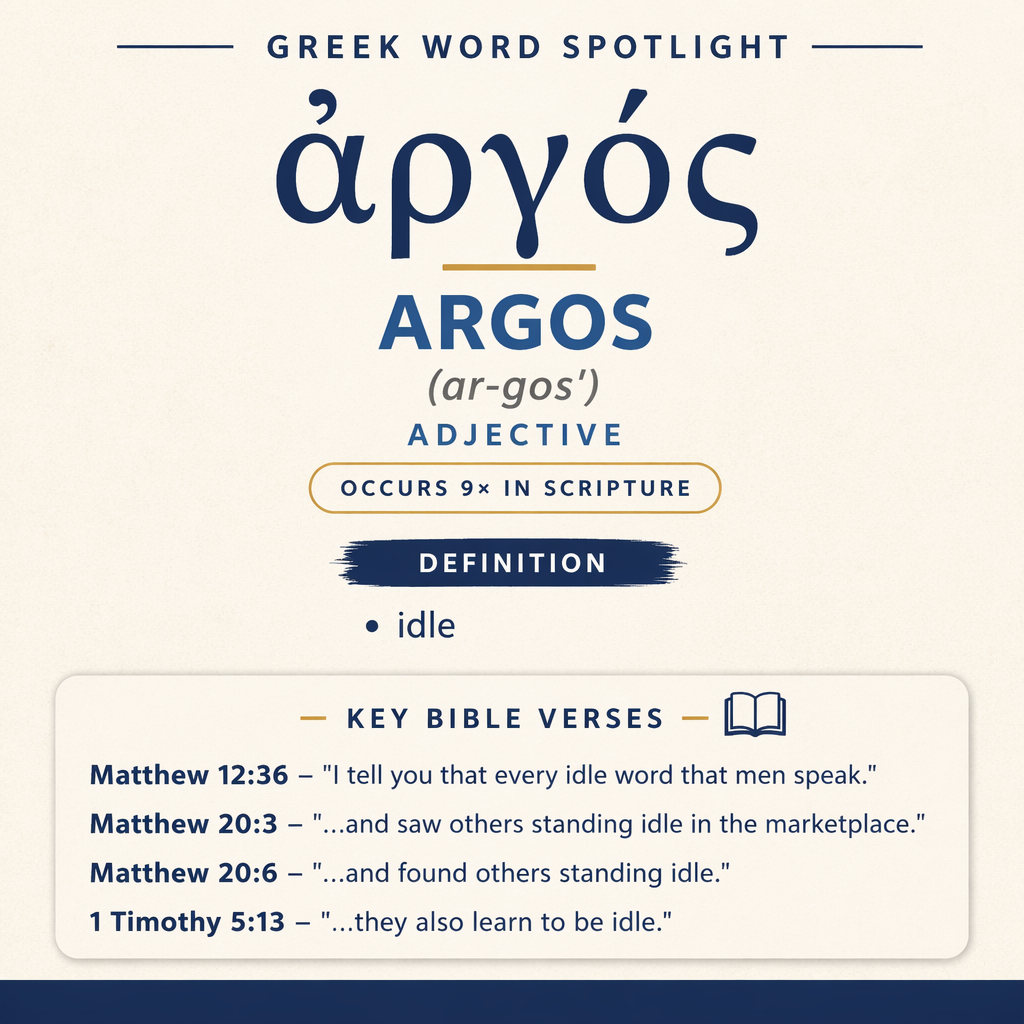
ἀργός means “idle” and occurs in Scripture in Matthew 12:36; Matthew 20:3,6; 1 Timothy 5:13; Titus 1:12; James 2:20; and 2 Peter 1:8.
Core Meaning
ἀργός is defined as “idle.” It describes what is unproductive or without work.
Learn More →Gospel Examples
In Matthew, it describes an “idle word” (Matthew 12:36) and people standing idle in the marketplace (Matthew 20:3,6).
Learn More →Apostolic Warnings
It appears in warnings about being idle (1 Timothy 5:13) and “idle gluttons” (Titus 1:12). 2 Peter 1:8 contrasts it with being fruitful in knowing the Lord Jesus.
Learn More →ἀργός describes what is idle, applied both to speech and to conduct. In the passages where it appears, it helps portray words without useful labor behind them and people whose time and appetite drift into inactivity.
Occurrences
“I tell you that every idle word that men speak, they will give account of it in the day of judgment.” (Matthew 12:36)
Here ἀργός qualifies “word,” so the focus is not silence but speech that does no honest work. The setting is accountability: “every” such word becomes material for “account” in “the day of judgment.” The adjective presses the idea that speech can be evaluated not only for what it says but for what it fails to do—words can be present, plentiful, and still idle. In this line, ἀργός makes “word” a kind of action whose inactivity is itself blameworthy.

“He went out about the third hour, and saw others standing idle in the marketplace.” (Matthew 20:3)
In the parable scene, ἀργός marks a posture: “standing idle.” The marketplace is a public place for movement and exchange, yet the people are stationary, available but unoccupied. The adjective paints a contrast between the landowner’s purposeful “went out” and their lack of employment. It also frames their situation as visible: he “saw” them as idle, making their inactivity part of the story’s observable reality rather than a hidden attitude.
“About the eleventh hour he went out, and found others standing idle. He said to them, ‘Why do you stand here all day idle?’” (Matthew 20:6)
This later moment intensifies the earlier picture. ἀργός again attaches to “standing,” but now it is tied to time: “about the eleventh hour” and “all day.” The landowner’s question, “Why do you stand here all day idle?” uses the adjective to spotlight a full day’s worth of unworked time. In this dialogue, idleness becomes something that can be asked about and explained; it is not merely a condition but a state that invites inquiry.
“Besides, they also learn to be idle, going about from house to house. Not only idle, but also gossips and busybodies, saying things which they ought not.” (1 Timothy 5:13)
In this pastoral warning, ἀργός is presented as learned behavior: “they also learn to be idle.” The sentence immediately supplies its social expression—“going about from house to house”—so idleness is not portrayed as stillness but as unproductive motion. The repetition, “Not only idle,” makes the adjective a starting point for a cascade of harmful speech and interference: “gossips and busybodies, saying things which they ought not.” Within the verse’s logic, ἀργός describes a pattern of life that leaves room for talk and meddling precisely because it is not occupied with proper work.
“One of them, a prophet of their own, said, “Cretans are always liars, evil beasts, and idle gluttons.”” (Titus 1:12)
Here ἀργός appears inside a quoted characterization, paired with a vivid noun: “idle gluttons.” The adjective modifies a life dominated by appetite, sharpening the picture by adding inactivity to indulgence. Within the triad (“always liars, evil beasts, and idle gluttons”), ἀργός contributes the specific charge that the appetite described is not balanced by labor; it suggests consumption without corresponding productive effort. The force in context is rhetorical and diagnostic: idleness is treated as a recognizable feature of the behavior being criticized.
“But do you want to know, vain man, that faith apart from works is dead?” (James 2:20)
In this rebuke, the verse turns on the contrast between “faith” and “works,” with “dead” describing faith “apart from works.” In this setting, ἀργός contributes to the picture of inactivity: the point being pressed is that what claims to be living faith is shown to be lifeless when it is separated from working action. The address “vain man” frames the argument as a correction of empty confidence, and the adjective’s contribution lies in underscoring that the issue is not merely what is claimed but what is done.
“For if these things are yours and abound, they make you to not be idle or unfruitful in the knowledge of our Lord Jesus Christ.” (2 Peter 1:8)
In this sentence, ἀργός stands opposite a desired outcome. The clause “if these things are yours and abound” presents a condition of abundance that produces a result: “they make you to not be idle.” Idleness is paired with “unfruitful,” so ἀργός helps frame inactivity as a failure to yield results. The sphere is specified: “in the knowledge of our Lord Jesus Christ.” Thus, the adjective marks an unproductive stance within knowledge itself—not a lack of information, but a lack of active, fruitful engagement that the preceding “things” are meant to prevent.

Sense and Usage
Across these passages, ἀργός consistently names inactivity in a way that is morally and socially significant. It is not a neutral description of rest. In Matthew 12:36 it reaches into speech: words can be spoken and still be idle, and such speech is weighty enough to be “account[ed]” for. The adjective thus helps define responsibility not only for overt harm but for wasted verbal action—speech that does not carry the kind of purposeful labor implied by accountable communication.
In Matthew 20:3 and 20:6 the word takes on a visible, bodily shape: people “standing idle” in a public place. The repetition in the parable allows idleness to be tracked over time (“about the third hour,” “about the eleventh hour,” “all day”). This makes ἀργός a narrative tool: it marks a human situation that can be observed (“saw,” “found”) and questioned (“Why do you stand here all day idle?”). The adjective does more than label a state; it highlights the mismatch between available time and unworked time.
In 1 Timothy 5:13, ἀργός moves from momentary posture to acquired habit: “they also learn to be idle.” The verse then shows how such idleness manifests. It is not necessarily quiet; it can be restless and relationally invasive—“going about from house to house.” The word functions as a root description from which certain kinds of speech grow: “gossips and busybodies, saying things which they ought not.” Here idleness is pictured as a breeding ground, not because it is identical with gossip, but because it leaves life unoccupied in a way that spills into harmful talk.
Titus 1:12 places ἀργός in a compact, memorable phrase: “idle gluttons.” The pairing suggests that idleness can accompany appetite and become part of a settled character portrait. Within that quoted saying, ἀργός helps define the critique with a concrete edge: the problem is not merely eating but the kind of eating linked with inactivity.
James 2:20 and 2 Peter 1:8 both situate the idea of idleness near the question of whether something is living, productive, and active. James speaks of “faith apart from works” as “dead,” pressing the notion that what is genuine does not remain inactive. Peter makes the point in a positive direction: when certain qualities “abound,” they prevent a person from being “idle or unfruitful.” In both, ἀργός belongs to a cluster of concepts contrasting inertness with effective action—works, fruitfulness, and the kind of knowledge that produces results.
Imagery in Context
The passages attach ἀργός to memorable images: a marketplace filled with men “standing idle,” a household circuit of “going about from house to house,” and the sharp phrase “idle gluttons.” Even where the imagery is less visual, the word still evokes inactivity—“idle word” makes speech itself appear as labor that can be wasted, and “not be idle or unfruitful” casts knowledge in agricultural terms by joining idleness to fruitlessness. Together these scenes keep ἀργός from being an abstract label; it is portrayed as a real stance in public life, domestic life, and moral responsibility.
Sources: Lexical data from Strong’s Exhaustive Concordance and the Translators Brief Lexicon of Extended Strongs for Greek (STEPBible, CC BY). Occurrence data from the Translators Amalgamated Greek New Testament (STEPBible, CC BY). Scripture quotations from the World English Bible (public domain).