Understanding the Significance of Ara in Greek
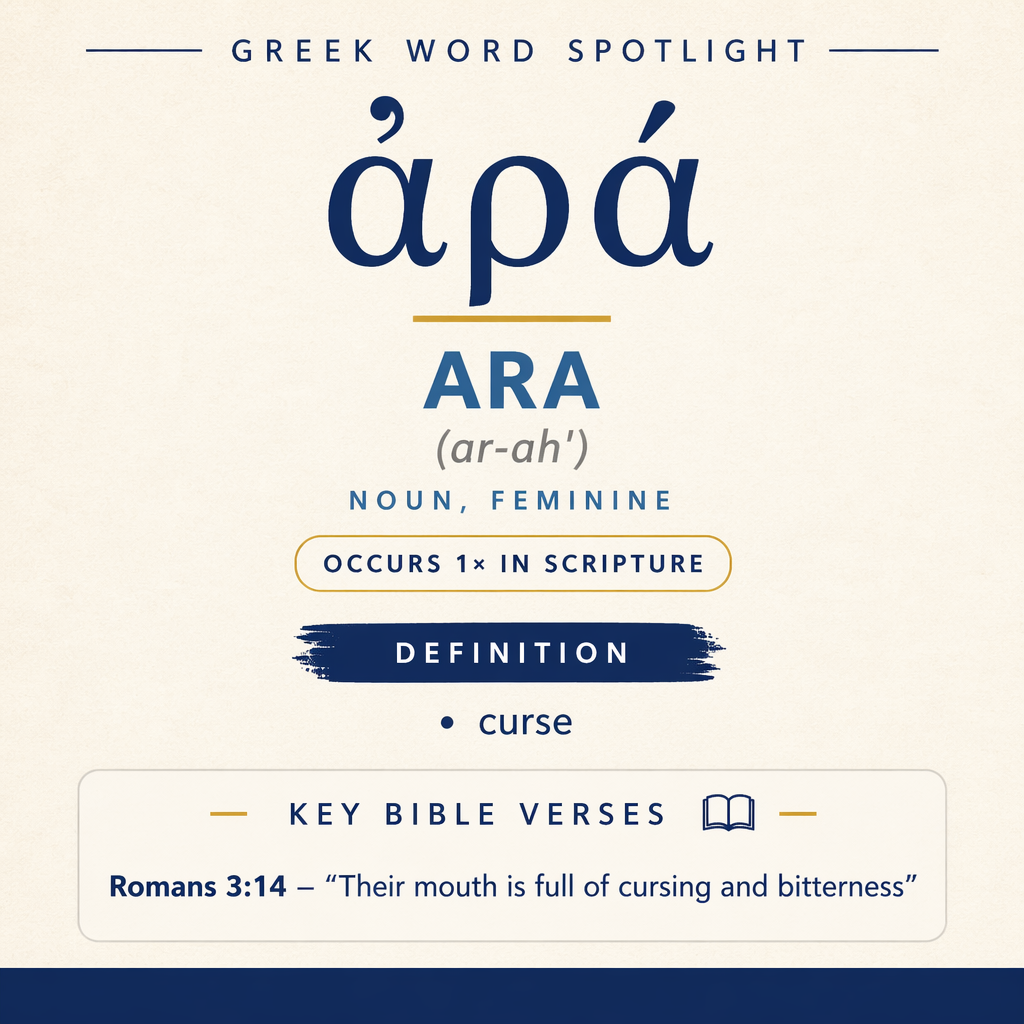
ἀρά means “curse” and appears once in Scripture, in Romans 3:14.
ἀρά expresses a “curse” and appears once in the New Testament, in Paul’s description of human speech in Romans 3:14. In that line it belongs to a cluster of words that portray the moral quality of what comes out of the mouth.
Root and Related Words
Strong’s associates ἀρά with the verb airo (αἴρω), “to take up” (Strong’s G142). The relationship is presented as derivational: the noun is connected to a verbal idea of lifting or taking up, which frames the noun as something that can be borne, raised, or brought forward in speech.

Occurrences
“Their mouth is full of cursing and bitterness.” (Romans 3:14)
Here ἀρά is part of a compact portrayal of what characterizes “their mouth.” The sentence does not focus on a single utterance but on what fills the mouth—speech as a storehouse or reservoir. “Full of” suggests abundance and readiness: the mouth is pictured as stocked with verbal materials that spill out, and among those materials is ἀρά. The pairing with “bitterness” links the curse to a corrosive inner disposition that has found its expression in words. In this scene, ἀρά contributes to the depiction of speech as morally charged content, not merely sound: what comes out carries harm in its wake and reveals what is inside.

The grammar of the line also places ἀρά in a plural environment (“cursing and bitterness”), emphasizing not an isolated act but a pattern. The phrase works as a diagnostic description: the mouth is measured by what fills it, and the presence of ἀρά marks speech as a vehicle for antagonism rather than blessing. Within Paul’s larger rhetoric in Romans 3, this line functions as one feature among several that together portray the universality of human wrongdoing; but within the quoted sentence itself, ἀρά is specifically tied to the mouth, making verbal expression a visible symptom of a deeper problem.
Sense and Usage
The sense “curse” in Romans 3:14 operates as a term for speech that is charged with hostility and directed harm. The immediate co-text—“full of … bitterness”—makes the curse more than a formal pronouncement; it is the verbal overflow of a bitter stance. The mouth is the instrument, but the content is what is being weighed: ἀρά is presented as something that can accumulate (“full of”) and thus something habitual, repeatable, and defining.
Because the only attested New Testament use here is embedded in a statement about what the mouth contains, the word’s force is shaped by that imagery. A curse is treated as a substance-like element of speech: it can fill, mingle, and accompany other verbal toxins. The coordination with “bitterness” gives the term a social and relational edge. A curse in this portrait is not private; it is expressed outwardly, in words that strike others or poison relationships. Even without naming a target, the line depicts cursing as part of a pattern of communication marked by antagonism.
The association (as presented by Strong’s) with airo (αἴρω), “to take up,” can be read alongside Romans 3:14’s picture of a mouth “full.” What is inside can be “taken up” and brought forward into speech. In this way ἀρά is conceived not simply as an abstract idea but as something that is lifted from within and carried into the open. The verse’s metaphor of fullness gives a concrete shape to how such speech operates: it is ready at hand, near the surface, and easily produced because it is already stored within.
In Romans 3:14, then, ἀρά functions as an index of moral condition as disclosed through language. The line does not analyze motives at length; it names what the mouth contains and lets that content reveal what kind of person is speaking. The result is a stark anthropology of speech: human words can be saturated with cursing, and that saturation is paired with bitterness as a companion quality.
Imagery
Romans 3:14 presents a vivid physical metaphor: a mouth as a container, filled to the brim. Within that image, ἀρά is not merely spoken; it is stockpiled, kept close, and produced in quantity. The picture invites the reader to imagine speech as something drawn from an interior supply—what is “full” inside becomes what is heard outside.
Sources: Lexical data from Strong’s Exhaustive Concordance and the Translators Brief Lexicon of Extended Strongs for Greek (STEPBible, CC BY). Occurrence data from the Translators Amalgamated Greek New Testament (STEPBible, CC BY). Scripture quotations from the World English Bible (public domain).