Exploring the Meaning of Apotinasso in Greek
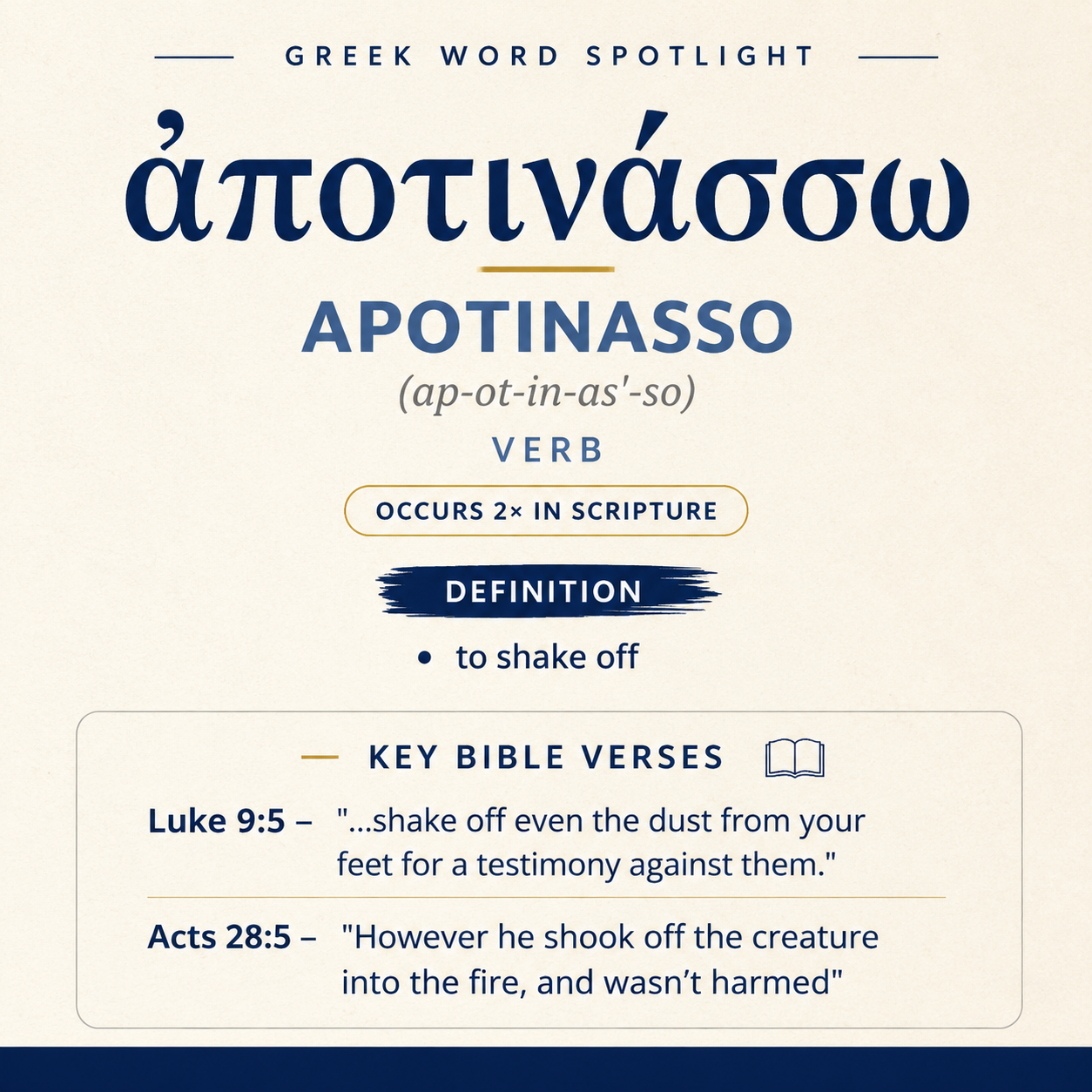
ἀποτινάσσω means “to shake off” and appears twice in Scripture: Luke 9:5 and Acts 28:5.
Context Examples
In Luke 9:5, disciples are told to shake off dust from their feet as a testimony. In Acts 28:5, Paul shook a creature into the fire and was not harmed.
Learn More →ἀποτινάσσω means “to shake off,” and it appears in two narrative settings: Jesus’ instructions to his messengers and Paul’s response to danger. In both scenes it names a decisive physical action that marks separation from what clings.
Root and Related Words
ἀποτινάσσω is related to apo (ἀπό), “away from” (Strong’s G575). In context, this relationship frames the verb’s motion as a removal in the direction of separation.

Occurrences
“As many as don’t receive you, when you depart from that city, shake off even the dust from your feet for a testimony against them.” (Luke 9:5)
Here the action is commanded in response to rejection: “As many as don’t receive you.” The verb is paired with leaving—“when you depart from that city”—so the shaking-off is not random but timed to the moment of departure. What is shaken off is specified and minimal: “even the dust from your feet.” The phrase pictures the messengers’ feet as carrying residue from their contact with the place, and the command directs them to remove even that residue as they go. The purpose clause, “for a testimony against them,” gives the act a public, evidentiary function. In this scene the verb contributes a concrete gesture that embodies the break created by non-reception: they physically disengage and leave behind what has adhered from that city, and the gesture stands as a witness directed “against them.”

“However he shook off the creature into the fire, and wasn’t harmed.” (Acts 28:5)
In Acts the verb describes Paul’s immediate reaction to a threat already attached to him: “the creature.” The sentence is structured around contrast—“However”—and outcome—“and wasn’t harmed.” The shaking-off is directed to a location: “into the fire.” The verb therefore functions as an abrupt, forceful removal that transfers what clings to him away from his body and into a destructive element. The narrative emphasizes the effectiveness of the action by linking it to the result: after the creature is shaken off into the fire, “he…wasn’t harmed.” In this setting the verb contributes quick physical resolution: a dangerous attachment is removed, displaced, and rendered non-threatening by where it is cast.
Sense and Usage
Across its two occurrences, ἀποτινάσσω names a distinct kind of bodily motion: not merely dropping something, but actively dislodging what adheres. The shared imagery is of contact that leaves something clinging—dust on feet in Luke, a creature attached in Acts—and of a sharp movement that breaks that contact. The definition “to shake off” naturally fits situations where the problem is not distance alone but attachment; the action deals with what remains after contact.
In Luke, the verb’s object (“even the dust from your feet”) and the accompanying purpose (“for a testimony against them”) shape its communicative force. The gesture is meaningful precisely because dust is insignificant; shaking off “even” that suggests an intentional refusal to carry anything away from the rejecting city. The verb thus serves as an enacted sign at the boundary between staying and departing. It is tied to place (“that city”) and to relationship (“don’t receive you”), so the shaking off marks the end of association as the messengers move on.
In Acts, the verb is less about symbolic communication and more about immediate physical deliverance. The object (“the creature”) is not incidental debris but an active danger, and the direction (“into the fire”) highlights removal to a place of destruction. The narrative’s closing note, “and wasn’t harmed,” shows the shaking off as an effective severing of contact that prevents injury. Even so, the action remains concrete and visible, and its clarity serves the story: the audience can picture the sudden motion and the creature’s trajectory away from Paul and into the flames.
These scenes together show that ἀποτινάσσω can be used where the thing removed is either trivial (dust) or threatening (a creature), yet in both cases the motion is the same kind of decisive dislodging. The verb’s association with apo (ἀπό), “away from,” is reflected in the way each context highlights separation: the dust is removed as the messengers depart “from that city,” and the creature is removed away from Paul and redirected “into the fire.” The core action remains the same, but the narrative effects differ—testimony in Luke, safety in Acts—because each text assigns a distinct significance to what is being shaken off and why.
Imagery
The word carries vivid, tactile imagery. In Luke 9:5 it evokes gritty dust clinging to travelers’ feet and the deliberate motion of knocking it free at the edge of a town, turning an ordinary travel detail into “a testimony against them.” In Acts 28:5 it evokes a sudden, forceful jerk that flings an attached creature away “into the fire,” with the calm result that Paul “wasn’t harmed.” In both passages, ἀποτινάσσω is an action you can see: separation enacted with the body, leaving what clings behind.
Sources: Lexical data from Strong’s Exhaustive Concordance and the Translators Brief Lexicon of Extended Strongs for Greek (STEPBible, CC BY). Occurrence data from the Translators Amalgamated Greek New Testament (STEPBible, CC BY). Scripture quotations from the World English Bible (public domain).